
Mindmap
GI System
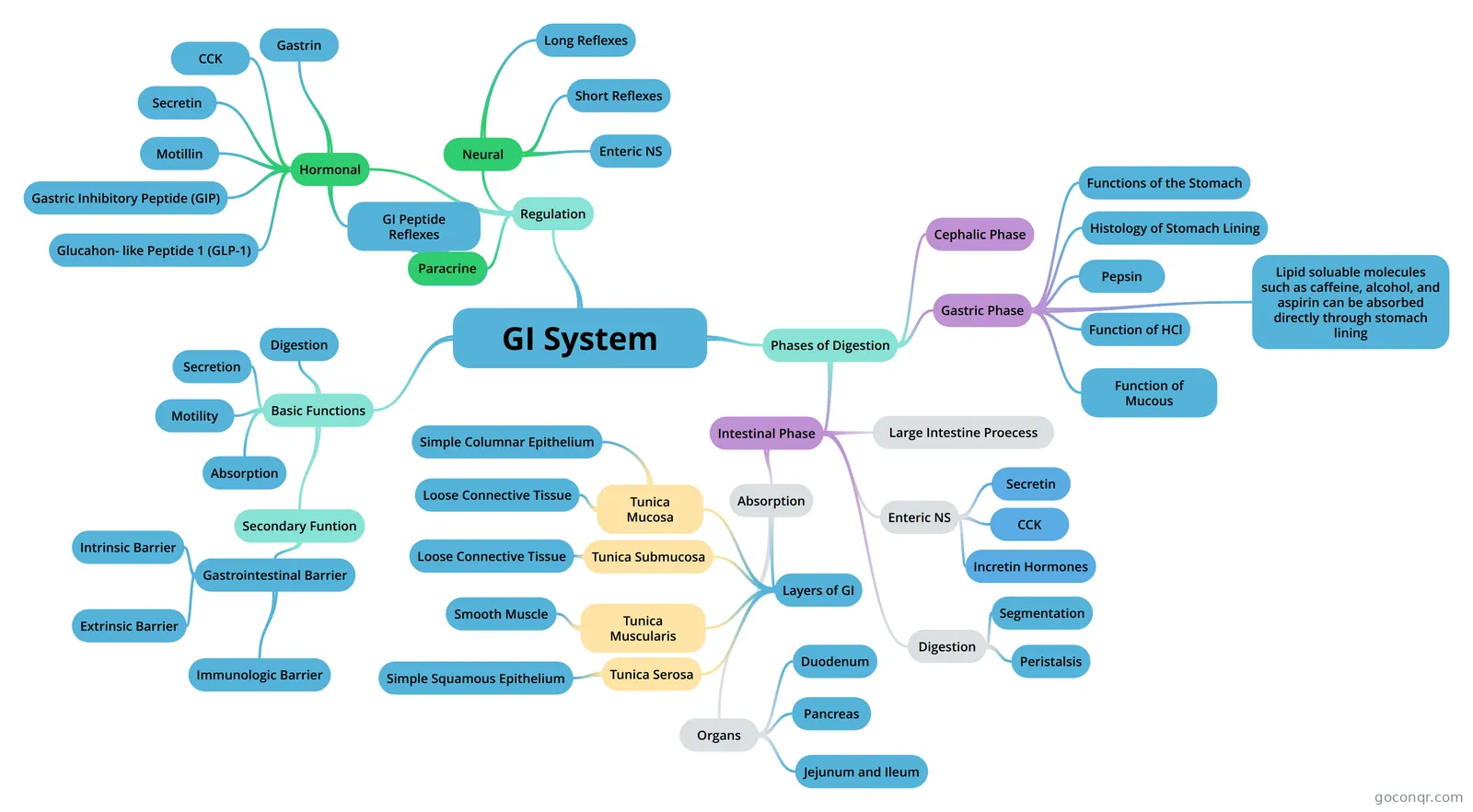
Mind map: GI system
Inhalt der Mindmap
GI System
Basic Functions
- Motility
- movement of food through the digesetive system
- Secretion
- release of substances to enhance breakdown of food
- Digestion
- physical and chemical barrier, lots of opportunity for infection here
- Absorption
- Transfer of materials to interal environment
- Secondary Funtion
- Gastrointestinal Barrier
- gut offers large surface or pathogens to enter the internal environment, cells are joined primarily by tight junctions, making it difficult for pathogens to pass
- Extrinsic Barrier
- Mucus, Cl-, HCO3-, Antimicrobial Peptides, microbiota
- Intrinsic Barrier
- Tight junctions of the epithelial cells
- Immunologic Barrier
- IgA
- Gastrointestinal Barrier
- Motility
Regulation
- Neural
- Long Reflexes
- Initiated within the CNS, may originate in or outside the GI tract (cephalic reflexes. Emotionall or feedforward reflexes that are initiated and integrated entirely outside the GI tract.
- Short Reflexes
- Initiated by the Enteric NS: Changes in pH, distention, osmolarity, products of digestion. Submucosal plexus contains the sensory neurons. Afferent information to ganglia Efferent information to submuscosal or myenteric plexuses for control of secretion, motility and growth.
- Enteric NS
- PNS and SNS do not directly innervate the GI Innervated by nerves in the CNS Activities like peristalsis and secretion cannot occur if not intact even if PNS and SNS are.
- Long Reflexes
- Hormonal
- GI Peptide Reflexes
- Peptides alter secretion and motility, alter behavior related to eatting
- Gastrin
- Stomach, stimulated by peptides and amino acids, neural reflexes. Target the parietal cells, and ECL cells. Stimulate gastric acid secretion and mucosal growth Somatostatin Inhibits release
- CCK
- Cholecystokinin Stimulated by fatty acids and some amino acids Targets Gallbladder, pancreas, and stomach Stimulates: gallbladder contraction and pancreatic enzyme secretion, inhibits gastric emptying and acid secretion Promotes satiety
- Secretin
- Stimulated by acid in small intestine Targets pancreas and stomach. Stimulates bicarbonate secretion Inhibits gastric emptying and acid secretion
- Motillin
- Stimulated by fasting Targets gastric and intestinal smooth muscle Stimulates migrating motor complex Inhibited by eating a meal.
- Gastric Inhibitory Peptide (GIP)
- Released in intestine Stimulated by glucose, fatty acids, and amino acids in sm intestine. Targets Beta cells of pancreas Stimulates insulin release, inhibits gastric emptying and acid secretion
- Glucahon- like Peptide 1 (GLP-1)
- Released in intestine Stimulated by mixed meal that includes carbs or fats in lumen. Targets endocrine pancreas Stimulated insulin release. Inhibits glucagon release and gastric function Promotes satiety
- GI Peptide Reflexes
- Paracrine
- Neural
Phases of Digestion
- Cephalic Phase
- What happens when food goes into the mouth. Saliva secreted, physical digestion Chemical digestions by amylast and lingual lipase (Von Ebner's Glands) Prepare for swallowing of bolus
- Gastric Phase
- Deglutination reflex (swallowing) moves food to the stomach to start gastric phase 3.5 L liters of content enters fundus/day
- Functions of the Stomach
- 1. Stored ingested food until it can be emptied into the small intestine 2. Secrete HCl and enzymes to begin protein digestion 3. Convert stomach contents to chyme (gastric contents and pulverized food)
- Histology of Stomach Lining
- Parietal Cells- release HCl (activates pepsinogen) and intrinsic factor (must be bound to B12 for absorption) into gastric pits Chief Cells- secrete pepsinogen ( a proenzyme or inactivated enzyme) Surface Epithelial Cells: secrete mucous that coat the inner lining of the stomach, Enterochromaffin-like Cells- secrete histamine in response to PNS and gastrin D Cells- Secrete somatostatin when pH drops in inhibit further parietal cell secretions G Cells- Secrete gastrin to stimulate parietal cells, increases pyloric sphincter activity and lower stomach motility
- Pepsin
- Protease that digests protein into small chain fatty acids, working in acidic environments
- Function of HCl
- Keeps stomach acidity between 1 and 3 pH. Breaks down large protein fibers like collagen in meat, and kill microorganisms ** Proton Pump Inhibitors (PPI's) will block and enzyme requires to transport H+ into gastric lumen, blocking 99% of gastric secretion.
- Function of Mucous
- Coats the inside lining of the stomach, protects from autodigestion. It is alkaline, any acid that is in the vicinity becomes neutralized Stimulated by irritation and food ingestions. Mast cells release of prostaglandins also stimulates mucous production. ** Why NSAIDS can cause ulcers, they block prostaglandin secretion.
- Lipid soluable molecules such as caffeine, alcohol, and aspirin can be absorbed directly through stomach lining
- Intestinal Phase
- Digestion
- Triggered by interstitial cells of Cajal
- Peristalsis
- Segmentation
- Mixing of bolus in intesting
- Absorption
- Layers of GI
- Tunica Mucosa
- Simple Columnar Epithelium
- Specialized for secretion and absorption Lining constantly being scraped off by food, chyme, and fecal material scrape
- Loose Connective Tissue
- Very vascular, nutrients are absorbed through digestive tract and picked up in this layer because of all the capillaries here
- Simple Columnar Epithelium
- Tunica Submucosa
- Loose Connective Tissue
- Contains larger blood vessels and some nerve plexes
- Loose Connective Tissue
- Tunica Muscularis
- Smooth Muscle
- Inner circular layer Puter longitudinal layer
- Smooth Muscle
- Tunica Serosa
- Simple Squamous Epithelium
- Provides a slippery lining on the outside of all of digestive organs that allows them to rub together in a frictionless environment.
- Simple Squamous Epithelium
- Tunica Mucosa
- Organs
- Duodenum
- Specifically absorbs lipids, iron, and calcium Sugars and proteins are also absorbed here and along the length of the small intestine.
- Pancreas
- Pancreatic pain is often felt as flank pain because of the way it is innervated Last gland to secrete enzymes, responsible for the final breakdown of nutrients into absorpable molecules Secretes fluid that acts as a medium for enzyme transport Proteases digest proteins (Tripsinogen--> becomes Tripsin in duodenum, so caustic can destroy pancreas) Amylases digest Carbs Lipases digest lipids- secreted by acinar cells
- Jejunum and Ileum
- Primary role is to absorb digested nutrients,mainly sugars and proteins, vitamins and minerals. Large amounts of Na Followed by large volumes of water are absorbed with the nutrients. *** This process is enhances by ALDOSTERONE SECRETION. Jejunum has deep circular folds and microvilli increasing its surface area for absorption.
- Duodenum
- Layers of GI
- Enteric NS
- Enterence of Chyme into duodenum stimulates the release of neurotransmitters
- Secretin
- CCK
- secreted in response to lipids and slows gastric motility and gastric acid secretion
- Incretin Hormones
- slow gastric acid and emptying, stimulate insulin release from pancreas
- Large Intestine Proecess
- Concentrating wast- removing water, only about 0.1 L of water lost through feces/day Movement & Defication- Ileocecal valce controls chyme enterance into colon Defication reflex- increases abdominal pressure, relaxes anal sphincters.
- Digestion
- Cephalic Phase
Informationen
- Beschreibung
- 1 Clinical Managment 1 (Exam 2 Mind Maps) Mindmap am GI System, erstellt von Maggie McCormick am 04/11/2016.
- Erstellt von
- Maggie McCormick
- Aufrufe
- 5
- Bewertung