
Mindmap
Othello Character Map Key Quotations
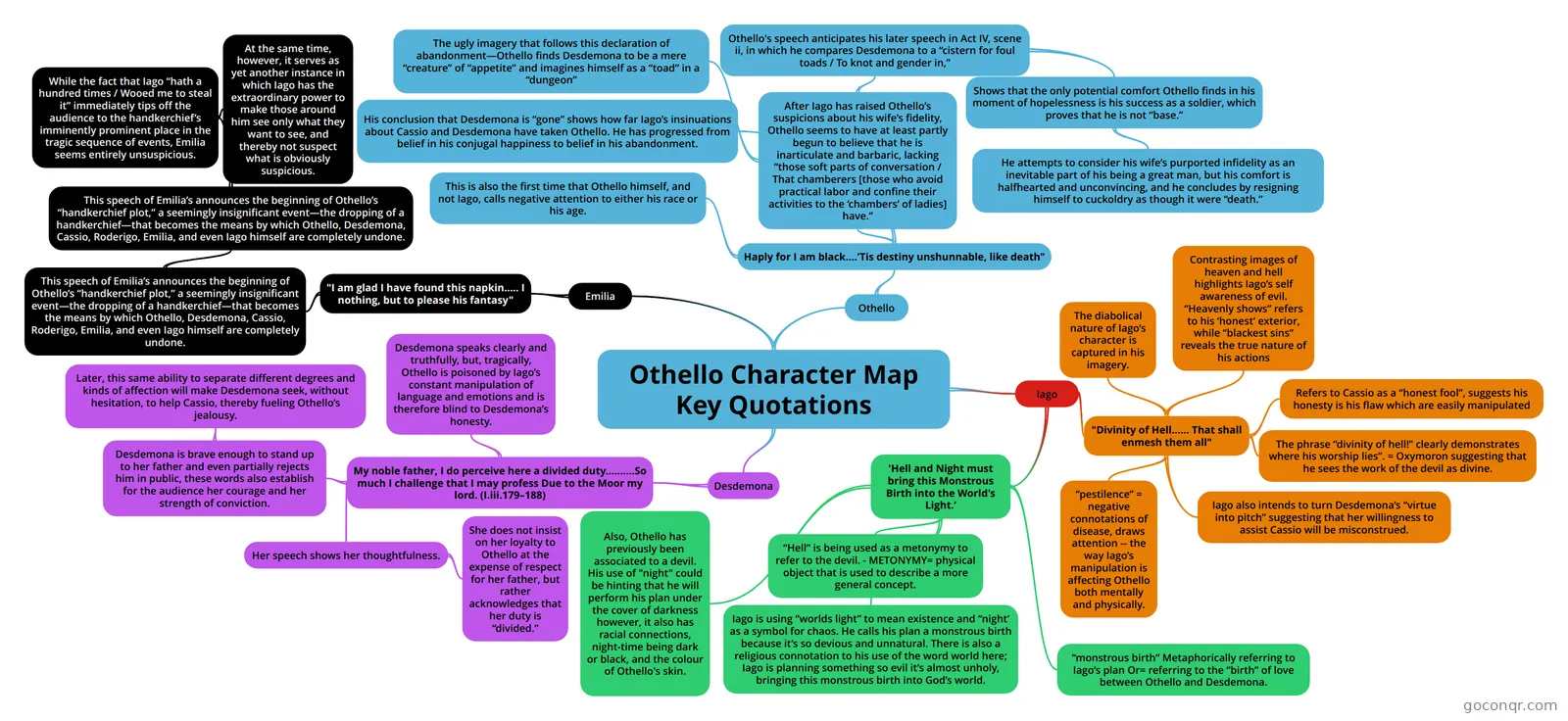
Mind map: Othello character map key quotations
Inhalt der Mindmap
Othello Character Map Key Quotations
Othello
- Haply for I am black....’Tis destiny unshunnable, like death"
- After Iago has raised Othello’s suspicions about his wife’s fidelity, Othello seems to have at least partly begun to believe that he is inarticulate and barbaric, lacking “those soft parts of conversation / That chamberers [those who avoid practical labor and confine their activities to the ‘chambers’ of ladies] have.”
- The ugly imagery that follows this declaration of abandonment—Othello finds Desdemona to be a mere “creature” of “appetite” and imagines himself as a “toad” in a “dungeon”
- Othello's speech anticipates his later speech in Act IV, scene ii, in which he compares Desdemona to a “cistern for foul toads / To knot and gender in,”
- Shows that the only potential comfort Othello finds in his moment of hopelessness is his success as a soldier, which proves that he is not “base.”
- He attempts to consider his wife’s purported infidelity as an inevitable part of his being a great man, but his comfort is halfhearted and unconvincing, and he concludes by resigning himself to cuckoldry as though it were “death.”
- Shows that the only potential comfort Othello finds in his moment of hopelessness is his success as a soldier, which proves that he is not “base.”
- This is also the first time that Othello himself, and not Iago, calls negative attention to either his race or his age.
- His conclusion that Desdemona is “gone” shows how far Iago’s insinuations about Cassio and Desdemona have taken Othello. He has progressed from belief in his conjugal happiness to belief in his abandonment.
- After Iago has raised Othello’s suspicions about his wife’s fidelity, Othello seems to have at least partly begun to believe that he is inarticulate and barbaric, lacking “those soft parts of conversation / That chamberers [those who avoid practical labor and confine their activities to the ‘chambers’ of ladies] have.”
- Haply for I am black....’Tis destiny unshunnable, like death"
Iago
- "Divinity of Hell...... That shall enmesh them all"
- “pestilence” = negative connotations of disease, draws attention -- the way Iago’s manipulation is affecting Othello both mentally and physically.
- Iago also intends to turn Desdemona’s “virtue into pitch” suggesting that her willingness to assist Cassio will be misconstrued.
- The phrase “divinity of hell!” clearly demonstrates where his worship lies”. = Oxymoron suggesting that he sees the work of the devil as divine.
- Refers to Cassio as a “honest fool”, suggests his honesty is his flaw which are easily manipulated
- Contrasting images of heaven and hell highlights Iago’s self awareness of evil. “Heavenly shows” refers to his ‘honest’ exterior, while “blackest sins” reveals the true nature of his actions
- The diabolical nature of Iago’s character is captured in his imagery.
- 'Hell and Night must bring this Monstrous Birth into the World's Light.‘
- Also, Othello has previously been associated to a devil. His use of "night" could be hinting that he will perform his plan under the cover of darkness however, it also has racial connections, night-time being dark or black, and the colour of Othello's skin.
- “Hell” is being used as a metonymy to refer to the devil. - METONYMY= physical object that is used to describe a more general concept.
- “monstrous birth” Metaphorically referring to Iago’s plan Or= referring to the “birth” of love between Othello and Desdemona.
- Iago is using “worlds light” to mean existence and “night’ as a symbol for chaos. He calls his plan a monstrous birth because it’s so devious and unnatural. There is also a religious connotation to his use of the word world here; Iago is planning something so evil it’s almost unholy, bringing this monstrous birth into God’s world.
- "Divinity of Hell...... That shall enmesh them all"
Desdemona
- My noble father, I do perceive here a divided duty..........So much I challenge that I may profess Due to the Moor my lord. (I.iii.179–188)
- Her speech shows her thoughtfulness.
- She does not insist on her loyalty to Othello at the expense of respect for her father, but rather acknowledges that her duty is “divided.”
- Desdemona is brave enough to stand up to her father and even partially rejects him in public, these words also establish for the audience her courage and her strength of conviction.
- Later, this same ability to separate different degrees and kinds of affection will make Desdemona seek, without hesitation, to help Cassio, thereby fueling Othello’s jealousy.
- Desdemona speaks clearly and truthfully, but, tragically, Othello is poisoned by Iago’s constant manipulation of language and emotions and is therefore blind to Desdemona’s honesty.
- Her speech shows her thoughtfulness.
- My noble father, I do perceive here a divided duty..........So much I challenge that I may profess Due to the Moor my lord. (I.iii.179–188)
Emilia
- "I am glad I have found this napkin..... I nothing, but to please his fantasy"
- This speech of Emilia’s announces the beginning of Othello’s “handkerchief plot,” a seemingly insignificant event—the dropping of a handkerchief—that becomes the means by which Othello, Desdemona, Cassio, Roderigo, Emilia, and even Iago himself are completely undone.
- This speech of Emilia’s announces the beginning of Othello’s “handkerchief plot,” a seemingly insignificant event—the dropping of a handkerchief—that becomes the means by which Othello, Desdemona, Cassio, Roderigo, Emilia, and even Iago himself are completely undone.
- While the fact that Iago “hath a hundred times / Wooed me to steal it” immediately tips off the audience to the handkerchief’s imminently prominent place in the tragic sequence of events, Emilia seems entirely unsuspicious.
- At the same time, however, it serves as yet another instance in which Iago has the extraordinary power to make those around him see only what they want to see, and thereby not suspect what is obviously suspicious.
- While the fact that Iago “hath a hundred times / Wooed me to steal it” immediately tips off the audience to the handkerchief’s imminently prominent place in the tragic sequence of events, Emilia seems entirely unsuspicious.
- This speech of Emilia’s announces the beginning of Othello’s “handkerchief plot,” a seemingly insignificant event—the dropping of a handkerchief—that becomes the means by which Othello, Desdemona, Cassio, Roderigo, Emilia, and even Iago himself are completely undone.
- This speech of Emilia’s announces the beginning of Othello’s “handkerchief plot,” a seemingly insignificant event—the dropping of a handkerchief—that becomes the means by which Othello, Desdemona, Cassio, Roderigo, Emilia, and even Iago himself are completely undone.
- "I am glad I have found this napkin..... I nothing, but to please his fantasy"
Informationen
- Beschreibung
- AS level Literature Mindmap am Othello Character Map Key Quotations, erstellt von Chloe Anderson am 05/12/2016.
- Erstellt von
- Chloe Anderson
- Aufrufe
- 13
- Bewertung