
Mindmap
Euthanasia
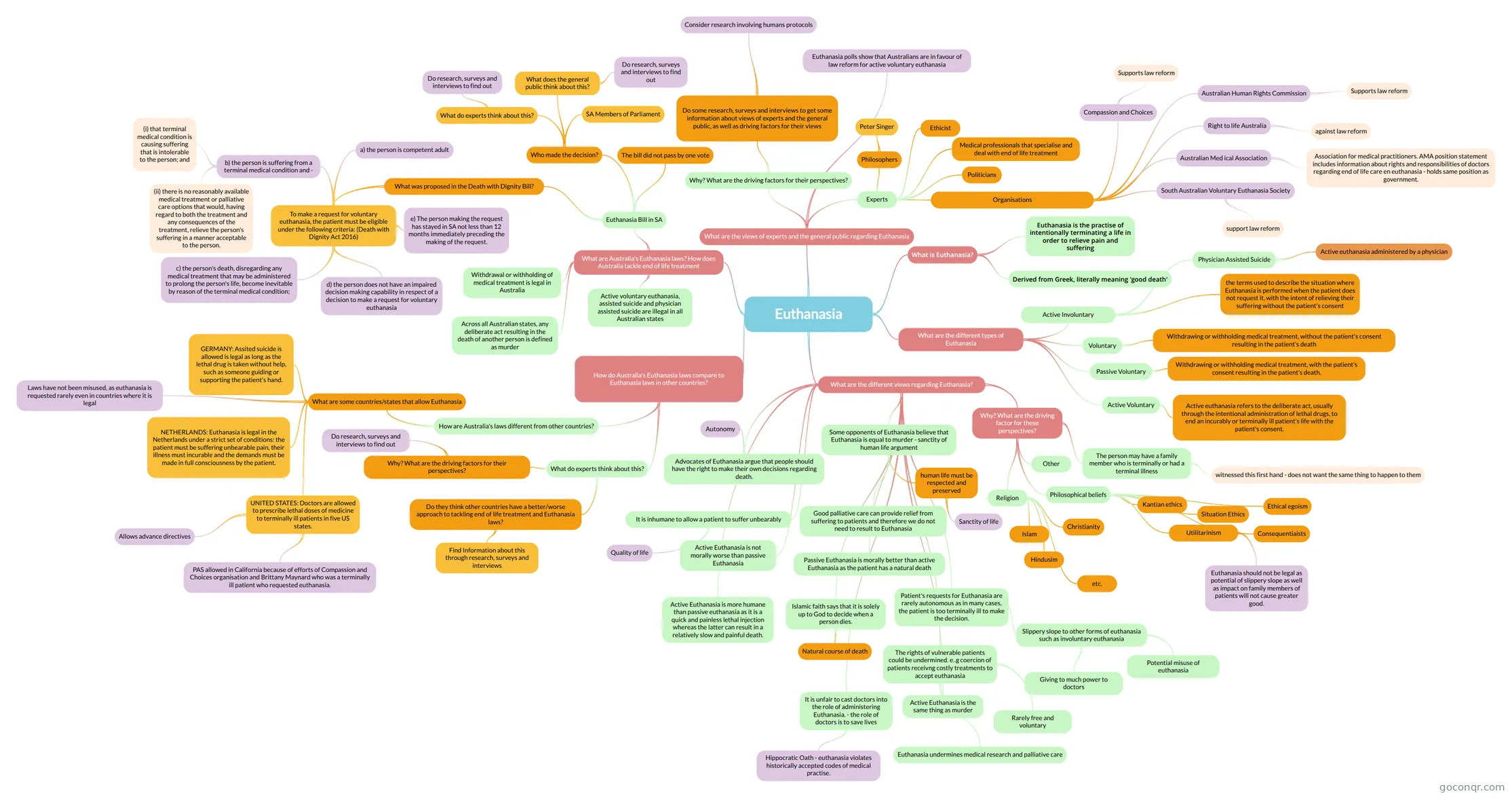
Mind map: Euthanasia
Inhalt der Mindmap
Euthanasia
What is Euthanasia?
- Euthanasia is the practise of intentionally terminating a life in order to relieve pain and suffering
- Derived from Greek, literally meaning 'good death'
What are the different types of Euthanasia
- Active Involuntary
- the terms used to describe the situation where Euthanasia is performed when the patient does not request it, with the intent of relieving their suffering without the patient's consent
- Physician Assisted Suicide
- Active euthanasia administered by a physician
- Voluntary
- Withdrawing or withholding medical treatment, without the patient's consent resulting in the patient's death
- Active Voluntary
- Active euthanasia refers to the deliberate act, usually through the intentional administration of lethal drugs, to end an incurably or terminally ill patient's life with the patient's consent.
- Passive Voluntary
- Withdrawing or withholding medical treatment, with the patient's consent resulting in the patient's death.
- Active Involuntary
How do Australia's Euthanasia laws compare to Euthanasia laws in other countries?
- How are Australia's laws different from other countries?
- What are some countries/states that allow Euthanasia
- NETHERLANDS: Euthanasia is legal in the Netherlands under a strict set of conditions: the patient must be suffering unbearable pain, their illness must incurable and the demands must be made in full consciousness by the patient.
- UNITED STATES: Doctors are allowed to prescribe lethal doses of medicine to terminally ill patients in five US states.
- PAS allowed in California because of efforts of Compassion and Choices organisation and Brittany Maynard who was a terminally ill patient who requested euthanasia.
- Allows advance directives
- GERMANY: Assited suicide is allowed is legal as long as the lethal drug is taken without help, such as someone guiding or supporting the patient's hand.
- Laws have not been misused, as euthanasia is requested rarely even in countries where it is legal
- What are some countries/states that allow Euthanasia
- What do experts think about this?
- Why? What are the driving factors for their perspectives?
- Do research, surveys and interviews to find out
- Do they think other countries have a better/worse approach to tackling end of life treatment and Euthanasia laws?
- Find Information about this through research, surveys and interviews
- Why? What are the driving factors for their perspectives?
- How are Australia's laws different from other countries?
What are the different views regarding Euthanasia?
- Why? What are the driving factor for these perspectives?
- Religion
- Christianity
- Islam
- Hindusim
- etc.
- Philosophical beliefs
- Utilitarinism
- Euthanasia should not be legal as potential of slippery slope as well as impact on family members of patients will not cause greater good.
- Situation Ethics
- Kantian ethics
- Consequentiaists
- Ethical egoism
- Utilitarinism
- The person may have a family member who is terminally or had a terminal illness
- witnessed this first hand - does not want the same thing to happen to them
- Other
- Religion
- Advocates of Euthanasia argue that people should have the right to make their own decisions regarding death.
- Autonomy
- Some opponents of Euthanasia believe that Euthanasia is equal to murder - sanctity of human life argument
- Good palliative care can provide relief from suffering to patients and therefore we do not need to result to Euthanasia
- human life must be respected and preserved
- Sanctity of life
- It is inhumane to allow a patient to suffer unbearably
- Quality of life
- Active Euthanasia is not morally worse than passive Euthanasia
- Active Euthanasia is more humane than passive euthanasia as it is a quick and painless lethal injection whereas the latter can result in a relatively slow and painful death.
- Passive Euthanasia is morally better than active Euthanasia as the patient has a natural death
- Islamic faith says that it is solely up to God to decide when a person dies.
- Natural course of death
- Active Euthanasia is the same thing as murder
- Patient's requests for Euthanasia are rarely autonomous as in many cases, the patient is too terminally ill to make the decision.
- Slippery slope to other forms of euthanasia such as involuntary euthanasia
- Giving to much power to doctors
- Potential misuse of euthanasia
- Slippery slope to other forms of euthanasia such as involuntary euthanasia
- The rights of vulnerable patients could be undermined. e..g coercion of patients receivng costly treatments to accept euthanasia
- Rarely free and voluntary
- Euthanasia undermines medical research and palliative care
- It is unfair to cast doctors into the role of administering Euthanasia. - the role of doctors is to save lives
- Hippocratic Oath - euthanasia violates historically accepted codes of medical practise.
- Why? What are the driving factor for these perspectives?
What are the views of experts and the general public regarding Euthanasia
- Why? What are the driving factors for their perspectives?
- Do some research, surveys and interviews to get some information about views of experts and the general public, as well as driving factors for their views
- Consider research involving humans protocols
- Do some research, surveys and interviews to get some information about views of experts and the general public, as well as driving factors for their views
- Experts
- Philosophers
- Peter Singer
- Ethicist
- Medical professionals that specialise and deal with end of life treatment
- Politicians
- Organisations
- South Australian Voluntary Euthanasia Society
- support law reform
- Australian Med ical Association
- Association for medical practitioners. AMA position statement includes information about rights and responsibilities of doctors regarding end of life care en euthanasia - holds same position as government.
- Right to life Australia
- against law reform
- Australian Human Rights Commission
- Supports law reform
- Compassion and Choices
- Supports law reform
- South Australian Voluntary Euthanasia Society
- Philosophers
- Euthanasia polls show that Australians are in favour of law reform for active voluntary euthanasia
- Why? What are the driving factors for their perspectives?
What are Australia's Euthanasia laws? How does Australia tackle end of life treatment
- Euthanasia Bill in SA
- Who made the decision?
- What does the general public think about this?
- Do research, surveys and interviews to find out
- What do experts think about this?
- Do research, surveys and interviews to find out
- SA Members of Parliament
- What does the general public think about this?
- The bill did not pass by one vote
- What was proposed in the Death with Dignity Bill?
- To make a request for voluntary euthanasia, the patient must be eligible under the following criteria: (Death with Dignity Act 2016)
- a) the person is competent adult
- b) the person is suffering from a terminal medical condition and -
- (i) that terminal medical condition is causing suffering that is intolerable to the person; and
- (ii) there is no reasonably available medical treatment or palliative care options that would, having regard to both the treatment and any consequences of the treatment, relieve the person's suffering in a manner acceptable to the person.
- c) the person's death, disregarding any medical treatment that may be administered to prolong the person's life, become inevitable by reason of the terminal medical condition;
- d) the person does not have an impaired decision making capability in respect of a decision to make a request for voluntary euthanasia
- e) The person making the request has stayed in SA not less than 12 months immediately preceding the making of the request.
- To make a request for voluntary euthanasia, the patient must be eligible under the following criteria: (Death with Dignity Act 2016)
- Who made the decision?
- Active voluntary euthanasia, assisted suicide and physician assisted suicide are illegal in all Australian states
- Withdrawal or withholding of medical treatment is legal in Australia
- Across all Australian states, any deliberate act resulting in the death of another person is defined as murder
- Euthanasia Bill in SA
Informationen
- Beschreibung
- Mindmap am Euthanasia, erstellt von Vatsala Bhatia am 11/02/2017.
- Erstellt von
- Vatsala Bhatia
- Aufrufe
- 0
- Bewertung
Mehr zu Euthanasia and Assisted Suicide