
820859
Beschreibung

Mindmap von francescak99, aktualisiert more than 1 year ago
|
|
Erstellt von francescak99
vor mehr als 11 Jahre
|
|
C11
- C11.1
- All substances are
made up of atoms.
- Atoms can be found on
their own, or in groups.
When they're in groups,
this is called a molecule.
- Atoms are made of protons,
neutrons and electrons.
- Protons and neutrons are
gathered in a cluster at the centre
of the atom, whilst electrons orbit
the atom in layers called shells.
- Electrons have a negative charge,
where as protons have a positive
charge and neutrons are neutral.
- An atom contains the
same amount of
protons and electrons,
so it is not charged.
- The amount of protons
in an atom is known as
the atomic number.
- The mass number is the
amount of protons and
neutrons in the atom.
- To find out the number of neutrons,
you must subtract the mass
number and the atomic number.
- To find out the number of neutrons,
you must subtract the mass
number and the atomic number.
- The mass number is the
amount of protons and
neutrons in the atom.
- The amount of protons
in an atom is known as
the atomic number.
- An atom contains the
same amount of
protons and electrons,
so it is not charged.
- Electrons have a negative charge,
where as protons have a positive
charge and neutrons are neutral.
- Protons and neutrons are
gathered in a cluster at the centre
of the atom, whilst electrons orbit
the atom in layers called shells.
- Atoms can be found on
their own, or in groups.
When they're in groups,
this is called a molecule.
- A substance which
contains only one type of
atom is called an element.
- There are about 100 different
elements, which can be
found on the periodic table.
- There are about 100 different
elements, which can be
found on the periodic table.
- A mixture is a group
of atoms which are not
chemically bonded.
- A compound is made
up of more than one
type of atom which have
been chemically bonded.
- An atom can have 2 electrons in its
innermost shell, and up to 8 electrons in its
other shells. In order to have electrons in
outer shells, the inner shells must first be full.
- All substances are
made up of atoms.
- C11.2
- Rows of elements are called
periods. Elements in the same period
have the same amount of shells.
- Columns of elements are called groups. Elements in the
same group have the same amount of electrons in their
outer shell, and all have the same amount of reactivity.
- Elements in group 1 are called
the alkaline metals, and elements
in group 0 are called noble gases.
- The alkaline metals
are the most reactive
elements on the
periodic table.
- The noble
gases are
almost inert..
- The alkaline metals
are the most reactive
elements on the
periodic table.
- Elements in group 1 are called
the alkaline metals, and elements
in group 0 are called noble gases.
- Columns of elements are called groups. Elements in the
same group have the same amount of electrons in their
outer shell, and all have the same amount of reactivity.
- Rows of elements are called
periods. Elements in the same period
have the same amount of shells.
- C11.3
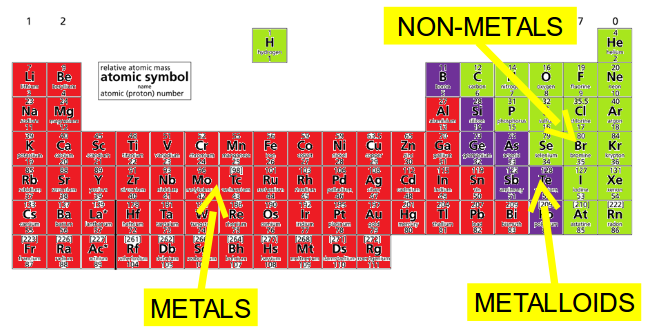
- The periodic table can
be divided into 3 groups:
- A metalloid is an element with
some qualities of a metal, and
some qualities of a non-metal.
- When you go down a group
and to the left of a period, the
elements get more and more
reactive.
- When you go down a group
and to the left of a period, the
elements get more and more
reactive.
- A metalloid is an element with
some qualities of a metal, and
some qualities of a non-metal.
- The alkali metals
are so reactive
that they are rarely
found in nature,
and have to be
stored in oil to
prevent them from
reacting with the
air.
- They are very soft and can be easily cut.
They react with water to form alkaline
compounds. They have a low density and
low melting and boiling points.
- Alkali metals all have 1
electron in their outer shell.
- More reactive metals have more shells, because
the further away an electron is from the nucleus of
the atom, the easier it is for the electrons to be lost.
- alkali metal + water -> alkali metal hydroxide + hydrogen
- alkali metal + oxygen -> alkali metal oxide
- alkali metal + oxygen -> alkali metal oxide
- alkali metal + water -> alkali metal hydroxide + hydrogen
- More reactive metals have more shells, because
the further away an electron is from the nucleus of
the atom, the easier it is for the electrons to be lost.
- Alkali metals all have 1
electron in their outer shell.
- They are very soft and can be easily cut.
They react with water to form alkaline
compounds. They have a low density and
low melting and boiling points.
- The noble gases all form colourless
gases at room temperature.
- Helium only has 2 electrons
in it's outer shell, but all the
other noble gases have 8.
- Helium only has 2 electrons
in it's outer shell, but all the
other noble gases have 8.
- The periodic table can
be divided into 3 groups:
- C11.4
- A chemical reaction is a change that takes place
when one or more substances (called reactants)
form one or more new substances (called products)
- Many chemical reactions are are irreversible
changes. You can spot this by a colour change,
a precipitate (solid) forming, an odour being
produced, or energy being produced (which is
shown by fizzing or burning.
- In a chemical reaction,
electrons are either
shared, lost or gained.
- An ion is a
charged atom
- Ionic bonding takes place
between a metal and a non
metal. Electrons are taken,
not shared. The metal atoms
will lose electrons and become
positively charged, and the
non-metal atoms will gain
electrons and become
negatively charged. The ionic
bond is the attraction between
positive and negative ions.
- Ionic bonding takes place
between a metal and a non
metal. Electrons are taken,
not shared. The metal atoms
will lose electrons and become
positively charged, and the
non-metal atoms will gain
electrons and become
negatively charged. The ionic
bond is the attraction between
positive and negative ions.
- In covalent bonding,
electrons are shared. It
only occurs between
non-metals. Each shared
pair is a covalent bond.
- Metallic bonding occurs between metals. Metals
lose electrons, which become delocalised.
Because of these free-moving electrons, metals
can conduct heat and electricity well. Metallic
bonding is the attraction between positive metal
ions and delocalised electrons.
- An ion is a
charged atom
- In a chemical
reaction, the
mass doesn't
change. This is
because no
atoms are made
or destroyed,
the reaction just
changes how
atoms are
bonded
together.
- Many chemical reactions are are irreversible
changes. You can spot this by a colour change,
a precipitate (solid) forming, an odour being
produced, or energy being produced (which is
shown by fizzing or burning.
- A chemical reaction is a change that takes place
when one or more substances (called reactants)
form one or more new substances (called products)
- C11.5
- In an ionic compound, the non
metal will be negatively charged and
the metal will be positively charged.
- In an ionic compound, the non
metal will be negatively charged and
the metal will be positively charged.
Medienanhänge
Möchten Sie kostenlos Ihre eigenen Mindmaps mit GoConqr erstellen? Mehr erfahren.