
Mindmap
THE ALTERNATIVES IN LANGUAGE ASSESSMENT
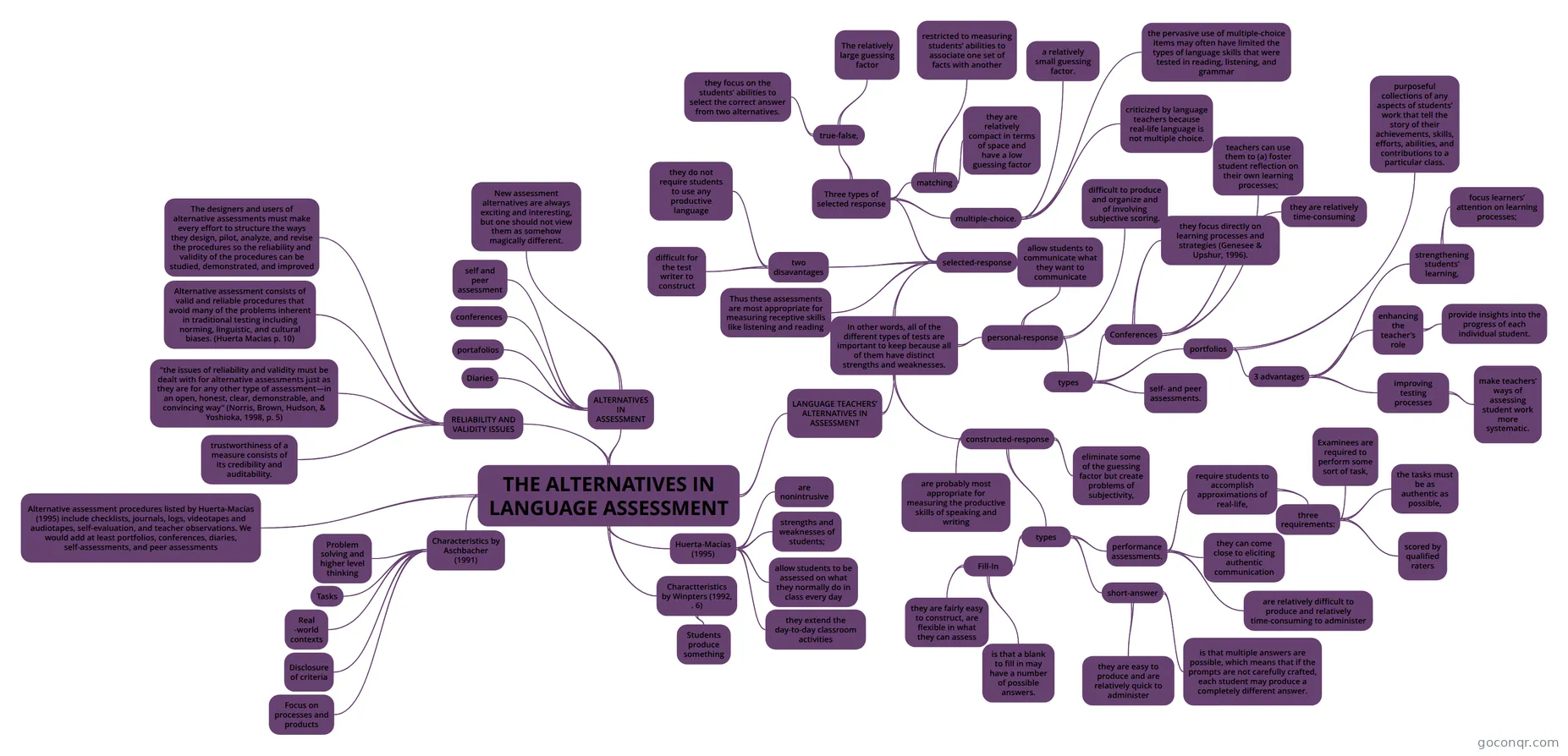
Mind map: Alternatives in language assessment
Inhalt der Mindmap
THE ALTERNATIVES IN LANGUAGE ASSESSMENT
Alternative assessment procedures listed by Huerta-Macías (1995) include checklists, journals, logs, videotapes and audiotapes, self-evaluation, and teacher observations. We would add at least portfolios, conferences, diaries, self-assessments, and peer assessments
Characteristics by Aschbacher (1991)
- Problem solving and higher level thinking
- Tasks
- Real -world contexts
- Focus on processes and products
- Disclosure of criteria
Charactteristics by Winpters (1992, . 6)
- Students produce something
Huerta-Macías (1995)
- are nonintrusive
- they extend the day-to-day classroom activities
- allow students to be assessed on what they normally do in class every day
- strengths and weaknesses of students;
RELIABILITY AND VALIDITY ISSUES
- Alternative assessment consists of valid and reliable procedures that avoid many of the problems inherent in traditional testing including norming, linguistic, and cultural biases. (Huerta Macias p. 10)
- The designers and users of alternative assessments must make every effort to structure the ways they design, pilot, analyze, and revise the procedures so the reliability and validity of the procedures can be studied, demonstrated, and improved
- “the issues of reliability and validity must be dealt with for alternative assessments just as they are for any other type of assessment—in an open, honest, clear, demonstrable, and convincing way” (Norris, Brown, Hudson, & Yoshioka, 1998, p. 5)
- trustworthiness of a measure consists of its credibility and auditability.
ALTERNATIVES IN ASSESSMENT
- portafolios
- conferences
- Diaries
- self and peer assessment
- New assessment alternatives are always exciting and interesting, but one should not view them as somehow magically different.
LANGUAGE TEACHERS’ ALTERNATIVES IN ASSESSMENT
- In other words, all of the different types of tests are important to keep because all of them have distinct strengths and weaknesses.
- selected-response
- Thus these assessments are most appropriate for measuring receptive skills like listening and reading
- two disavantages
- difficult for the test writer to construct
- they do not require students to use any productive language
- Three types of selected response
- true-false,
- they focus on the students’ abilities to select the correct answer from two alternatives.
- The relatively large guessing factor
- matching
- they are relatively compact in terms of space and have a low guessing factor
- restricted to measuring students’ abilities to associate one set of facts with another
- multiple-choice.
- a relatively small guessing factor.
- criticized by language teachers because real-life language is not multiple choice.
- the pervasive use of multiple-choice items may often have limited the types of language skills that were tested in reading, listening, and grammar
- true-false,
- constructed-response
- are probably most appropriate for measuring the productive skills of speaking and writing
- eliminate some of the guessing factor but create problems of subjectivity,
- types
- Fill-In
- they are fairly easy to construct, are flexible in what they can assess
- is that a blank to fill in may have a number of possible answers.
- short-answer
- they are easy to produce and are relatively quick to administer
- is that multiple answers are possible, which means that if the prompts are not carefully crafted, each student may produce a completely different answer.
- performance assessments.
- require students to accomplish approximations of real-life,
- three requirements:
- Examinees are required to perform some sort of task,
- the tasks must be as authentic as possible,
- scored by qualified raters
- three requirements:
- they can come close to eliciting authentic communication
- are relatively difficult to produce and relatively time-consuming to administer
- require students to accomplish approximations of real-life,
- Fill-In
- personal-response
- allow students to communicate what they want to communicate
- difficult to produce and organize and of involving subjective scoring.
- types
- Conferences
- they focus directly on learning processes and strategies (Genesee & Upshur, 1996).
- teachers can use them to (a) foster student reflection on their own learning processes;
- they are relatively time-consuming
- portfolios
- purposeful collections of any aspects of students’ work that tell the story of their achievements, skills, efforts, abilities, and contributions to a particular class.
- 3 advantages
- strengthening students’ learning,
- focus learners’ attention on learning processes;
- enhancing the teacher’s role
- provide insights into the progress of each individual student.
- improving testing processes
- make teachers’ ways of assessing student work more systematic.
- strengthening students’ learning,
- self- and peer assessments.
- Conferences
- selected-response
- In other words, all of the different types of tests are important to keep because all of them have distinct strengths and weaknesses.
Informationen
- Beschreibung
- Mindmap am THE ALTERNATIVES IN LANGUAGE ASSESSMENT, erstellt von Leidy Gomez am 22/03/2017.
- Erstellt von
- Leidy Gomez
- Aufrufe
- 1
- Bewertung
Mehr zu Alternative and Authentic Assessment