
Mindmap
Associative Learning
Inhalt der Mindmap
Associative Learning
What is associative learning?
- Learning is any relatively long lasting change in behaviour resulting from experience. Associative learning is said to have occured when this change in behaviour results form pairings of two events. An association is a hypothetical link between two events. The association contains all the information you need.Can be weak or strong.
- Rescorla (1988) 3 fundamental questions about learning - what information is acquired? What are the conditions of learning? What factors determine when and how rigorously a response will be formed? So complex, no one really knows.
Pavlovian Conditioning
- Passivley exposed to events and learns. Pavlov's dogs. Light comes on and then food appears. Dog salivates. Food elicits the unconditioned response of salivation. By trial 10, animals starts to salivate as light comes on. This is a conditioned response. Then the light in isolation makes animal salivate.
Instrumental conditioning
- Animal has to learn about behaviour. Thorndike and cat puzzle box. animal has to learn how to escape to get treat. has to learn by randomly doing things - trial and error. then forms association.
Everyday examples
- Names and faces, appearance of food and taste, pressig light switch and light
- Less everyday examples = clinical behavioural therapies, phobias, alleviating anticipatory nausea in cancer patients, relapse in drug abuse, drug tolerance (addicts more likely to overdose in unfamiliar environment)
Why conditioning
- Tools for analysing associative learning in animals. Orderly changes in behaviour that provide ways of building an account of the conceptual nervous system
- The conceptual nervous system
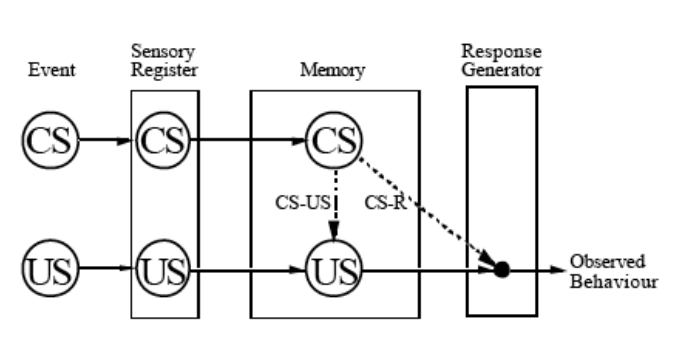
- Theorists interested purely in learning tend not to talk in terms of physiological processes. Why? because tese precise physiological mechanisms are still unknown. Instead they often work within a framework provided by an information processing model of conditioning.
- Event in the environment --> CNS --> behavioural response
- Event in the environment --> sensory register --> memory --> behavioural response
- Event in the environment --> CNS --> behavioural response
- Theorists interested purely in learning tend not to talk in terms of physiological processes. Why? because tese precise physiological mechanisms are still unknown. Instead they often work within a framework provided by an information processing model of conditioning.
- The conceptual nervous system
- Why study animals
- Wealth of information, degree of control, potential snythesis across levels of anaysis (artificial intelligence, psychology, neuroscience
- Relevance to humans
- Common evolutionary history, confronted by similar problems in world, convergence between theories of humans and animal learning, parallel effects observed in humans and other animals
- Relevance to humans
- Wealth of information, degree of control, potential snythesis across levels of anaysis (artificial intelligence, psychology, neuroscience
- Tools for analysing associative learning in animals. Orderly changes in behaviour that provide ways of building an account of the conceptual nervous system
Instrumental conditioning
- Contemporary procedures = key pecking in pigeons, level pressing in rats, chain pulling
- Thorndikes law of effect. If a response leads to a satisfying outcome it will be strengthened. The outcome strengthens the response elicited by the stimulus. It has a modulatory effect; it is not part of the association that is formed.
- What is learned?
- Stimulus --> Response
- A memory of the sight of the level (stimulus) is associated with motor program for pressing the lever
- Response --> Outcome
- The motor program for pressing the lever becomes associated with the outcome or reinforcer
- Outcome devaluation as a way of discriminating between S-R and R-O associative structures. Stage 1: Lever press - food and chain pull - sucrose. Stage 2 (devaluation) Food-Illness and sucrose - nothing. Then tested on the lever and chain. Colwill and Rescorla 1985. If learning S-R they should carry on with both as do not have knowledge about the outcome. If learnt about R-O then know response leads to food, which is bad, and should stop pressing lever. In test they pull the chain a lot more than the lever, therefore we can infer that they do not want food because food has been devalued - formed a R-O association.
- Stimulus --> Response
Pavlovian Conditioning
- When is a response a conditioned response?: the importance of control procedures
- If responding increased to both sitmuli it is possible that the response is caused by sensitisation rather than conditioning. Responding has to be dependnt on CS-US pairings.
- Pseudo-conditioning: If both groups show equal responding to the CS in the test phase then it is possible that mere exposure to the US results in eliciting the response (i.e. exposure to the US will result in the ‘conditioned’ response being displayed in the presence of any stimulus.
- When is a response a conditioned response?: the importance of control procedures
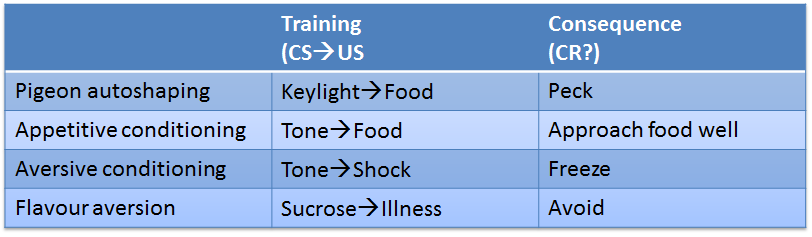
What is the CR? Stimulus substitution: does the CS become mistaken for the US? Sometimes CR mimics the UR and sometimes the cR is different
Konorski - USs have affective and specific properties. If specific properties are retrieved by presentation of cS a consummatory CR is elicited. If affective properties are retrieved then preparatory CR is elicited.
- Nature of outcome affects nature of conditioned response
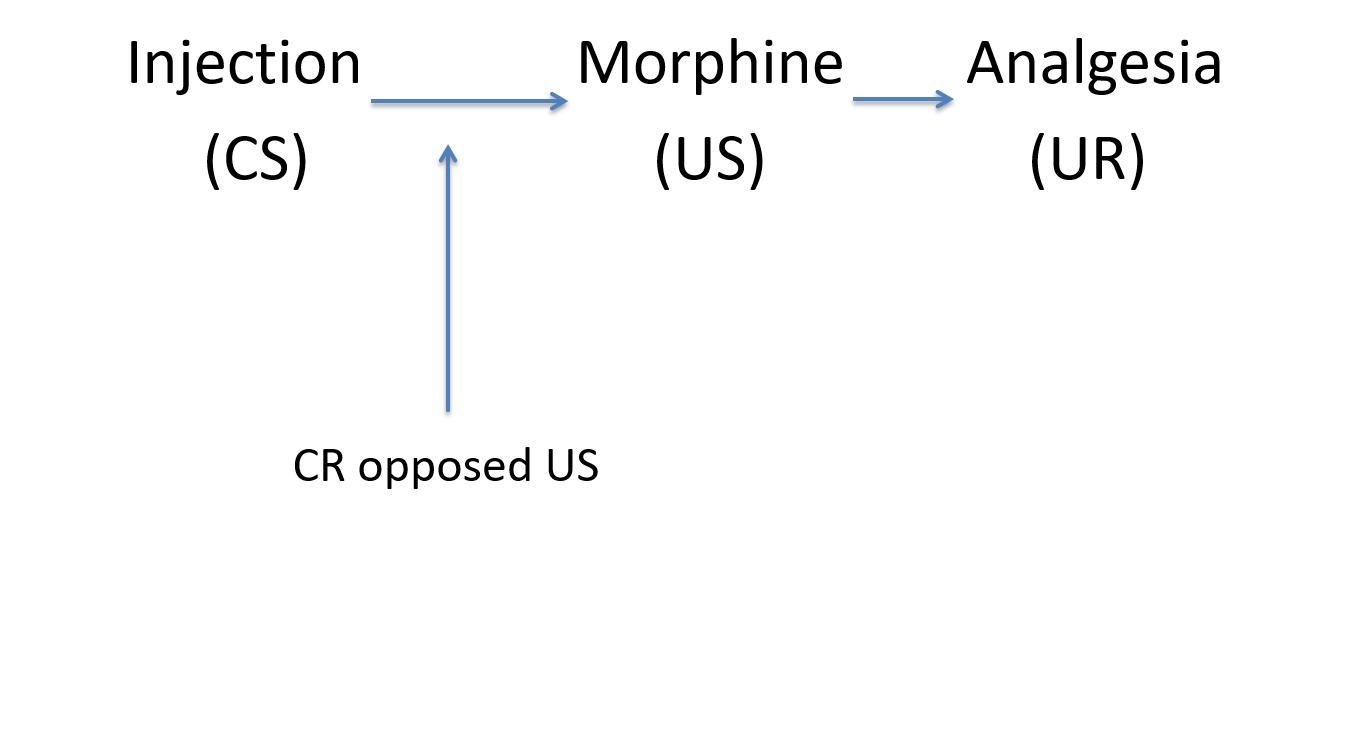
- Compensatory CR - tolerance is decreased in sensitivity to a drug as a result of repeated exposure to it. This tolerance results from compensatory mechanisms. Biological = metabolic changes, snyaptic changes; psychological = conditioning affects, homeostasis mechanisms
- Learn about environment!
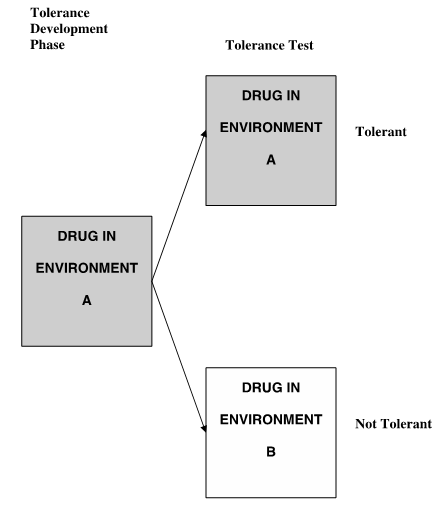
- Siegel, Hinson, Krank and McCully (1982). Heroin overdose. A lot of evidence of people dying from taking an amount of drug they are used too, or smaller than normal. Become tolerant in environment you take it in but not tolerant in another. Built up association between environment and drug, context specific. Looked at heroin overdose in rats, 32% died in same environment, 64% in diferent, 96% in control. Started with low dosee and increased tolerance over time in same room. Amount would be toxic to naive rats.Associative learning keeps the rats in the same room alive! This is a great problem for rehab.
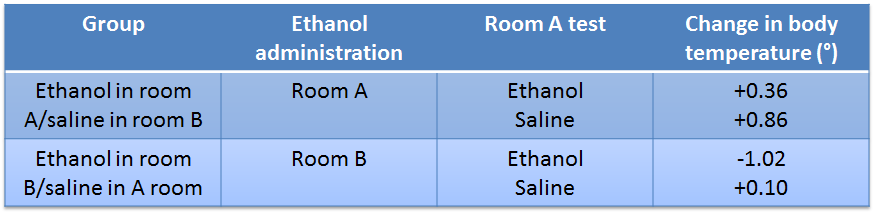
- Ethanol -> reduction temp. When receive ethanol in room they dont expect, they get a decrease in body temp. If expected saline room A but got saline, no change. If expected ethanol but got saline, increase. Crowell, Hinson and Siegel 1981
- Learn about environment!
What is learnt in Pavlovian conditioning?
- S-->R. A memory of the tone (stimulus) is associated with motor program for approaching the site of food delivery
- S--~> S. A memory of tone (stimulus) associated with a memory of food; the approach motor program is activated through activation of the memory of food
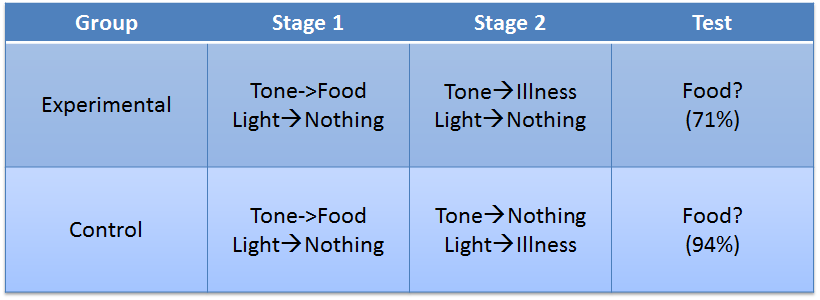
- US devaluation as a way of discriminating between S-S and S-R associative structures. Holand and Straub 1979
- Holland 1981.Further evidence that animals acquire S-S associations: US-memory devaluation
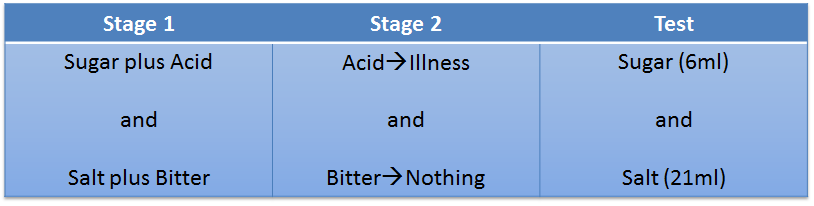
- More direct evidence that animals acquire S-S associations: Sensory Preconditioning
- S-R behaviourists: Thorndike, Skinner, Hull, Guthrie. S-S cognitivists: Tolman, and everyone since
Pavlovian and instrumental conditioning procedures bring about marked changes in animal behaviour. As Konorski (1967) argued “the conditioned response [is] playing the role of a ‘tracer’ allowing the association to be detected.” The effects of reinforcer de/revaluation and the existence of sensory preconditioning help us to understand the nature of the associative structures that underlie these changes in behaviour. Associations between representations or memories of the stimulus and reinforcer (in Pavlovian conditioning) and a response and a reinforcer (in Instrumental conditioning) play an important role in generating behaviour
Bilder und Dateien der Mindmap

Informationen
- Beschreibung
- Y3 Uni Learning and Animal cognition - David Mindmap am Associative Learning, erstellt von Issy de Silva am 26/03/2017.
- Erstellt von
- Issy de Silva
- Aufrufe
- 1
- Bewertung