
Mindmap
Tectonic hazards
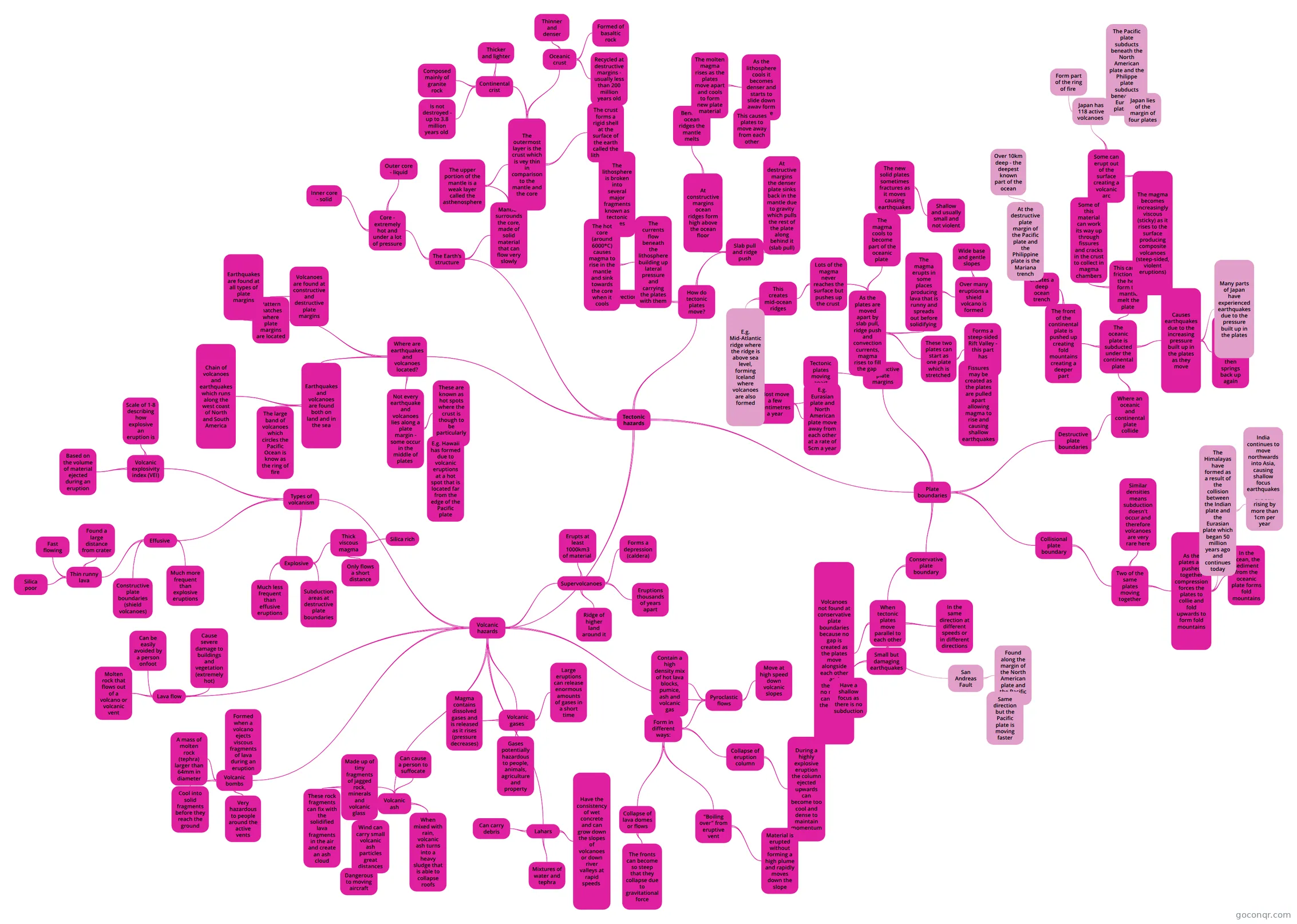
Mind map: Tectonic hazards
Inhalt der Mindmap
Tectonic hazards
The Earth's structure
- Core - extremely hot and under a lot of pressure
- Inner core - solid
- Outer core - liquid
- Mantle - surrounds the core, made of solid material that can flow very slowly
- The upper portion of the mantle is a weak layer called the asthenosphere
- The outermost layer is the crust which is vey thin in comparison to the mantle and the core
- Oceanic crust
- Thinner and denser
- Formed of basaltic rock
- Recycled at destructive margins - usually less than 200 million years old
- Continental crist
- Thicker and lighter
- Composed mainly of granite rock
- Is not destroyed - up to 3.8 million years old
- The crust forms a rigid shell at the surface of the earth called the lithosphere
- The lithosphere is broken into several major fragments known as tectonic plates
- Oceanic crust
- The outermost layer is the crust which is vey thin in comparison to the mantle and the core
- The upper portion of the mantle is a weak layer called the asthenosphere
- Core - extremely hot and under a lot of pressure
How do tectonic plates move?
- Convection
- The hot core (around 6000*C) causes magma to rise in the mantle and sink towards the core when it cools
- The currents flow beneath the lithosphere building up lateral pressure and carrying the plates with them
- The hot core (around 6000*C) causes magma to rise in the mantle and sink towards the core when it cools
- Slab pull and ridge push
- At constructive margins ocean ridges form high above the ocean floor
- Beneath ocean ridges the mantle melts
- The molten magma rises as the plates move apart and cools to form new plate material
- As the lithosphere cools it becomes denser and starts to slide down away form the ridge
- This causes plates to move away from each other
- As the lithosphere cools it becomes denser and starts to slide down away form the ridge
- The molten magma rises as the plates move apart and cools to form new plate material
- Beneath ocean ridges the mantle melts
- At destructive margins the denser plate sinks back in the mantle due to gravity which pulls the rest of the plate along behind it (slab pull)
- At constructive margins ocean ridges form high above the ocean floor
- Convection
Where are earthquakes and volcanoes located?
- Pattern matches where plate margins are located
- Earthquakes are found at all types of plate margins
- Volcanoes are found at constructive and destructive plate margins
- Earthquakes and volcanoes are found both on land and in the sea
- Chain of volcanoes and earthquakes which runs along the west coast of North and South America
- The large band of volcanoes which circles the Pacific Ocean is know as the ring of fire
- Not every earthquake and volcanoes lies along a plate margin - some occur in the middle of plates
- These are known as hot spots where the crust is though to be particularly thin
- E.g. Hawaii has formed due to volcanic eruptions at a hot spot that is located far from the edge of the Pacific plate
- These are known as hot spots where the crust is though to be particularly thin
- Pattern matches where plate margins are located
Plate boundaries
- Constructive plate margins
- Tectonic plates moving apart
- Most move a few centimetres a year
- E.g. Eurasian plate and North American plate move away from each other at a rate of 5cm a year
- Most move a few centimetres a year
- As the plates are moved apart by slab pull, ridge push and convection currents, magma rises to fill the gap
- The magma cools to become part of the oceanic plate
- The new solid plates sometimes fractures as it moves causing earthquakes
- Shallow and usually small and not violent
- The new solid plates sometimes fractures as it moves causing earthquakes
- The magma erupts in some places producing lava that is runny and spreads out before solidifying
- Over many eruptions a shield volcano is formed
- Wide base and gentle slopes
- Over many eruptions a shield volcano is formed
- Lots of the magma never reaches the surface but pushes up the crust
- This creates mid-ocean ridges
- E.g. Mid-Atlantic ridge where the ridge is above sea level, forming Iceland where volcanoes are also formed
- This creates mid-ocean ridges
- These two plates can start as one plate which is stretched
- Forms a steep-sided Rift Valley - this part has become thinner
- Fissures may be created as the plates are pulled apart allowing magma to rise and causing shallow earthquakes
- Forms a steep-sided Rift Valley - this part has become thinner
- The magma cools to become part of the oceanic plate
- Tectonic plates moving apart
- Destructive plate boundaries
- Where an oceanic and continental plate collide
- The oceanic plate is subducted under the continental plate
- The front of the continental plate is pushed up creating fold mountains creating a deeper part
- Creates a deep ocean trench
- At the destructive plate margin of the Pacific plate and the Philippine plate is the Mariana trench
- Over 10km deep - the deepest known part of the ocean
- At the destructive plate margin of the Pacific plate and the Philippine plate is the Mariana trench
- Creates a deep ocean trench
- This causes friction and the heat form the mantle melt the plate
- Some of this material can work its way up through fissures and cracks in the crust to collect in magma chambers
- Some can erupt out of the surface creating a volcanic arc
- The magma becomes increasingly viscous (sticky) as it rises to the surface producing composite volcanoes (steep-sided, violent eruptions)
- Japan has 118 active volcanoes
- Form part of the ring of fire
- Japan lies of the margin of four plates
- The Pacific plate subducts beneath the North American plate and the Philippe plate subducts beneath the Eurasian plate and
- Some can erupt out of the surface creating a volcanic arc
- Some of this material can work its way up through fissures and cracks in the crust to collect in magma chambers
- Causes earthquakes due to the increasing pressure built up in the plates as they move
- The front edge of the continental plate is dragged down and then springs back up again
- Many parts of Japan have experienced earthquakes due to the pressure built up in the plates
- The front of the continental plate is pushed up creating fold mountains creating a deeper part
- The oceanic plate is subducted under the continental plate
- Where an oceanic and continental plate collide
- Collisional plate boundary
- Two of the same plates moving together
- Similar densities means subduction doesn't occur and therefore volcanoes are very rare here
- As the plates are pushed together compression forces the plates to collie and fold upwards to form fold mountains
- In the ocean, the sediment from the oceanic plate forms fold mountains
- The Himalayas have formed as a result of the collision between the Indian plate and the Eurasian plate which began 50 million years ago and continues today
- The Himalayas are still rising by more than 1cm per year
- India continues to move northwards into Asia, causing shallow focus earthquakes
- The Himalayas are still rising by more than 1cm per year
- Two of the same plates moving together
- Conservative plate boundary
- When tectonic plates move parallel to each other
- In the same direction at different speeds or in different directions
- Volcanoes not found at conservative plate boundaries because no gap is created as the plates move alongside each other and therefore, no magma can rise to the surface
- Small but damaging earthquakes
- Have a shallow focus as there is no subduction
- When subduction is involved the focus is deeper down
- Have a shallow focus as there is no subduction
- San Andreas Fault
- Found along the margin of the North American plate and the Pacific plate
- Same direction but the Pacific plate is moving faster
- Found along the margin of the North American plate and the Pacific plate
- When tectonic plates move parallel to each other
- Constructive plate margins
Volcanic hazards
- Types of volcanism
- Volcanic explosivity index (VEI)
- Scale of 1-8 describing how explosive an eruption is
- Based on the volume of material ejected during an eruption
- Effusive
- Thin runny lava
- Fast flowing
- Found a large distance from crater
- Silica poor
- Constructive plate boundaries (shield volcanoes)
- Much more frequent than explosive eruptions
- Thin runny lava
- Explosive
- Thick viscous magma
- Only flows a short distance
- Silica rich
- Subduction areas at destructive plate boundaries
- Much less frequent than effusive eruptions
- Thick viscous magma
- Volcanic explosivity index (VEI)
- Lava flow
- Molten rock that flows out of a volcano or volcanic vent
- Can be easily avoided by a person onfoot
- Cause severe damage to buildings and vegetation (extremely hot)
- Volcanic bombs
- A mass of molten rock (tephra) larger than 64mm in diameter
- Formed when a volcano ejects viscous fragments of lava during an eruption
- Very hazardous to people around the active vents
- Cool into solid fragments before they reach the ground
- Volcanic ash
- Made up of tiny fragments of jagged rock, minerals and volcanic glass
- These rock fragments can fix with the solidified lava fragments in the air and create an ash cloud
- Wind can carry small volcanic ash particles great distances
- Dangerous to moving aircraft
- Iceland eruption 2011 cost aviation industry $2.6 billion dollars
- Dangerous to moving aircraft
- Can cause a person to suffocate
- When mixed with rain, volcanic ash turns into a heavy sludge that is able to collapse roofs
- Made up of tiny fragments of jagged rock, minerals and volcanic glass
- Volcanic gases
- Magma contains dissolved gases and is released as it rises (pressure decreases)
- Large eruptions can release enormous amounts of gases in a short time
- Gases potentially hazardous to people, animals, agriculture and property
- Pyroclastic flows
- Contain a high density mix of hot lava blocks, pumice, ash and volcanic gas
- Move at high speed down volcanic slopes
- Form in different ways:
- Collapse of eruption column
- During a highly explosive eruption the column ejected upwards can become too cool and dense to maintain momentum
- "Boiling over" from eruptive vent
- Material is erupted without forming a high plume and rapidly moves down the slope
- Collapse of lava domes or flows
- The fronts can become so steep that they collapse due to gravitational force
- Collapse of eruption column
- Lahars
- Mixtures of water and tephra
- Have the consistency of wet concrete and can grow down the slopes of volcanoes or down river valleys at rapid speeds
- Can carry debris
- Supervolcanoes
- Erupts at least 1000km3 of material
- Forms a depression (caldera)
- Ridge of higher land around it
- Eruptions thousands of years apart
- Types of volcanism
Informationen
- Beschreibung
- Year 10 (Geography) Mindmap am Tectonic hazards, erstellt von Emily H am 14/04/2017.
- Erstellt von
- Emily H
- Aufrufe
- 0
- Bewertung