
Mindmap
Caregiver-Infant Interactions
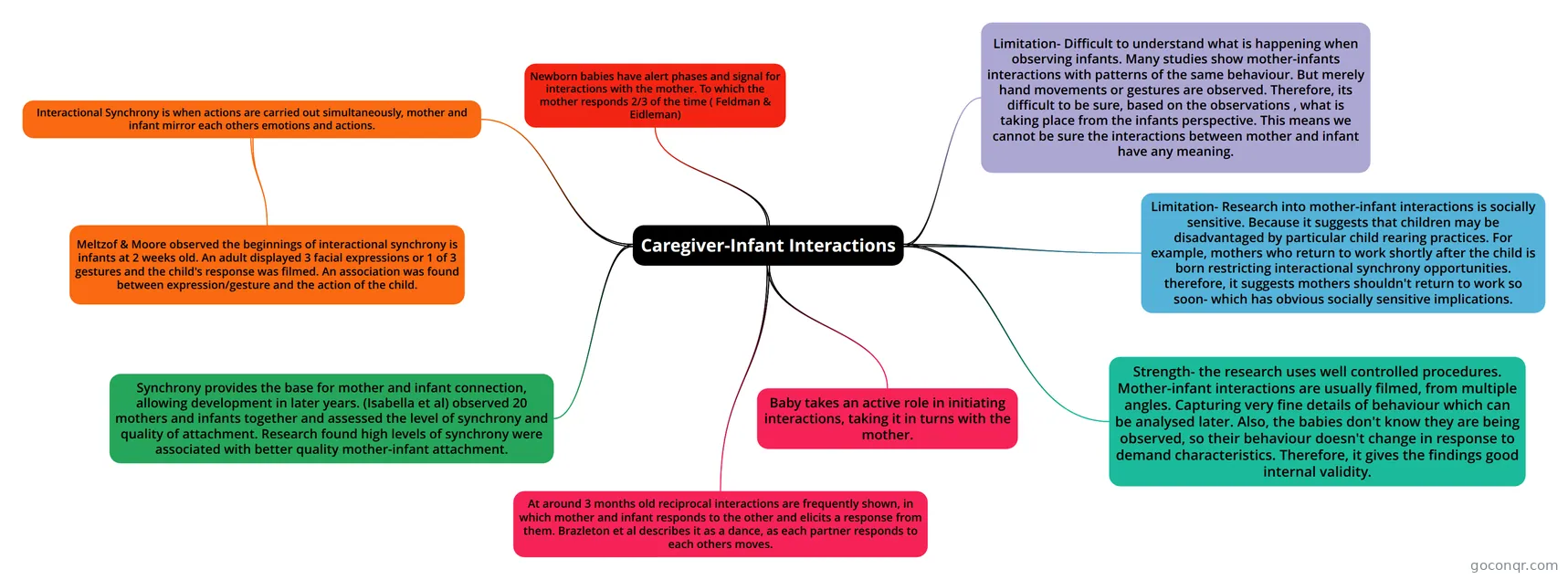
Mind map: Caregiver-Infant Interactions
Inhalt der Mindmap
Caregiver-Infant Interactions
Newborn babies have alert phases and signal for interactions with the mother. To which the mother responds 2/3 of the time ( Feldman & Eidleman)
Interactional Synchrony is when actions are carried out simultaneously, mother and infant mirror each others emotions and actions.
- Meltzof & Moore observed the beginnings of interactional synchrony is infants at 2 weeks old. An adult displayed 3 facial expressions or 1 of 3 gestures and the child's response was filmed. An association was found between expression/gesture and the action of the child.
Synchrony provides the base for mother and infant connection, allowing development in later years. (Isabella et al) observed 20 mothers and infants together and assessed the level of synchrony and quality of attachment. Research found high levels of synchrony were associated with better quality mother-infant attachment.
At around 3 months old reciprocal interactions are frequently shown, in which mother and infant responds to the other and elicits a response from them. Brazleton et al describes it as a dance, as each partner responds to each others moves.
Baby takes an active role in initiating interactions, taking it in turns with the mother.
Limitation- Difficult to understand what is happening when observing infants. Many studies show mother-infants interactions with patterns of the same behaviour. But merely hand movements or gestures are observed. Therefore, its difficult to be sure, based on the observations , what is taking place from the infants perspective. This means we cannot be sure the interactions between mother and infant have any meaning.
Limitation- Research into mother-infant interactions is socially sensitive. Because it suggests that children may be disadvantaged by particular child rearing practices. For example, mothers who return to work shortly after the child is born restricting interactional synchrony opportunities. therefore, it suggests mothers shouldn't return to work so soon- which has obvious socially sensitive implications.
Strength- the research uses well controlled procedures. Mother-infant interactions are usually filmed, from multiple angles. Capturing very fine details of behaviour which can be analysed later. Also, the babies don't know they are being observed, so their behaviour doesn't change in response to demand characteristics. Therefore, it gives the findings good internal validity.
Informationen
- Beschreibung
- AO1 & A03
- Erstellt von
- Alexandra Page
- Aufrufe
- 8
- Bewertung
Mehr zu Caregiver-infant interactions