
Mindmap
PCR
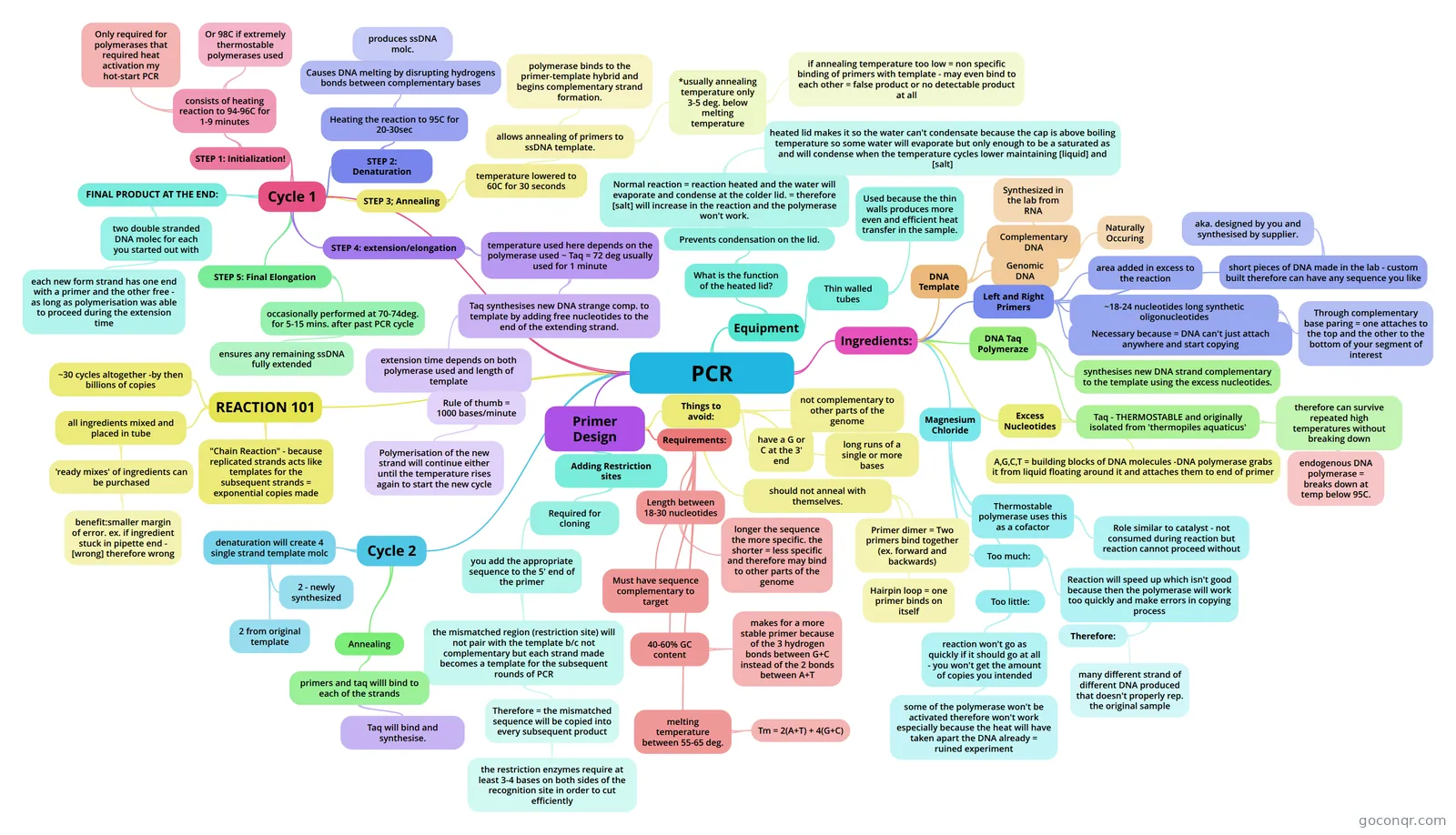
Mind map: PCR
Inhalt der Mindmap
PCR
Ingredients:
- DNA Template
- Complementary DNA
- Synthesized in the lab from RNA
- Genomic DNA
- Naturally Occuring
- Complementary DNA
- Left and Right Primers
- short pieces of DNA made in the lab - custom built therefore can have any sequence you like
- aka. designed by you and synthesised by supplier.
- ~18-24 nucleotides long synthetic oligonucleotides
- Through complementary base paring = one attaches to the top and the other to the bottom of your segment of interest
- Necessary because = DNA can't just attach anywhere and start copying
- area added in excess to the reaction
- short pieces of DNA made in the lab - custom built therefore can have any sequence you like
- DNA Taq Polymeraze
- synthesises new DNA strand complementary to the template using the excess nucleotides.
- Taq - THERMOSTABLE and originally isolated from 'thermopiles aquaticus'
- therefore can survive repeated high temperatures without breaking down
- endogenous DNA polymerase = breaks down at temp below 95C.
- therefore can survive repeated high temperatures without breaking down
- Excess Nucleotides
- A,G,C,T = building blocks of DNA molecules -DNA polymerase grabs it from liquid floating around it and attaches them to end of primer
- Magnesium Chloride
- Thermostable polymerase uses this as a cofactor
- Role similar to catalyst - not consumed during reaction but reaction cannot proceed without
- Too much:
- Reaction will speed up which isn't good because then the polymerase will work too quickly and make errors in copying process
- Therefore:
- many different strand of different DNA produced that doesn't properly rep. the original sample
- Therefore:
- Reaction will speed up which isn't good because then the polymerase will work too quickly and make errors in copying process
- Too little:
- reaction won't go as quickly if it should go at all - you won't get the amount of copies you intended
- some of the polymerase won't be activated therefore won't work especially because the heat will have taken apart the DNA already = ruined experiment
- reaction won't go as quickly if it should go at all - you won't get the amount of copies you intended
- Thermostable polymerase uses this as a cofactor
- DNA Template
Primer Design
- Things to avoid:
- long runs of a single or more bases
- have a G or C at the 3' end
- not complementary to other parts of the genome
- should not anneal with themselves.
- Primer dimer = Two primers bind together (ex. forward and backwards)
- Hairpin loop = one primer binds on itself
- Requirements:
- Must have sequence complementary to target
- 40-60% GC content
- makes for a more stable primer because of the 3 hydrogen bonds between G+C instead of the 2 bonds between A+T
- melting temperature between 55-65 deg.
- Tm = 2(A+T) + 4(G+C)
- Length between 18-30 nucleotides
- longer the sequence the more specific. the shorter = less specific and therefore may bind to other parts of the genome
- Adding Restriction sites
- Required for cloning
- you add the appropriate sequence to the 5' end of the primer
- the mismatched region (restriction site) will not pair with the template b/c not complementary but each strand made becomes a template for the subsequent rounds of PCR
- Therefore = the mismatched sequence will be copied into every subsequent product
- the restriction enzymes require at least 3-4 bases on both sides of the recognition site in order to cut efficiently
- Therefore = the mismatched sequence will be copied into every subsequent product
- the mismatched region (restriction site) will not pair with the template b/c not complementary but each strand made becomes a template for the subsequent rounds of PCR
- you add the appropriate sequence to the 5' end of the primer
- Required for cloning
- Things to avoid:
Equipment
- Thin walled tubes
- Used because the thin walls produces more even and efficient heat transfer in the sample.
- What is the function of the heated lid?
- Prevents condensation on the lid.
- Normal reaction = reaction heated and the water will evaporate and condense at the colder lid. = therefore [salt] will increase in the reaction and the polymerase won't work.
- heated lid makes it so the water can't condensate because the cap is above boiling temperature so some water will evaporate but only enough to be a saturated as and will condense when the temperature cycles lower maintaining [liquid] and [salt]
- Normal reaction = reaction heated and the water will evaporate and condense at the colder lid. = therefore [salt] will increase in the reaction and the polymerase won't work.
- Prevents condensation on the lid.
- Thin walled tubes
Cycle 1
- STEP 1: Initialization!
- consists of heating reaction to 94-96C for 1-9 minutes
- Or 98C if extremely thermostable polymerases used
- Only required for polymerases that required heat activation my hot-start PCR
- consists of heating reaction to 94-96C for 1-9 minutes
- STEP 2: Denaturation
- Heating the reaction to 95C for 20-30sec
- Causes DNA melting by disrupting hydrogens bonds between complementary bases
- produces ssDNA molc.
- Causes DNA melting by disrupting hydrogens bonds between complementary bases
- Heating the reaction to 95C for 20-30sec
- STEP 3; Annealing
- temperature lowered to 60C for 30 seconds
- allows annealing of primers to ssDNA template.
- *usually annealing temperature only 3-5 deg. below melting temperature
- if annealing temperature too low = non specific binding of primers with template - may even bind to each other = false product or no detectable product at all
- polymerase binds to the primer-template hybrid and begins complementary strand formation.
- *usually annealing temperature only 3-5 deg. below melting temperature
- allows annealing of primers to ssDNA template.
- temperature lowered to 60C for 30 seconds
- STEP 4: extension/elongation
- temperature used here depends on the polymerase used ~ Taq = 72 deg usually used for 1 minute
- Taq synthesises new DNA strange comp. to template by adding free nucleotides to the end of the extending strand.
- extension time depends on both polymerase used and length of template
- Rule of thumb = 1000 bases/minute
- Polymerisation of the new strand will continue either until the temperature rises again to start the new cycle
- Rule of thumb = 1000 bases/minute
- extension time depends on both polymerase used and length of template
- Taq synthesises new DNA strange comp. to template by adding free nucleotides to the end of the extending strand.
- temperature used here depends on the polymerase used ~ Taq = 72 deg usually used for 1 minute
- STEP 5: Final Elongation
- occasionally performed at 70-74deg. for 5-15 mins. after past PCR cycle
- ensures any remaining ssDNA fully extended
- occasionally performed at 70-74deg. for 5-15 mins. after past PCR cycle
- FINAL PRODUCT AT THE END:
- two double stranded DNA molec for each you started out with
- each new form strand has one end with a primer and the other free - as long as polymerisation was able to proceed during the extension time
- two double stranded DNA molec for each you started out with
- STEP 1: Initialization!
Cycle 2
- denaturation will create 4 single strand template molc
- 2 from original template
- 2 - newly synthesized
- Annealing
- primers and taq willl bind to each of the strands
- Taq will bind and synthesise.
- primers and taq willl bind to each of the strands
- denaturation will create 4 single strand template molc
REACTION 101
- ~30 cycles altogether -by then billions of copies
- "Chain Reaction" - because replicated strands acts like templates for the subsequent strands = exponential copies made
- all ingredients mixed and placed in tube
- 'ready mixes' of ingredients can be purchased
- benefit:smaller margin of error. ex. if ingredient stuck in pipette end - [wrong] therefore wrong
- 'ready mixes' of ingredients can be purchased
Informationen
- Beschreibung
- Mindmap am PCR, erstellt von sylviedroz am 13/05/2014.
- Erstellt von
- sylviedroz
- Aufrufe
- 24
- Bewertung
Mehr zu PCR and Gel Electrophoresis