
Mindmap
B3 2.1-2.5
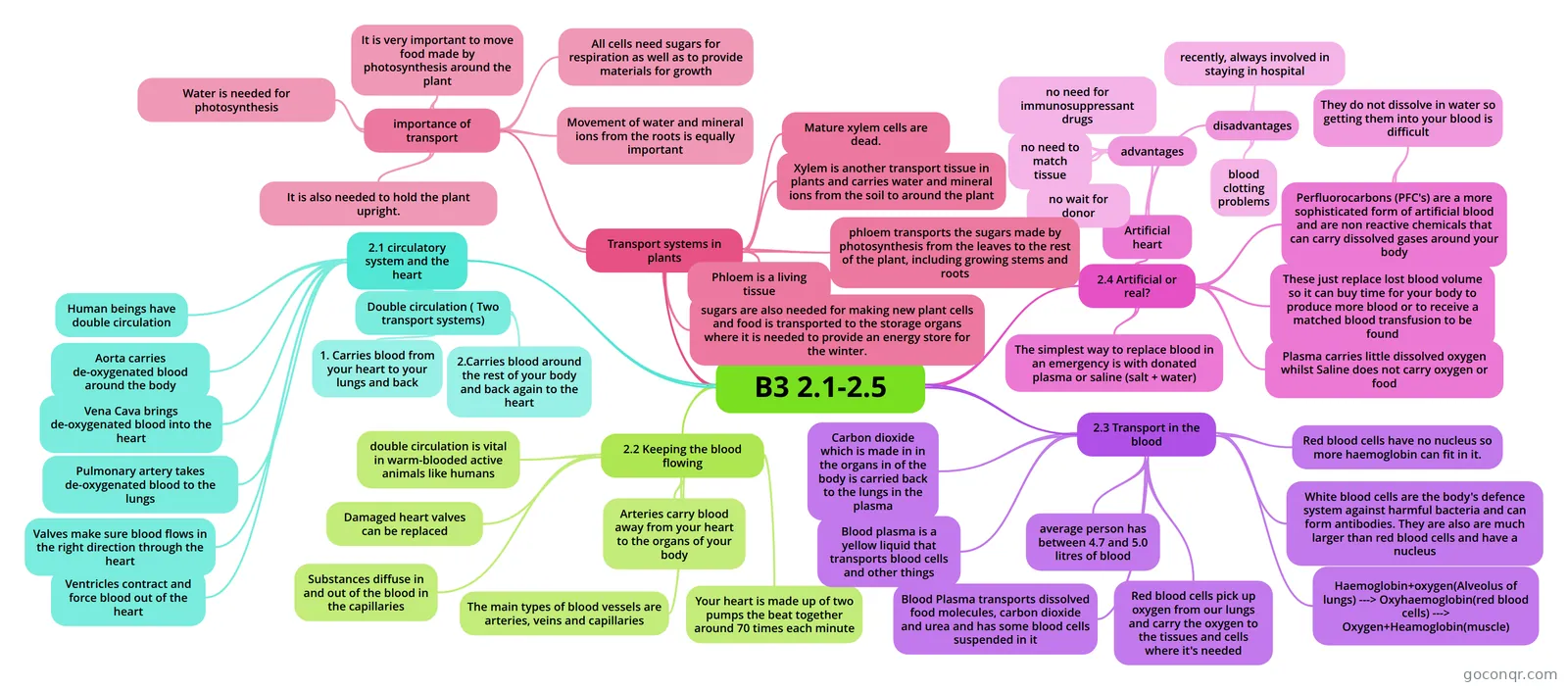
Mind map: B3 circulatory system and blood
Inhalt der Mindmap
B3 2.1-2.5
2.1 circulatory system and the heart
- Human beings have double circulation
- Valves make sure blood flows in the right direction through the heart
- Ventricles contract and force blood out of the heart
- Pulmonary artery takes de-oxygenated blood to the lungs
- Vena Cava brings de-oxygenated blood into the heart
- Aorta carries de-oxygenated blood around the body
- Double circulation ( Two transport systems)
- 2.Carries blood around the rest of your body and back again to the heart
- 1. Carries blood from your heart to your lungs and back
2.2 Keeping the blood flowing
- double circulation is vital in warm-blooded active animals like humans
- Damaged heart valves can be replaced
- The main types of blood vessels are arteries, veins and capillaries
- Arteries carry blood away from your heart to the organs of your body
- Your heart is made up of two pumps the beat together around 70 times each minute
- Substances diffuse in and out of the blood in the capillaries
2.3 Transport in the blood
- Blood plasma is a yellow liquid that transports blood cells and other things
- average person has between 4.7 and 5.0 litres of blood
- Red blood cells pick up oxygen from our lungs and carry the oxygen to the tissues and cells where it's needed
- Haemoglobin+oxygen(Alveolus of lungs) ---> Oxyhaemoglobin(red blood cells) ---> Oxygen+Heamoglobin(muscle)
- Carbon dioxide which is made in in the organs in of the body is carried back to the lungs in the plasma
- Blood Plasma transports dissolved food molecules, carbon dioxide and urea and has some blood cells suspended in it
- White blood cells are the body's defence system against harmful bacteria and can form antibodies. They are also are much larger than red blood cells and have a nucleus
- Red blood cells have no nucleus so more haemoglobin can fit in it.
2.4 Artificial or real?
- The simplest way to replace blood in an emergency is with donated plasma or saline (salt + water)
- Plasma carries little dissolved oxygen whilst Saline does not carry oxygen or food
- These just replace lost blood volume so it can buy time for your body to produce more blood or to receive a matched blood transfusion to be found
- Perfluorocarbons (PFC's) are a more sophisticated form of artificial blood and are non reactive chemicals that can carry dissolved gases around your body
- They do not dissolve in water so getting them into your blood is difficult
- Artificial heart
- advantages
- no wait for donor
- no need to match tissue
- no need for immunosuppressant drugs
- disadvantages
- blood clotting problems
- recently, always involved in staying in hospital
- advantages
Transport systems in plants
- phloem transports the sugars made by photosynthesis from the leaves to the rest of the plant, including growing stems and roots
- sugars are also needed for making new plant cells and food is transported to the storage organs where it is needed to provide an energy store for the winter.
- Phloem is a living tissue
- Xylem is another transport tissue in plants and carries water and mineral ions from the soil to around the plant
- Mature xylem cells are dead.
- importance of transport
- All cells need sugars for respiration as well as to provide materials for growth
- Movement of water and mineral ions from the roots is equally important
- It is very important to move food made by photosynthesis around the plant
- Water is needed for photosynthesis
- It is also needed to hold the plant upright.
Informationen
- Beschreibung
- Mindmap am B3 2.1-2.5, erstellt von liammaddock am 13/05/2013.
- Erstellt von
- liammaddock
- Aufrufe
- 47
- Bewertung