
Mindmap
Rock Types
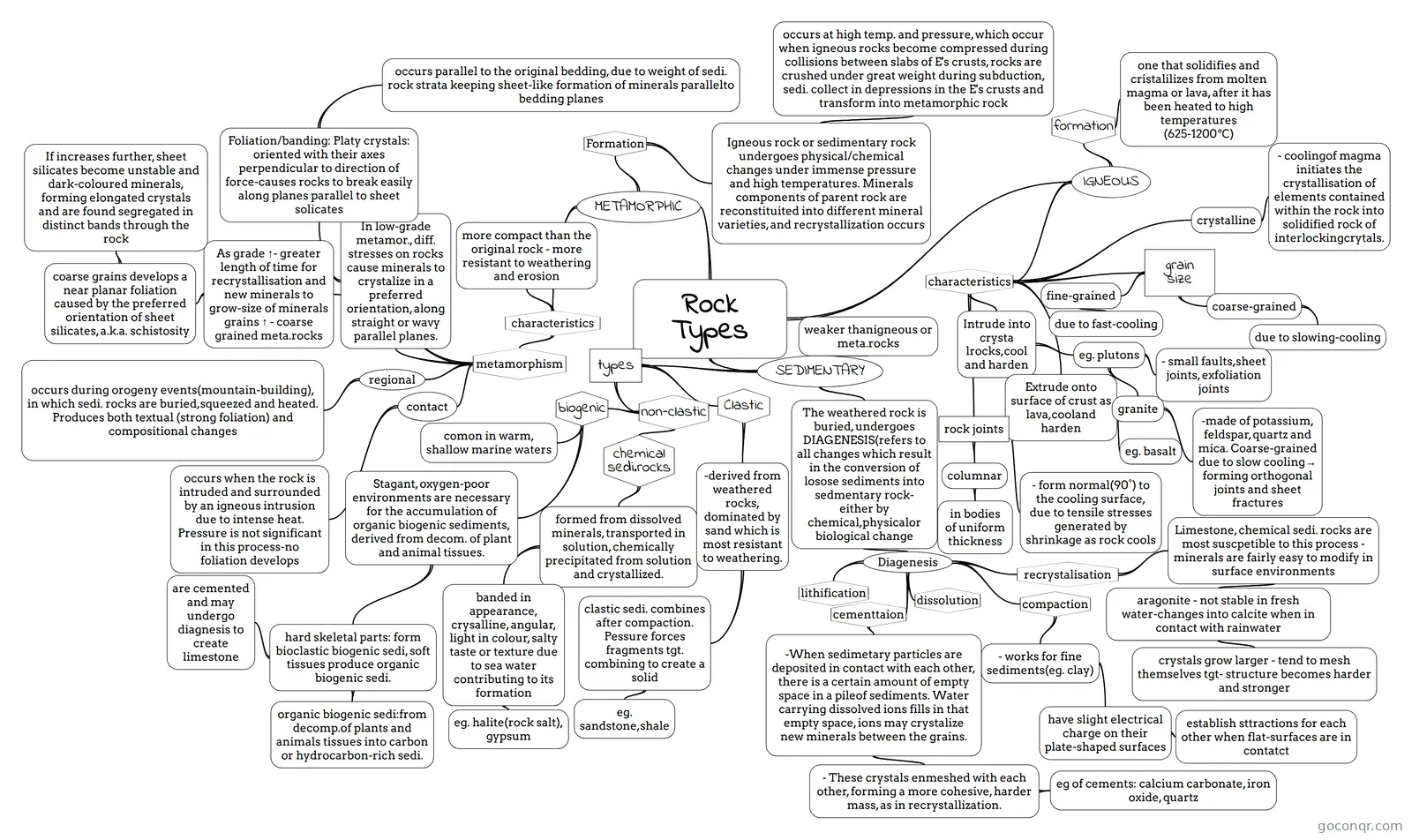
Mind map: Rock types
Inhalt der Mindmap
Rock Types
IGNEOUS
- characteristics
- Intrude into crysta lrocks,cool and harden
- eg. plutons
- - small faults,sheet joints, exfoliation joints
- granite
- -made of potassium, feldspar, quartz and mica. Coarse-grained due to slow cooling→ forming orthogonal joints and sheet fractures
- eg. plutons
- Extrude onto surface of crust as lava,cooland harden
- eg. basalt
- crystalline
- - coolingof magma initiates the crystallisation of elements contained within the rock into solidified rock of interlockingcrytals.
- grain size
- fine-grained
- due to fast-cooling
- coarse-grained
- due to slowing-cooling
- fine-grained
- rock joints
- - form normal(90°) to the cooling surface, due to tensile stresses generated by shrinkage as rock cools
- columnar
- in bodies of uniform thickness
- Intrude into crysta lrocks,cool and harden
- formation
- one that solidifies and cristalilizes from molten magma or lava, after it has been heated to high temperatures (625-1200℃)
- characteristics
SEDIMENTARY
- types
- Clastic
- -derived from weathered rocks, dominated by sand which is most resistant to weathering.
- clastic sedi. combines after compaction. Pessure forces fragments tgt. combining to create a solid
- eg. sandstone,shale
- clastic sedi. combines after compaction. Pessure forces fragments tgt. combining to create a solid
- -derived from weathered rocks, dominated by sand which is most resistant to weathering.
- non-clastic
- biogenic
- Stagant, oxygen-poor environments are necessary for the accumulation of organic biogenic sediments, derived from decom. of plant and animal tissues.
- hard skeletal parts: form bioclastic biogenic sedi, soft tissues produce organic biogenic sedi.
- are cemented and may undergo diagnesis to create limestone
- organic biogenic sedi:from decomp.of plants and animals tissues into carbon or hydrocarbon-rich sedi.
- hard skeletal parts: form bioclastic biogenic sedi, soft tissues produce organic biogenic sedi.
- comon in warm, shallow marine waters
- Stagant, oxygen-poor environments are necessary for the accumulation of organic biogenic sediments, derived from decom. of plant and animal tissues.
- chemical sedi.rocks
- formed from dissolved minerals, transported in solution, chemically precipitated from solution and crystallized.
- banded in appearance, crysalline, angular, light in colour, salty taste or texture due to sea water contributing to its formation
- eg. halite(rock salt), gypsum
- banded in appearance, crysalline, angular, light in colour, salty taste or texture due to sea water contributing to its formation
- formed from dissolved minerals, transported in solution, chemically precipitated from solution and crystallized.
- biogenic
- Clastic
- The weathered rock is buried, undergoes DIAGENESIS(refers to all changes which result in the conversion of losose sediments into sedmentary rock- either by chemical,physicalor biological change
- Diagenesis
- cementtaion
- -When sedimetary particles are deposited in contact with each other, there is a certain amount of empty space in a pileof sediments. Water carrying dissolved ions fills in that empty space, ions may crystalize new minerals between the grains.
- - These crystals enmeshed with each other, forming a more cohesive, harder mass, as in recrystallization.
- eg of cements: calcium carbonate, iron oxide, quartz
- - These crystals enmeshed with each other, forming a more cohesive, harder mass, as in recrystallization.
- -When sedimetary particles are deposited in contact with each other, there is a certain amount of empty space in a pileof sediments. Water carrying dissolved ions fills in that empty space, ions may crystalize new minerals between the grains.
- compaction
- - works for fine sediments(eg. clay)
- have slight electrical charge on their plate-shaped surfaces
- establish sttractions for each other when flat-surfaces are in contatct
- have slight electrical charge on their plate-shaped surfaces
- - works for fine sediments(eg. clay)
- dissolution
- recrystalisation
- Limestone, chemical sedi. rocks are most suscpetible to this process - minerals are fairly easy to modify in surface environments
- aragonite - not stable in fresh water-changes into calcite when in contact with rainwater
- crystals grow larger - tend to mesh themselves tgt- structure becomes harder and stronger
- aragonite - not stable in fresh water-changes into calcite when in contact with rainwater
- Limestone, chemical sedi. rocks are most suscpetible to this process - minerals are fairly easy to modify in surface environments
- lithification
- cementtaion
- Diagenesis
- weaker thanigneous or meta.rocks
- types
METAMORPHIC
- Formation
- Igneous rock or sedimentary rock undergoes physical/chemical changes under immense pressure and high temperatures. Minerals components of parent rock are reconstituited into different mineral varieties, and recrystallization occurs
- occurs at high temp. and pressure, which occur when igneous rocks become compressed during collisions between slabs of E's crusts, rocks are crushed under great weight during subduction, sedi. collect in depressions in the E's crusts and transform into metamorphic rock
- Igneous rock or sedimentary rock undergoes physical/chemical changes under immense pressure and high temperatures. Minerals components of parent rock are reconstituited into different mineral varieties, and recrystallization occurs
- characteristics
- more compact than the original rock - more resistant to weathering and erosion
- metamorphism
- As grade ↑- greater length of time for recrystallisation and new minerals to grow-size of minerals grains ↑ - coarse grained meta.rocks
- coarse grains develops a near planar foliation caused by the preferred orientation of sheet silicates, a.k.a. schistosity
- If increases further, sheet silicates become unstable and dark-coloured minerals, forming elongated crystals and are found segregated in distinct bands through the rock
- coarse grains develops a near planar foliation caused by the preferred orientation of sheet silicates, a.k.a. schistosity
- In low-grade metamor., diff. stresses on rocks cause minerals to crystalize in a preferred orientation, along straight or wavy parallel planes.
- Foliation/banding: Platy crystals: oriented with their axes perpendicular to direction of force-causes rocks to break easily along planes parallel to sheet solicates
- occurs parallel to the original bedding, due to weight of sedi. rock strata keeping sheet-like formation of minerals parallelto bedding planes
- Foliation/banding: Platy crystals: oriented with their axes perpendicular to direction of force-causes rocks to break easily along planes parallel to sheet solicates
- regional
- occurs during orogeny events(mountain-building), in which sedi. rocks are buried,squeezed and heated. Produces both textual (strong foliation) and compositional changes
- contact
- occurs when the rock is intruded and surrounded by an igneous intrusion due to intense heat. Pressure is not significant in this process-no foliation develops
- As grade ↑- greater length of time for recrystallisation and new minerals to grow-size of minerals grains ↑ - coarse grained meta.rocks
- Formation
Informationen
- Beschreibung
- Mindmap am Rock Types, erstellt von KANG JIAQI HCI am 28/05/2017.
- Erstellt von
- KANG JIAQI HCI
- Aufrufe
- 3
- Bewertung