
Mindmap
Changes to Water and Carbon Cycles
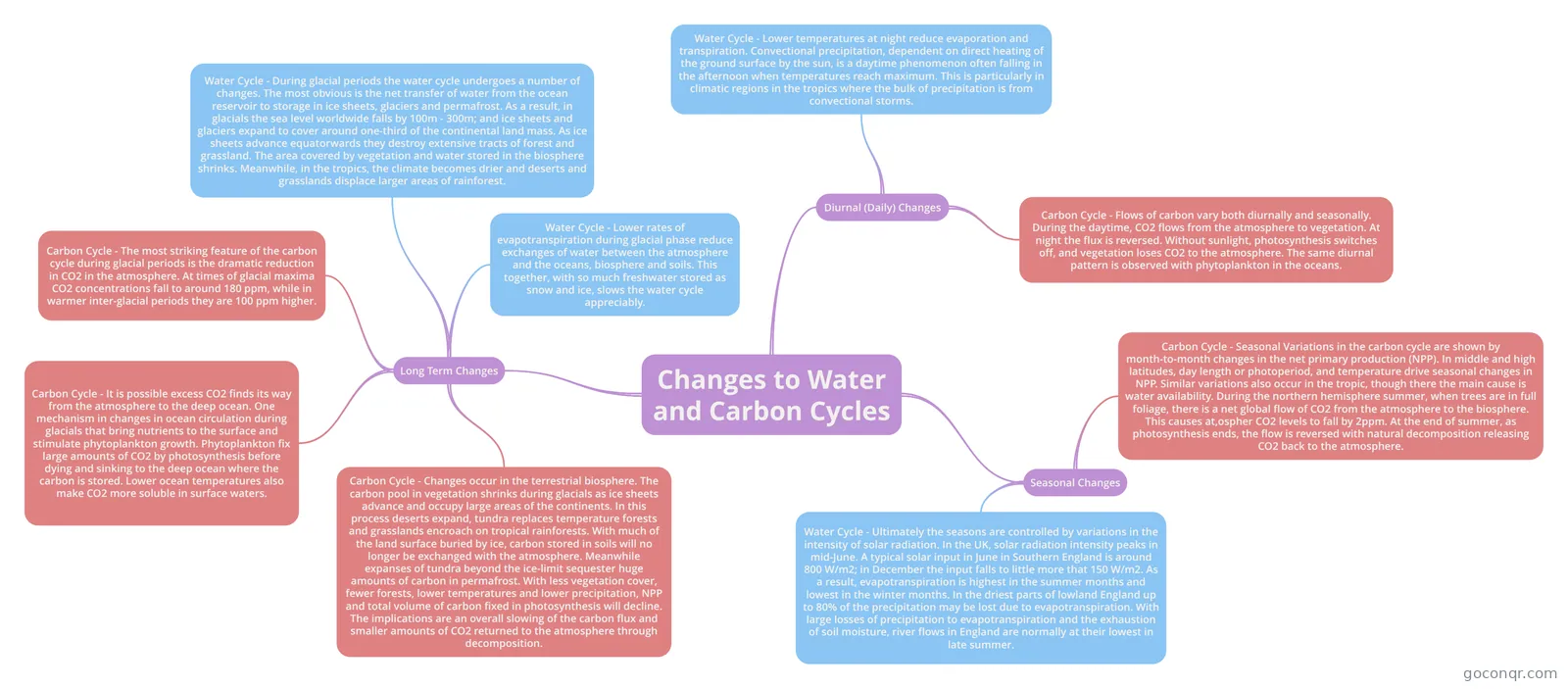
Mind map: Changes to Water and Carbon Cycles
Inhalt der Mindmap
Changes to Water and Carbon Cycles
Long Term Changes
- Water Cycle - During glacial periods the water cycle undergoes a number of changes. The most obvious is the net transfer of water from the ocean reservoir to storage in ice sheets, glaciers and permafrost. As a result, in glacials the sea level worldwide falls by 100m - 300m; and ice sheets and glaciers expand to cover around one-third of the continental land mass. As ice sheets advance equatorwards they destroy extensive tracts of forest and grassland. The area covered by vegetation and water stored in the biosphere shrinks. Meanwhile, in the tropics, the climate becomes drier and deserts and grasslands displace larger areas of rainforest.
- Water Cycle - Lower rates of evapotranspiration during glacial phase reduce exchanges of water between the atmosphere and the oceans, biosphere and soils. This together, with so much freshwater stored as snow and ice, slows the water cycle appreciably.
- Carbon Cycle - The most striking feature of the carbon cycle during glacial periods is the dramatic reduction in CO2 in the atmosphere. At times of glacial maxima CO2 concentrations fall to around 180 ppm, while in warmer inter-glacial periods they are 100 ppm higher.
- Carbon Cycle - It is possible excess CO2 finds its way from the atmosphere to the deep ocean. One mechanism in changes in ocean circulation during glacials that bring nutrients to the surface and stimulate phytoplankton growth. Phytoplankton fix large amounts of CO2 by photosynthesis before dying and sinking to the deep ocean where the carbon is stored. Lower ocean temperatures also make CO2 more soluble in surface waters.
- Carbon Cycle - Changes occur in the terrestrial biosphere. The carbon pool in vegetation shrinks during glacials as ice sheets advance and occupy large areas of the continents. In this process deserts expand, tundra replaces temperature forests and grasslands encroach on tropical rainforests. With much of the land surface buried by ice, carbon stored in soils will no longer be exchanged with the atmosphere. Meanwhile expanses of tundra beyond the ice-limit sequester huge amounts of carbon in permafrost. With less vegetation cover, fewer forests, lower temperatures and lower precipitation, NPP and total volume of carbon fixed in photosynthesis will decline. The implications are an overall slowing of the carbon flux and smaller amounts of CO2 returned to the atmosphere through decomposition.
Diurnal (Daily) Changes
- Water Cycle - Lower temperatures at night reduce evaporation and transpiration. Convectional precipitation, dependent on direct heating of the ground surface by the sun, is a daytime phenomenon often falling in the afternoon when temperatures reach maximum. This is particularly in climatic regions in the tropics where the bulk of precipitation is from convectional storms.
- Carbon Cycle - Flows of carbon vary both diurnally and seasonally. During the daytime, CO2 flows from the atmosphere to vegetation. At night the flux is reversed. Without sunlight, photosynthesis switches off, and vegetation loses CO2 to the atmosphere. The same diurnal pattern is observed with phytoplankton in the oceans.
Seasonal Changes
- Water Cycle - Ultimately the seasons are controlled by variations in the intensity of solar radiation. In the UK, solar radiation intensity peaks in mid-June. A typical solar input in June in Southern England is around 800 W/m2; in December the input falls to little more that 150 W/m2. As a result, evapotranspiration is highest in the summer months and lowest in the winter months. In the driest parts of lowland England up to 80% of the precipitation may be lost due to evapotranspiration. With large losses of precipitation to evapotranspiration and the exhaustion of soil moisture, river flows in England are normally at their lowest in late summer.
- Carbon Cycle - Seasonal Variations in the carbon cycle are shown by month-to-month changes in the net primary production (NPP). In middle and high latitudes, day length or photoperiod, and temperature drive seasonal changes in NPP. Similar variations also occur in the tropic, though there the main cause is water availability. During the northern hemisphere summer, when trees are in full foliage, there is a net global flow of CO2 from the atmosphere to the biosphere. This causes at,ospher CO2 levels to fall by 2ppm. At the end of summer, as photosynthesis ends, the flow is reversed with natural decomposition releasing CO2 back to the atmosphere.
Informationen
- Beschreibung
- A level Geography Mindmap am Changes to Water and Carbon Cycles, erstellt von Lily Anderson am 13/06/2017.
- Erstellt von
- Lily Anderson
- Aufrufe
- 2
- Verlauf
-
- Erstellt von Lily Anderson · 13 Jun 2017
- Kopiert von Lily Anderson · 13 Jun 2017
- Bewertung
Mehr zu Human Impacts on Biogeochemical Cycles