
Mindmap
The Asian Century
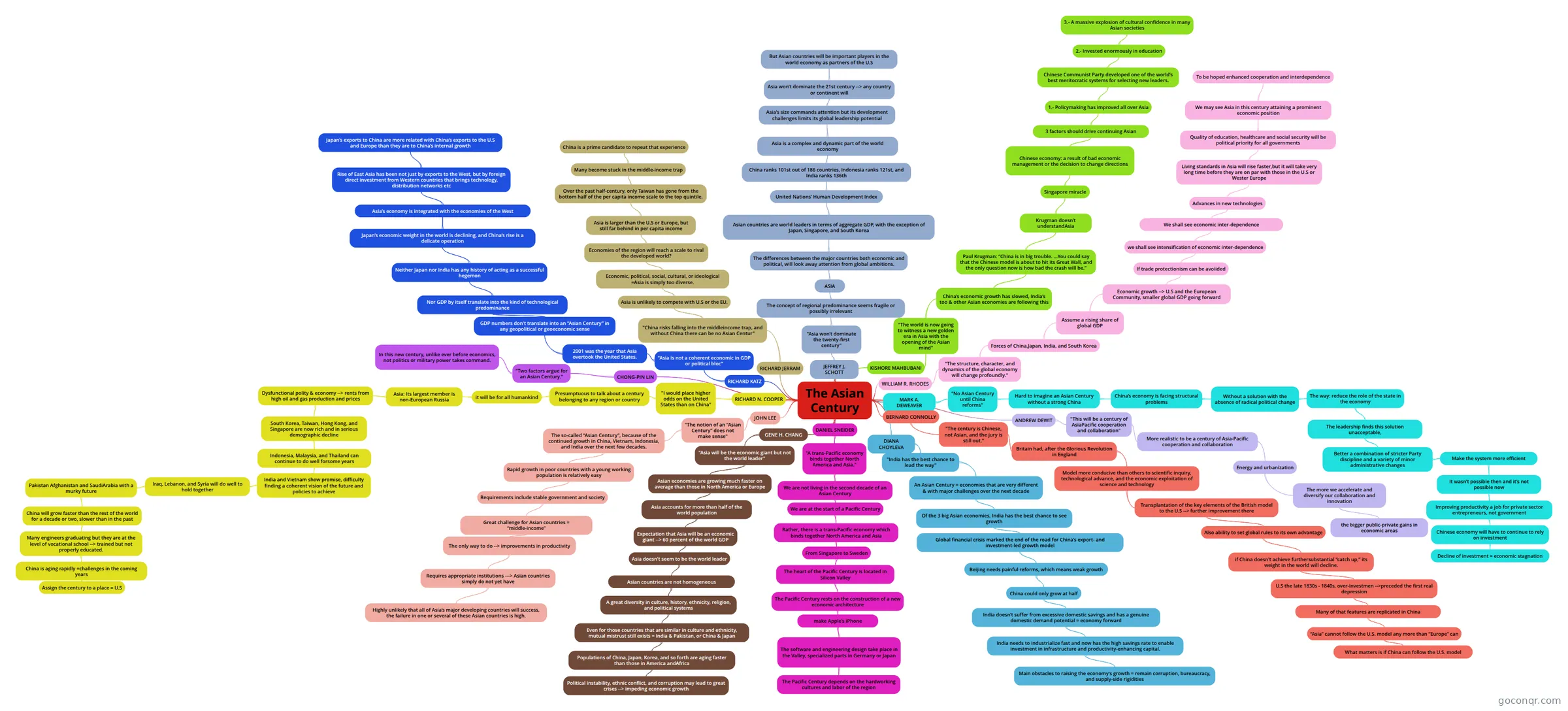
Mind map: The Asian Century
Inhalt der Mindmap
The Asian Century
JEFFREY J. SCHOTT
- "Asia won’t dominate the twenty-first century"
- The concept of regional predominance seems fragile or possibly irrelevant
- ASIA
- The differences between the major countries both economic and political, will look away attention from global ambitions.
- Asian countries are world leaders in terms of aggregate GDP, with the exception of Japan, Singapore, and South Korea
- United Nations’ Human Development Index
- China ranks 101st out of 186 countries, Indonesia ranks 121st, and India ranks 136th
- Asia is a complex and dynamic part of the world economy
- Asia's size commands attention but its development challenges limits its global leadership potential
- Asia won’t dominate the 21st century --> any country or continent will
- But Asian countries will be important players in the world economy as partners of the U.S
- Asia won’t dominate the 21st century --> any country or continent will
- Asia's size commands attention but its development challenges limits its global leadership potential
- Asia is a complex and dynamic part of the world economy
- China ranks 101st out of 186 countries, Indonesia ranks 121st, and India ranks 136th
- United Nations’ Human Development Index
- Asian countries are world leaders in terms of aggregate GDP, with the exception of Japan, Singapore, and South Korea
- The differences between the major countries both economic and political, will look away attention from global ambitions.
- ASIA
- The concept of regional predominance seems fragile or possibly irrelevant
- "Asia won’t dominate the twenty-first century"
CHONG-PIN LIN
- "Two factors argue for an Asian Century."
- In this new century, unlike ever before economics, not politics or military power takes command.
- "Two factors argue for an Asian Century."
DANIEL SNEIDER
- "A trans-Pacific economy binds together North America and Asia."
- We are not living in the second decade of an Asian Century
- We are at the start of a Pacific Century
- Rather, there is a trans-Pacific economy which binds together North America and Asia
- From Singapore to Sweden
- The heart of the Pacific Century is located in Silicon Valley
- The Pacific Century rests on the construction of a new economic architecture
- make Apple’s iPhone
- The software and engineering design take place in the Valley, specialized parts in Germany or Japan
- The Pacific Century depends on the hardworking cultures and labor of the region
- The software and engineering design take place in the Valley, specialized parts in Germany or Japan
- make Apple’s iPhone
- The Pacific Century rests on the construction of a new economic architecture
- The heart of the Pacific Century is located in Silicon Valley
- From Singapore to Sweden
- Rather, there is a trans-Pacific economy which binds together North America and Asia
- We are at the start of a Pacific Century
- We are not living in the second decade of an Asian Century
- "A trans-Pacific economy binds together North America and Asia."
MARK A. DEWEAVER
- "No Asian Century until China reforms"
- Hard to imagine an Asian Century without a strong China
- China’s economy is facing structural problems
- Without a solution with the absence of radical political change
- The way: reduce the role of the state in the economy
- The leadership finds this solution unacceptable,
- Better a combination of stricter Party discipline and a variety of minor administrative changes
- Make the system more efficient
- It wasn’t possible then and it’s not possible now
- Improving productivity a job for private sector entrepreneurs, not government
- Chinese economy will have to continue to rely on investment
- Decline of investment = economic stagnation
- Chinese economy will have to continue to rely on investment
- Improving productivity a job for private sector entrepreneurs, not government
- It wasn’t possible then and it’s not possible now
- Make the system more efficient
- Better a combination of stricter Party discipline and a variety of minor administrative changes
- The leadership finds this solution unacceptable,
- The way: reduce the role of the state in the economy
- Without a solution with the absence of radical political change
- China’s economy is facing structural problems
- Hard to imagine an Asian Century without a strong China
- "No Asian Century until China reforms"
RICHARD N. COOPER
- "I would place higher odds on the United States than on China"
- Presumptuous to talk about a century belonging to any region or country
- it will be for all humankind
- Asia: Its largest member is non-European Russia
- Dysfunctional polity & economy --> rents from high oil and gas production and prices
- South Korea, Taiwan, Hong Kong, and Singapore are now rich and in serious demographic decline
- Indonesia, Malaysia, and Thailand can continue to do well forsome years
- India and Vietnam show promise, difficulty finding a coherent vision of the future and policies to achieve
- Iraq, Lebanon, and Syria will do well to hold together
- Pakistan Afghanistan and SaudiArabia with a murky future
- China will grow faster than the rest of the world for a decade or two, slower than in the past
- Many engineers graduating but they are at the level of vocational school --> trained but not properly educated.
- China is aging rapidly =challenges in the coming years
- Assign the century to a place = U.S
- China is aging rapidly =challenges in the coming years
- Many engineers graduating but they are at the level of vocational school --> trained but not properly educated.
- China will grow faster than the rest of the world for a decade or two, slower than in the past
- Pakistan Afghanistan and SaudiArabia with a murky future
- Iraq, Lebanon, and Syria will do well to hold together
- India and Vietnam show promise, difficulty finding a coherent vision of the future and policies to achieve
- Indonesia, Malaysia, and Thailand can continue to do well forsome years
- South Korea, Taiwan, Hong Kong, and Singapore are now rich and in serious demographic decline
- Dysfunctional polity & economy --> rents from high oil and gas production and prices
- Asia: Its largest member is non-European Russia
- it will be for all humankind
- Presumptuous to talk about a century belonging to any region or country
- "I would place higher odds on the United States than on China"
KISHORE MAHBUBANI
- "The world is now going to witness a new golden era in Asia with the opening of the Asian mind"
- China’s economic growth has slowed, India’s too & other Asian economies are following this
- Paul Krugman: “China is in big trouble. …You could say that the Chinese model is about to hit its Great Wall, and the only question now is how bad the crash will be.”
- Krugman doesn’t understandAsia
- Singapore miracle
- Chinese economy: a result of bad economic management or the decision to change directions
- 3 factors should drive continuing Asian
- 1.- Policymaking has improved all over Asia
- Chinese Communist Party developed one of the world’s best meritocratic systems for selecting new leaders.
- 2.- Invested enormously in education
- 3.- A massive explosion of cultural confidence in many Asian societies
- 2.- Invested enormously in education
- Chinese Communist Party developed one of the world’s best meritocratic systems for selecting new leaders.
- 1.- Policymaking has improved all over Asia
- 3 factors should drive continuing Asian
- Chinese economy: a result of bad economic management or the decision to change directions
- Singapore miracle
- Krugman doesn’t understandAsia
- Paul Krugman: “China is in big trouble. …You could say that the Chinese model is about to hit its Great Wall, and the only question now is how bad the crash will be.”
- China’s economic growth has slowed, India’s too & other Asian economies are following this
- "The world is now going to witness a new golden era in Asia with the opening of the Asian mind"
RICHARD JERRAM
- "China risks falling into the middleincome trap, and without China there can be no Asian Centur"
- Asia is unlikely to compete with U.S or the EU.
- Economic, political, social, cultural, or ideological =Asia is simply too diverse.
- Economies of the region will reach a scale to rival the developed world?
- Asia is larger than the U.S or Europe, but still far behind in per capita income
- Over the past half-century, only Taiwan has gone from the bottom half of the per capita income scale to the top quintile.
- Many become stuck in the middle-income trap
- China is a prime candidate to repeat that experience
- Many become stuck in the middle-income trap
- Over the past half-century, only Taiwan has gone from the bottom half of the per capita income scale to the top quintile.
- Asia is larger than the U.S or Europe, but still far behind in per capita income
- Economies of the region will reach a scale to rival the developed world?
- Economic, political, social, cultural, or ideological =Asia is simply too diverse.
- Asia is unlikely to compete with U.S or the EU.
- "China risks falling into the middleincome trap, and without China there can be no Asian Centur"
WILLIAM R. RHODES
- "The structure, character, and dynamics of the global economy will change profoundly."
- Forces of China,Japan, India, and South Korea
- Assume a rising share of global GDP
- Economic growth --> U.S and the European Community, smaller global GDP going forward
- If trade protectionism can be avoiided
- we shall see intensification of economic inter-dependence
- We shall see economic inter-dependence
- Advances in new technologies
- Living standards in Asia will rise faster,but it will take very long time before they are on par with those in the U.S or Wester Europe
- Quality of education, healthcare and social security will be political priority for all governments
- We may see Asia in this century attaining a prominent economic position
- To be hoped enhanced cooperation and interdependence
- We may see Asia in this century attaining a prominent economic position
- Quality of education, healthcare and social security will be political priority for all governments
- Living standards in Asia will rise faster,but it will take very long time before they are on par with those in the U.S or Wester Europe
- Advances in new technologies
- We shall see economic inter-dependence
- we shall see intensification of economic inter-dependence
- If trade protectionism can be avoiided
- Economic growth --> U.S and the European Community, smaller global GDP going forward
- Assume a rising share of global GDP
- Forces of China,Japan, India, and South Korea
- "The structure, character, and dynamics of the global economy will change profoundly."
RICHARD KATZ
- "Asia is not a coherent economic in GDP or political bloc"
- 2001 was the year that Asia overtook the United States.
- GDP numbers don't translate into an “Asian Century” in any geopolitical or geoeconomic sense
- Nor GDP by itself translate into the kind of technological predominance
- Neither Japan nor India has any history of acting as a successful hegemon
- Japan’s economic weight in the world is declining, and China’s rise is a delicate operation
- Asia’s economy is integrated with the economies of the West
- Rise of East Asia has been not just by exports to the West, but by foreign direct investment from Western countries that brings technology, distribution networks etc
- Japan’s exports to China are more related with China’s exports to the U.S and Europe than they are to China’s internal growth
- Rise of East Asia has been not just by exports to the West, but by foreign direct investment from Western countries that brings technology, distribution networks etc
- Asia’s economy is integrated with the economies of the West
- Japan’s economic weight in the world is declining, and China’s rise is a delicate operation
- Neither Japan nor India has any history of acting as a successful hegemon
- Nor GDP by itself translate into the kind of technological predominance
- GDP numbers don't translate into an “Asian Century” in any geopolitical or geoeconomic sense
- 2001 was the year that Asia overtook the United States.
- "Asia is not a coherent economic in GDP or political bloc"
BERNARD CONNOLLY
- "The century is Chinese, not Asian, and the jury is still out."
- Britain had, after the Glorious Revolution in England
- Model more conducive than others to scientific inquiry, technological advance, and the economic exploitation of science and technology
- Transplantation of the key elements of the British model to the U.S --> further improvement there
- Also ability to set global rules to its own advantage
- if China doesn't achieve furthersubstantial “catch up,” its weight in the world will decline.
- U.S the late 1830s - 1840s, over-investmen -->preceded the first real depression
- Many of that features are replicated in China
- “Asia” cannot follow the U.S. model any more than “Europe” can
- What matters is if China can follow the U.S. model
- “Asia” cannot follow the U.S. model any more than “Europe” can
- Many of that features are replicated in China
- U.S the late 1830s - 1840s, over-investmen -->preceded the first real depression
- if China doesn't achieve furthersubstantial “catch up,” its weight in the world will decline.
- Also ability to set global rules to its own advantage
- Transplantation of the key elements of the British model to the U.S --> further improvement there
- Model more conducive than others to scientific inquiry, technological advance, and the economic exploitation of science and technology
- Britain had, after the Glorious Revolution in England
- "The century is Chinese, not Asian, and the jury is still out."
ANDREW DEWIT
- "This will be a century of AsiaPacific cooperation and collaboration"
- More realistic to be a century of Asia-Pacific cooperation and collaboration
- Energy and urbanization
- The more we accelerate and diversify our collaboration and innovation
- the bigger public-private gains in economic areas
- The more we accelerate and diversify our collaboration and innovation
- Energy and urbanization
- More realistic to be a century of Asia-Pacific cooperation and collaboration
- "This will be a century of AsiaPacific cooperation and collaboration"
DIANA CHOYLEVA
- "India has the best chance to lead the way"
- An Asian Century = economies that are very different & with major challenges over the next decade
- Of the 3 big Asian economies, India has the best chance to see growth
- Global financial crisis marked the end of the road for China’s export- and investment-led growth model
- Beijing needs painful reforms, which means weak growth
- China could only grow at half
- India doesn’t suffer from excessive domestic savings and has a genuine domestic demand potential = economy forward
- India needs to industrialize fast and now has the high savings rate to enable investment in infrastructure and productivity-enhancing capital.
- Main obstacles to raising the economy’s growth = remain corruption, bureaucracy, and supply-side rigidities
- India needs to industrialize fast and now has the high savings rate to enable investment in infrastructure and productivity-enhancing capital.
- India doesn’t suffer from excessive domestic savings and has a genuine domestic demand potential = economy forward
- China could only grow at half
- Beijing needs painful reforms, which means weak growth
- Global financial crisis marked the end of the road for China’s export- and investment-led growth model
- Of the 3 big Asian economies, India has the best chance to see growth
- An Asian Century = economies that are very different & with major challenges over the next decade
- "India has the best chance to lead the way"
GENE H. CHANG
- "Asia will be the economic giant but not the world leader"
- Asian economies are growing much faster on average than those in North America or Europe
- Asia accounts for more than half of the world population
- Expectation that Asia will be an economic giant --> 60 percent of the world GDP
- Asia doesn't seem to be the world leader
- Asian countries are not homogeneous
- A great diversity in culture, history, ethnicity, religion, and political systems
- Even for those countries that are similar in culture and ethnicity, mutual mistrust still exists = India & Pakistan, or China & Japan
- Populations of China, Japan, Korea, and so forth are aging faster than those in America andAfrica
- Political instability, ethnic conflict, and corruption may lead to great crises --> impeding economic growth
- Populations of China, Japan, Korea, and so forth are aging faster than those in America andAfrica
- Even for those countries that are similar in culture and ethnicity, mutual mistrust still exists = India & Pakistan, or China & Japan
- A great diversity in culture, history, ethnicity, religion, and political systems
- Asian countries are not homogeneous
- Asia doesn't seem to be the world leader
- Expectation that Asia will be an economic giant --> 60 percent of the world GDP
- Asia accounts for more than half of the world population
- Asian economies are growing much faster on average than those in North America or Europe
- "Asia will be the economic giant but not the world leader"
JOHN LEE
- "The notion of an “Asian Century” does not make sense"
- The so-called “Asian Century”, because of the continued growth in China, Vietnam, Indonesia, and India over the next few decades.
- Rapid growth in poor countries with a young working population is relatively easy
- Requirements include stable government and society
- Great challenge for Asian countries = “middle-income”
- The only way to do --> improvements in productivity
- Requires appropriate institutions ---> Asian countries simply do not yet have
- Highly unlikely that all of Asia’s major developing countries will success, the failure in one or several of these Asian countries is high.
- Requires appropriate institutions ---> Asian countries simply do not yet have
- The only way to do --> improvements in productivity
- Great challenge for Asian countries = “middle-income”
- Requirements include stable government and society
- Rapid growth in poor countries with a young working population is relatively easy
- The so-called “Asian Century”, because of the continued growth in China, Vietnam, Indonesia, and India over the next few decades.
- "The notion of an “Asian Century” does not make sense"
Informationen
- Beschreibung
- Mindmap am The Asian Century, erstellt von Ana Carolina Solana am 12/08/2017.
- Erstellt von
- Ana Carolina Solana
- Aufrufe
- 0
- Bewertung