
Notizen
Landforms Created by Rivers
Inhalt der Notizen (1)
Seite 1
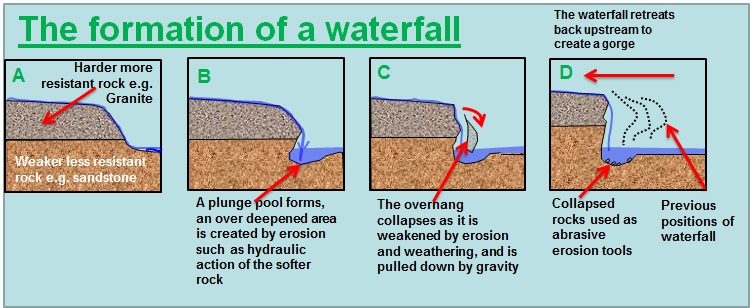
Waterfalls occur when there is a sudden interruption in the course of a river
These interruptions may be the result of earth movements, sea level changes or a change in rock type
In the case of a waterfall forming as a result of a change in rock type, the river will have met a band of softer, less resistant rock after flowing over a band of relatively hard, resistant rock
The river flows over the hard resistant rock and cascades into the plunge pool below
The plunge pool is deepened and widened through the process of hydraulic action
Splashes created as the river hits the water in the plunge pool erode the soft rock at the back of the waterfall through the process of hydraulic action
The erosion of the soft rock at the base of the waterfall means that the harder rock on top is undercut
This means that an overhang of hard rock is left unsupported
The weight of the river on the top layer of hard rock will put stress on the overhang
As a result, the overhang will eventually collapse
As the overhang falls into the plunge pool, rocks will collide with other rocks
They will break up into smaller pieces in the process known as attrition
Some of these smaller pieces of rock will ricochet into the back of the waterfall dislodging any loose material and eroding it further, this process is known as abrasion
The entire process is likely to be repeated several times causing the waterfall to retreat upstream
A deep sided gorge is left as a result of the waterfall retreating back towards its source
The Niagara Falls on the border of Canada/America are retreating by approximately one metre a year
As a river approaches its mouth, it usually flows over flatter land and develops increasingly large bends known as meanders
At this stage in its journey the river is eroding the landscape laterally
When the water reaches a meander most of the water is directed towards the outside of the bend
This increases the velocity and depth of the water at this point
The river therefore has more energy to transport material in suspension
This material will erode the outside of the bank through the process of abrasion
The bank will be undercut and a river cliff will form
Meanwhile, as there is less water on the inside of the bend, there is a decrease in velocity and depth
As the river loses energy, it begins to deposit some of its load
The deposited material builds up to form a gently sloping slip-off slop
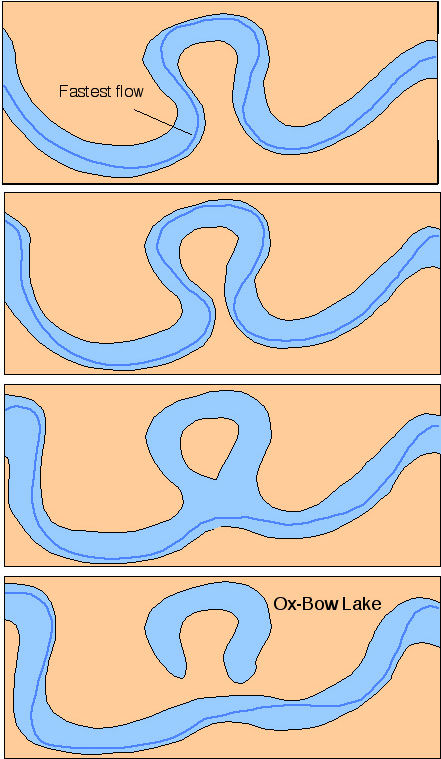
Continual erosion on the outside of the bend results in the neck of the meander getting wider until, during a flood, the river cuts completely through the neck
This means a separate channel is formed
The majority of the water will now flow through the new channel as it is the most direct way of reaching the sea
However, some water will continue to take the old route
As less water is now travelling around the meander, it has less energy and so more deposition will occur
In particular, deposition will occur at entrances to the old bend
The deposited material will form a bar
Over time the material will block off the old meander so no more water can enter it
The deposited material will be slowly colonised as plants will begin to grow and new land will eventually form
The original meander will remain in the landscape as a crescent shaped area of water known as an ox-bow lake
This lake will eventually dry up except during periods of heavy rain
Waterfalls
Ox-Bow Lakes
Informationen
- Beschreibung
- GCSE Geography (Rivers) Notiz am Landforms Created by Rivers, erstellt von rosetinley am 10/11/2013.
- Erstellt von
- rosetinley
- Aufrufe
- 512
- Tags
- Bewertung