
Notizen
Topic 6B: Language
Inhalt der Notizen (3)
Seite 1
Theories of Language Development:
Learning/behaviorist theory: proposed by B. F. Skinner, states children learn language by observing and imitating what they see, and this is reinforced by adult responses. Proposes that brain structures can grow as a result of external experiences
Nativist theory: proposed by Noam Chomsky, states language has innate properties and does not require teaching or reinforcement. Language acquisition in children occurs similarly across cultures.
proposes that infants have an innate neurological construct, the language acquisition device (LAD), which allows children to quickly learn language from the speech they hear daily
Initially Chomsky stated language was unique to humans but this was later disproved
Supported by children finding ways to communicate despite speaking different languages
Assimilation and accommodation: proposed by Piaget, states children use assimilation and accommodation to learn language
Assimilation: the ability to change one’s environment to put information into a pre-existing schema
Accommodation: process of changing one’s schema to adapt to a new environment
he believed children must create schemas in their mind 1st and mentally develop before being able to learn language
Interactionist: based on social interaction theory, posits that language I acquired and perfected through interactions with fluent speakers
Seite 2
influence of language on cognition:
children tend to start speaking around the same age cross culturally and experience a vocabulary spurt ~1-2 years of age.
Bilingual children tend to have greater analytical ability, selective attention, and cognitive flexibility, but slower language-processing speed as compared to monolingual children
overextension: a mistake children make while assigning meaning to words, where a categorical definition is applied to a larger group than it can or should describe (kitty to describe a lion)
children begin to learn language ~4 months, and continue to learn until age ~9
Language can alter how one interacts with the world
linguistic relativity: interaction of language and cognition
Sapir-Whorf hypothesis: grammatical structure of a person’s language influences their world perception
Has been abandoned, not much experimental support ---> their theory would suggest that speakers of languages with less words for different colors would perceive colors differently than other humans, however science has shown color perception is a biological and physical process
Cognitive-behavioral therapy: discusses the interplay between emotion, behavior, language, and thought
Internal dialogue, as a form of language can influence our daily life
Cognitive distortions: problems with internal dialogue that can lead to negative behaviors or serious emotional problems
Behavioral economics: studies the effects of psychological and cognitive factors on individuals’ behavior in an economic context
The more vividly an event is described, the more likely people will belie it is true; people will make different choices based on the language used to describe a situation
“critical period”: hypothesis that states the optimal time to learn a language that exists in children and if a child is not exposed to that language in early stages of life, that person will never have full intuitive command of that language
Supported by study of Genie, a child that due to abuse and neglect, grew up as a “feral child” and never learned language, and then was never able to completely learn it later in life
Seite 3
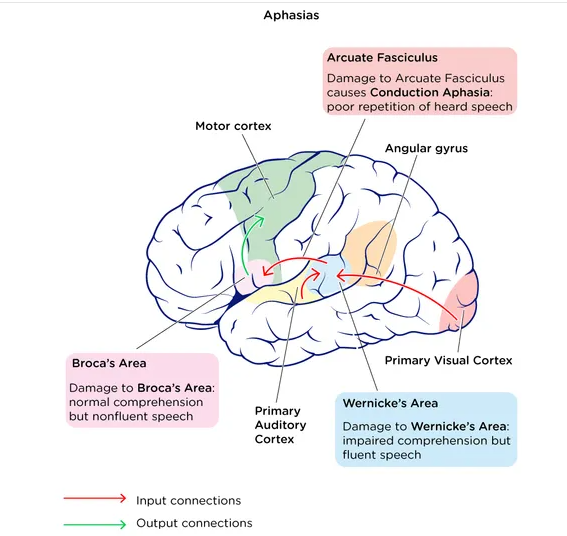
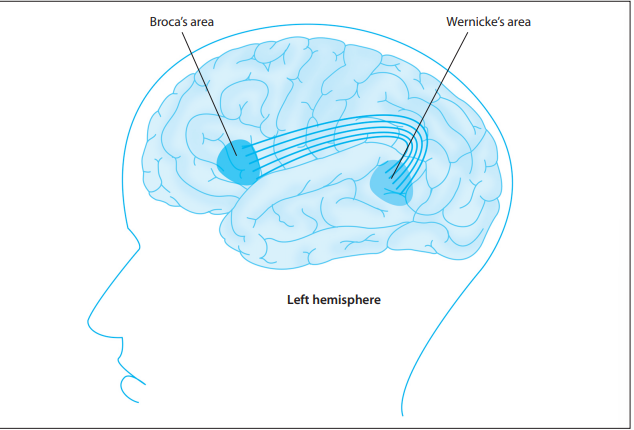
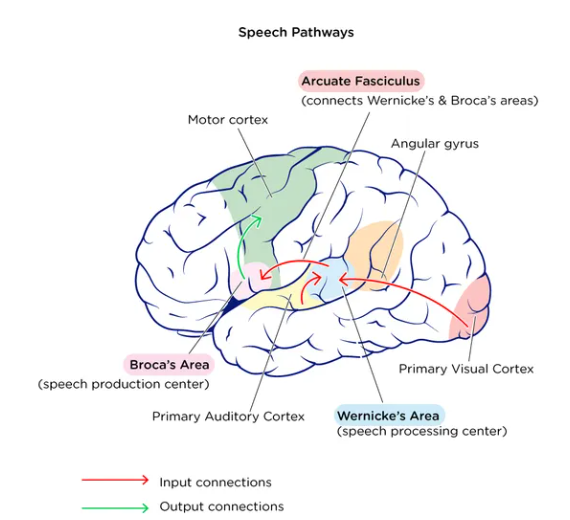
Brain areas that control language and speech:
aphasia: a disorder where there is loss of the ability to speak or understand language due to damage or injury of brain areas specific to language processing and production
multiple areas of the brain must function together for a person to use language
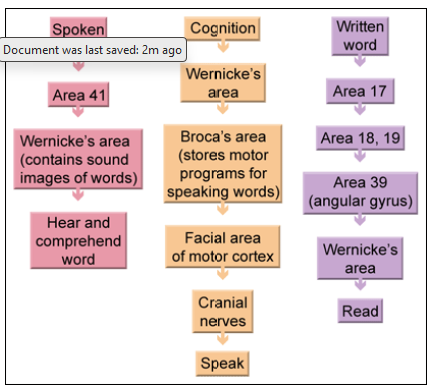
Broca’s area: in the L frontal lobe, responsible for speech production and language comprehension
if this area was damaged, the person would have productive aphasia ---> understand language but would have trouble producing the words to response
Wernicke’s area: located in the cerebral cortex, responsible for understanding written and spoken language
if this area was damaged, person would have receptive aphasia ---> produce words but they would not make sense together and also that person would have trouble understanding speech
Other areas of the brain involved in language processes:
Angular gyrus: in parietal lobe, responsible for number processing, spatial recognition, and attention
Primary auditory cortex: identifies loudness and pitch of sounds
Informationen
- Beschreibung
- Notiz am Topic 6B: Language, erstellt von 000 000 am 12/09/2022.
- Erstellt von
- 000 000
- Aufrufe
- 0
- Bewertung