
Notizen
Science Exam Study Notes
Inhalt der Notizen (1)
Seite 1
Recipe Book of the Universe
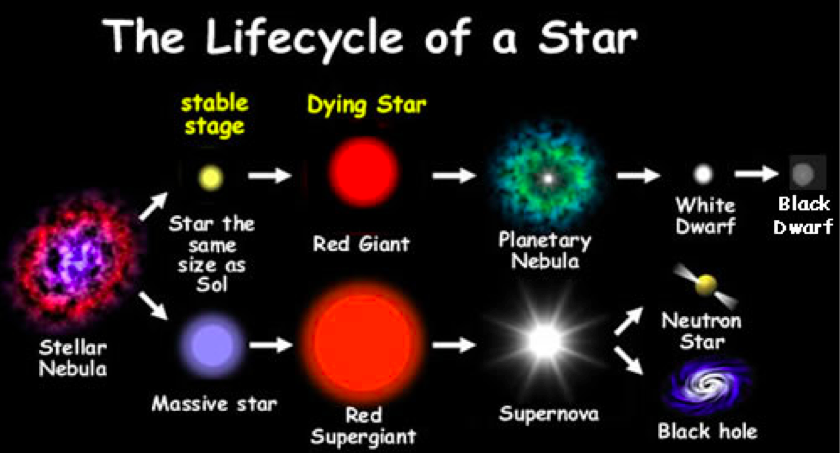
Life Cycle of a Star
All stars start off as a stellar nebula, however the size of the star determines which path it would follow.
A start the same size as the sun (or Sol) would
Formation of Elements
Structure of Atoms
Protons
Located in the nucleus (center of an atom)
Positive charge
Number of protons identify type of atom (atomic number, it’s a whole number)
Protons have a mass of about 1 amu (atomic mass unit)
Neutrons
Found in the nucleus (it holds the nucleus together)
Neutral (which means it has no charge)
Same mass as proton (1 amu)
Electrons
Found on the outside of the nucleus
Has a negative charge (of -1)
Virtually no mass (but still has some)
They’re in constant motion in the space around the nucleus
There is no distinct outer surface to a electron
An atom has no electric charge overall. It is neutral. This is because an atom has the same number of protons as electrons. So the number of positive charges is the same as the number of negative charges.
Atomic Number
The atomic number = number of protons in one atom of that element.
Mass Number
Mass Number = the number of protons + the number of neutrons in an atom
Trends in the Periodic Table
The periodic tabl
Hypothesis, Theories and Laws
Hypothesis
A hypothesis is an educated guess, based on previous observations. Usually, a hypothesis can be supported or refuted through experimentation or more observation.
Hypothesis are created for experiments (i.e. Cleaning effectiveness is not determined by which detergent you use.)
Once a hypothesis has been tested through observation and experiments and evidence gathered to support that hypothesis, it can be made into a THEORY.
Theory
A scientific theory summarizes a hypothesis or group of hypotheses that have been supported with repeated testing through experiments or observations.
Basically, if enough evidence accumulates to support a hypothesis, then the hypothesis can become accepted as a good explanation of a phenomenon. One definition of a theory is to say it's an accepted hypothesis.
Law
A scientific theory summarizes a hypothesis or group of hypotheses that have been supported with repeated testing through experiments or observations.
Scientific laws describe things, but they do not explain them. One way to tell a law and a theory apart is to that a theory will try to explain ‘why’ but a law will not.
Example - The Law of Reflection.
“The angle of incidence is equal to the angle of reflection”. It does not try to explain why this is the case, just that it is.
History of the Atomic Model
History of the Periodic Table
Informationen
- Beschreibung
- Notiz am Science Exam Study Notes , erstellt von Courtney Wong am 22/10/2017.
- Erstellt von
- Courtney Wong
- Aufrufe
- 0
- Bewertung