
Notizen
The 5 Steps to Exam Success

Inhalt der Notizen (1)
Seite 1
The road to achieving
successful exam results may seem like a long and arduous one for most of us.
However, you shouldn't be discouraged from the journey, so long as you take it one
step at a time.
Follow this guide on how to prepare and keep focused on the journey ahead. If you do, you will reap the rewards of successful exam
results and break down the journey into manageable paths.
A word of advice from the
outset though; achieving good exam results should never be your only
motivation, you must discover your own motivations. While getting straight A’s
feels great and is a tremendous achievement you should have your own goals you
wish to achieve by successfully completing your exams. This underlying
motivation is personal to each of us but once you discovered this knowledge it
will guide you through the rough and dark parts of your journey.
While it may seem slightly
hyperbolic to compare exams with a perilous and adventurous journey there are a
lot of similarities, especially if you ever want to make it to the end!
Preparation is key, having the motivation and energy to get up and go—even when
it seems impossible—are essential and most importantly of all, you always need
to have one eye on the prize; the end goal, the destination, the exam!
Adopting such a mindset
will not only make the humdrum business of studying more exciting but will
allow you to celebrate the small victories along the way.
Many people will tell you
they find it hard to sit down and study; this may feel true but it’s not!
Everyone has the capability to study and absorb information; what we all can
suffer from, however, is a lack of motivation. This guide will give you tips on
how to implement study practices that help keep you motivated and help you
succeed!

Step One: Define
Before you start any
journey you need a destination and a map! Exams are no different. Most of you
will know roughly, if not exactly, when your exams will be on. Whether you’re
preparing for a mid-term test or an end of year exam, you should always know
what it is you are preparing for. However, it is not simply when they are that
is important. Before you even begin contemplating studying you should consider
what you want to achieve.
Do you want straight A’s?
Who doesn't right? But you may be setting yourself up for failure! Set
yourself realistic goals; if you got a C last year in English, aim for a B this
year. Realistically assess your strengths and weaknesses, you may have a
natural aptitude and interest in one or more subjects but dread others. It may
be easier to start studying your favourite subjects more often but you should
ask yourself if such a strategy is productive. If you need to improve your
grades in your least favourite subjects you should spend more time with these.
Before you start studying
write out a simple plan of the grades you want to achieve by the end of the
year[1].
A classic tool to help you
define your goals is to use a S.M.A.R.T.
plan. This refers to:
Specific:
This means your goals are
clearly defined, they aren't ambiguous. A good example would be: By the end of
the year I want to achieve an A. A bad example would be: I want to be satisfied
with my results.
Measurable:
Having clearly defined
goals means that you know when you have accomplished them. In the above
examples, you will know if you got an A or not, however whether you are
satisfied with the results might be open to debate. The importance of having
your goals measurable is so that you know when things are going right and can
celebrate your victories but also, crucially, you know when you have under-achieved
and can become aware that you need to change your strategy and/or work harder.
Attainable:
A goal can be well defined
and measurable but there is little point in doing so if you know you can never
achieve it. If you failed a class last year, don’t aim for an A this year. Your
ambition should be lauded but in the long run, if you see you aren’t making as
much progress as you’d like, you will be become disheartened and this will
negatively affect your motivation and study skills.
Relevant:
The goals you set yourself
must hold meaning. There is little point in taking the time to set yourself a
goal if its accomplishment means nothing.
Timely:
For most of you, having
the end goal of your exams coming up will mean your goals will have a context
of time. This is an important element of any goal as it provides an impetus for
action and means you know how much work is needed each day in order to achieve
your goals.
When planning the most
important thing to do is be honest and realistic with yourself.
Adopting such a plan
throughout your study, on a subject by subject basis, will aid you greatly but
having a thorough understanding of your ‘big’ or ‘broader’ goals—the goals that
traverse your subjects-- from the outset will help you contextualize every
action taken thereafter. It will give you a barometer to measure your actions
against and you will know if what you’re doing is in line with your goals or
not. Following this approach will give
you the roadmap that will guide you on your journey and will be an important
tool in keeping you motivated.
[1]
Or whenever you have set your
‘destination’ for. Also, take account of any minimum course requirements you
may need to achieve.

Step Two: Organise
Now that you have your
overall plan mapped out, you need to get supplies and prepare yourself for the
journey ahead! Three basic tips to get you started:
Never underestimate the benefits of a well-stocked stationary
drawer, having all the necessary tools to hand will save you a lot of time and
make your study more efficient.
It’s also important to have a proper filing
system in place! Knowing where everything is can save you countless hours over
the year.
Most importantly, having all the content you need at your fingertips
reduces frustration, makes you more productive and, of course, keeps you
motivated!
Another crucial aspect of
your study journey is planning. Creating a study plan and sticking to it is the
No. 1 tip for successful exam results. Unlike your S.M.A.R.T. plans your study
planner or timetable should be more specific and detail what you will do on a
daily basis, topic by topic, subject by subject. When you’re creating your
timetable though, make sure you include free time for relaxation and your
social life. You should also keep it somewhat flexible to ensure that if, for
example, you miss a day because you’re sick you can make it up at a later date.
The benefits of creating a
study planner are numerous:
Your study immediately becomes more productive as
you know exactly what you should be doing, when you should be doing it and how
long it will take you. You will get a better return on investment than if you
simply opened a book and started to study a topic. You become more productive
and your study is of a higher quality- it’s a win-win.
There are also numerous
psychological benefits of implementing your timetable before you start your
arduous journey:
You don’t panic, waking up in the middle of the night with the
dreaded exam fear, because you feel on top of things.
You know what you’ve done
and what you need to do and, importantly, you know when you need to have it
done by. So long as you stick to your timetable you can sleep easy.
This ease
of mind means you become more confident in how you approach your study.
You
won’t feel guilty about spending time with friends or watching TV as you know
that you covered you’re allotted study requirements.
A side note, some people find a study planner
too restrictive and as such abandon the whole concept all together. You
shouldn’t do this; if you don’t like timetables give yourself a number of hours
for each day. If you study more one day you can take it away from another day
and vice versa if you want to finish early one day you can make it up the next.
Such an approach could be very beneficial for some types of studiers. What’s
important though is that you have some kind of plan in place.
Another useful tip is to
use exams as stepping stones. This is especially prevalent for mid-term exams.
You should use these exams as a barometer of the progress you are making. You
shouldn’t be discouraged if that C isn’t yet a B but you should at least be
maintaining and hopefully progressing. If this isn’t the case you need to
re-evaluate your study patterns.
Getting organised is the
final step before you actually put your foot out the door and take to the road.
If you have followed the first two steps you will be well on your way to exam
success and reaching your destination.

Step Three: Create
When it comes down to
actually studying you shouldn’t just sit there reading your text book from
beginning to end. You should always be in the process of creating a study resource;
something you can return to again and revise later. This could be a summary
sheet, a note, a flashcard deck, a mindmap, acronyms or any number of other
tools that help you study.
When you’re in class,
taking notes can be very beneficial. However, depending on what type of learner
you are, you may approach things differently. Some people like to take down
what the teacher/lecturer says word for word, some put it in their own language
and some simply prefer to listen[1].
You should know which style suits you best as this will help your study
patterns.
When reading from a text
you shouldn’t read passively. You should be actively engaged; highlighting
keywords and phrases, making notes in the margins and taking down notes in your
own words. Doing these simple tasks will greatly improve your retention of the
topic covered. It is better to cover 5 pages actively then to passively read a
whole chapter. You’ll get more out of it in the long run.
Also, a tip on
highlighting: you shouldn’t highlight more than one sentence per paragraph as
if you highlight too much, it becomes meaningless—only highlight the most
important parts.
If you can put notes into
your own words this shows that you have fully understood the concepts. This
will help you when it comes to revising it as it is easier to recall something
written in your own language.
Flashcards are perfect for
memorizing vocab lists, definitions or formulas and can be used for a myriad of
other topics.
Mindmaps can be used for
representing your notes visually but also for brainstorming and planning sample
essay-style answers. Simply have each node represent one paragraph and include
all the pertinent information in nodes off that.
Mnemonic devices are an
easy way of learning of lists. A famous example is ‘Richard Of York Gave Battle
In Vain’ which gives the first letter of each colour of rainbow: Red, Orange,
Yellow, Green, Blue, Indigo, Violet.
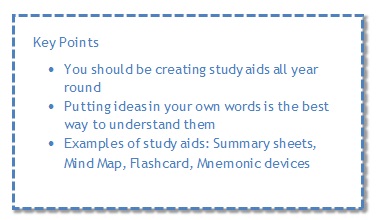
Although it may seem easier
and more productive to use materials from teachers/lecturers and other
professionals, creating your own study resources so that they are written in your words,
and have your emphasis on what is important, will be an immense help when it
comes to studying and revising them later on and closer to the exam date.
Keeping on top of your
creation of study aids as you engage with new content on a daily basis in class
will mean less study in the long run and more productive study over time. This
can only lead to better results and greater motivation.
Creating different study
aids as you go along is the equivalent of putting one foot in front of the
other as you travel along the road. It’s not glamorous but it is what gets you
from A to B… or hopefully in this instance B to A![2]
[1]
These learners may wish to
invest in a Dictaphone to help them recall classes/lecturers.
[2] Too corny?

Step Four: Study
In truth you have already
started studying when you sat down to create your study resources. However, what I mean
by study in this context is different from the creation aspects. Creation is
something that should be happening all year round; after every class, every
week you should be compiling study resources. When it comes to study though you are
more focused on preparing for your exams as opposed to documenting what you
covered in class.
You should be going back
over the study resources you created from week 1. Study consists of taking the
content you have learned in class and applying it to an exam context. So, you
frame the content in the style of your exams. If all your exams are multiple
choice, then practice using that format! If your exams are essay style then
practice these. There are numerous ways to prepare for each style of exam. You
should practice as much as possible.
For short questions or multiple
choice style exams your focus should be on memorization.
For essay style answers
you should focus on making connections; focus on the topics that are likely to
come up and have a store of facts and quotes and ideas that you can apply to
differing contexts.
You don’t need to know
everything and you shouldn't panic if you can’t master a topic in its entirety.
You may be able to cover 80% of the course work but find mastering that last
20% takes as much time as the 80% that went before; this is quite common! If
you have numerous subjects or are covering numerous topics it may be best to
quit while you’re ahead and move on instead of expending so much energy on
trying to master that final bit of content. You have to think of the big
picture.
A good tip for exam
strategy is that it may be possible to disregard certain topics so long as you
cover other ones. This may sound dangerous but it is actually studying smarter.
It’s very important though, that you always give yourself options. If you know
you have to answer on three topics then study at least five. The question on
the day could be awkwardly phrased and might throw you so you should have
options.
You should prioritise your
subject topics in order of how capable you are at each and plan from there.
Everyone will have a weakness in a subject so you should try and strategise so
that you can give your best answers. This may not always be possible but where
it is, focus on your strengths and bolster your weaknesses enough so that they
don’t impact on your overall score.
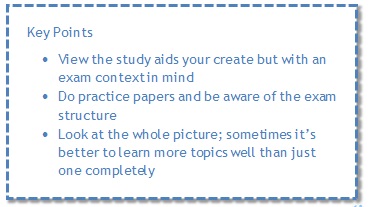
Practice papers are key to
good study. If you’re lucky enough to have example past papers for your exams
then these should be your first port of call. If you don’t have any past papers
to go on, then don’t hesitate to ask your teacher for example questions or for
the structure of the exam. Having these facts is paramount when preparing for
exams.
When you start studying
you can see your destination on the horizon. It’s still a long way away but
it’s closer than ever before! You shouldn’t look at the approaching Exam with
trepidation you should greet it happily as the traveler would be invigorated by
the sight of their destination.

Step Five: Success
So, you've planned, created
and studied to get to this point, the exams are upon you! When exam time is
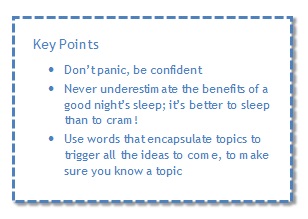
looming the stress may build. It’s very important to keep calm in this stage;
not to cram. If you have followed the other steps then you should be well prepared
to maintain a steady pace. You may wish to ramp up your timetable hours closer
to your exams but you should always have time to relax, do what you want to do
and don’t be afraid to socialise too!
The importance of sleep is
also something I wish to emphasize when exams are approaching. Getting enough
sleep is always an issue but the closers the exams the greater the temptation
there is to stay up late and study. You should fight this urge as much as
possible! 7 to 9 hours a night is the average and teenagers need the most sleep
out of all age groups; so make sure you’re getting enough. Been well rested
will give you a solid bedrock that will sustain you throughout the day and make
your revision more fruitful. It will also keep your stress levels down which in
turn will maintain your motivation.
Likewise with diet, it’s
an old one but Breakfast really is the most important meal of the day. Without
it your concentration levels will plummet and your revision will suffer.
By the time your exams
have come you should be able to use a number of ‘trigger’ words. These are
words that encapsulate a whole topic or area, when you come across them they
should trigger a whole host of different ideas to unfurl in your head without
the use of any study resources. When this occurs naturally you know you have covered
a topic enough and that you’re prepared for your exams.
At this point you are at
the foot of the hill, the final hurdle you need to surmount before you have
reached your destination. You shouldn’t rush to the finish line only to tire
yourself out before you get there, maintain the same steady pace, keep your
motivation high and be confident in the fact that you can reach your goal.

Homeward Bound
On the day of the exam
very little should have changed in your routine, you should be :
Be well rested,
Be well fed,
Be well prepared!
Have all the necessary stationary.
Plan to be at
least a half hour early as this will reduce any stress you may have and will prevent
you from being late which could upset all the hard work you put in.
If you do
find you are stressed or are panicking take a few deep breaths to calm yourself
down. You should rest easy in the knowledge that you have prepared yourself,
step by step, for this, the final stop, on your journey to exam success.



If you enjoyed this guide you might also like:
6 Tips to Make
Your Study Goals Last All Year!
Study Goals:
Planning for Exam Success
The Top 40 Most
Hilariously Wrong Exam Answers
How to Stop
Procrastination: 4 Tips to Help You Study
6 Tips on How to Create
an Online Mind Map with ExamTime
How to Get the
Most Out of Your Learning Style
View a Flashcard deck of study tips , click here
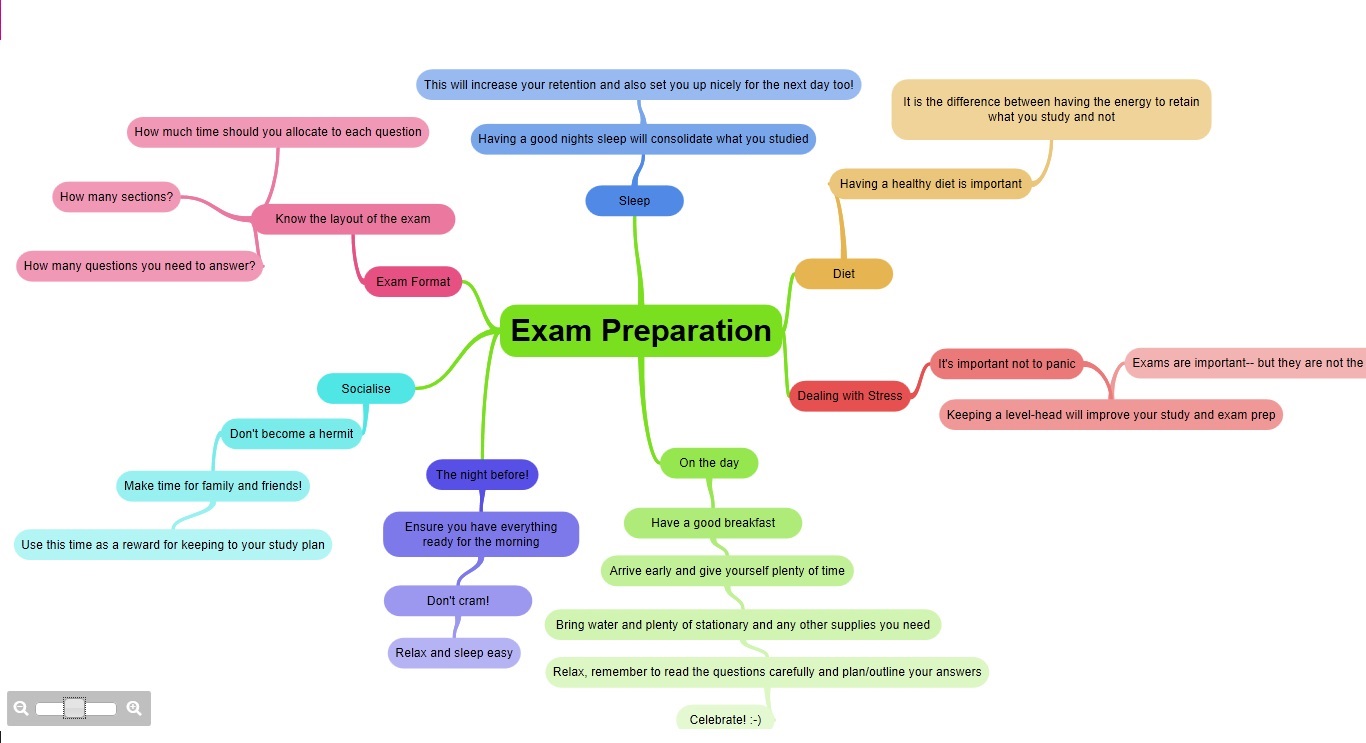
Click here for full-screen, interactive Mind Map on Exam Preparation

The Journey Ahead
Step One: Define
Step Two: Organise
Step Three: Create
Step Four: Study
Step Five: Success
Homeward Bound
More ExamTime Resources
Informationen
- Beschreibung
- Notiz am The 5 Steps to Exam Success, erstellt von examtime.user am 02/10/2013.
- Erstellt von
- examtime.user
- Aufrufe
- 1.777
- Verlauf
-
- Erstellt von PatrickNoonan · 2 Okt 2013
- Kopiert von examtime.user · 2 Okt 2013
- Bewertung