
Notizen
Advanced - Reading
Inhalt der Notizen (7)
Seite 1
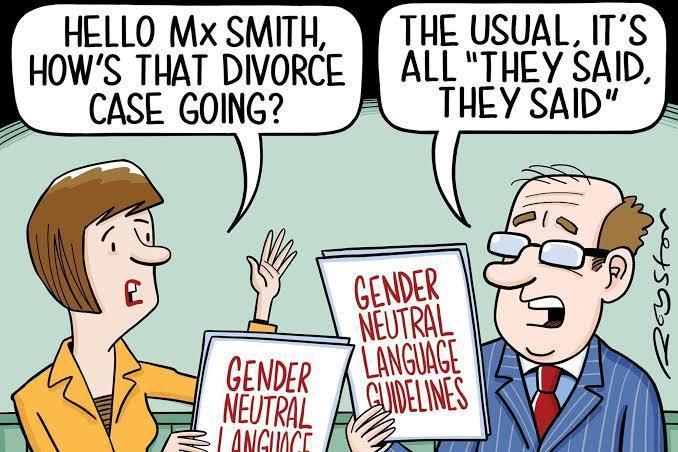
A guide to how gender-neutral language is developing around the world
Original article
Published at: Dec 15, 2019 | 10:30 am
Source: click to check it out
What pronoun do you use to identify yourself? He? She? They? Something altogether different? It’s a question asked increasingly often as acceptance of a spectrum of gender and sexual identities grows. Some languages, like Chinese and Persian, don’t assign nouns a gender or already have a gender-neutral form for people built in. But in languages whose grammar is traditionally based on exclusively male or female options, the answer to this question can still require an explanation.
So how do you talk about being queer or non-binary or gender nonconforming in grammatically gendered languages? In many ways, in fact. In recent years, LGBTQ activists and linguists around the world have championed more inclusive language, both by creating entirely new non-binary terms and by retooling already existing words and grammar constructions. It’s not always easy. For some people, it can be hard, scary or simply tiresome to keep explaining why they need more inclusive language. And it can be dangerous: Just in the United States, hate crimes against the LGBTQ community have been rising the last three years, according to the FBI.
English grammar doesn’t distinguish between genders except in assigning a masculine or feminine singular pronoun.
In 2019 the Merriam-Webster dictionary added “they” as the pronoun to use for a “single person whose gender identity is nonbinary.” Two years prior, in 2017, “they” as a gender-neutral form was added to the Associated Press Stylebook, the gold standard of sorts for journalists. The Washington Post, meanwhile, made the style guide change in 2015.
Critics of the change have argued that “they” as both singular and plural can be confusing and muddy a sentence’s syntax. Shakespeare and Jane Austen, among many other famed English writers, didn’t think so. They used singular “they” and “their,” as was the standard in English until Victorian-era grammarians shifted course and imposed “he” above all.
Source: Gender-neutral language
1. Gender-neutral language is language that avoids bias towards a particular sex or social gender. Read the gendered titles of professions below and write the gender-neutral title.
a) policeman:
b) actress:
c) stewardess:
d) fireman:
e) barman:
f) saleswoman:
g) businessman:
Seite 2
How the Loss of the Landline Is Changing Family Life
Original article
Published at: Dec 12, 2019 | 10:30 am
Source: click to check it out
How the Loss of the Landline Is Changing Family Life
The shared phone was a space of spontaneous connection for the entire household.
By Julia Cho
My tween will never know the sound of me calling her name from another room after the phone rings. She'll never sit on our kitchen floor, refrigerator humming in the background, twisting a cord around her finger while talking to her best friend. I'll get it, He's not here right now, and It's for you are all phrases that are on their way out of the modern domestic vernacular. According to the federal government, the majority of American homes now use cellphones exclusively. “We don't even have a landline anymore,” people began to say proudly as the new millennium progressed. But this came with a quieter, secondary loss—the loss of the shared social space of the family landline.
“The shared family phone served as an anchor for home,” says Luke Fernandez, a visiting computer-science professor at Weber State University and a co-author of Bored, Lonely, Angry, Stupid: Feelings About Technology, From the Telegraph to Twitter. “Home is where you could be reached, and where you needed to go to pick up your messages.” With smartphones, Fernandez says, “we have gained mobility and privacy. But the value of the home has been diminished, as has its capacity to guide and monitor family behavior and perhaps bind families more closely together.”
The home telephone was a communal invention from the outset. After the advent of the telephone, in the late 19th century, and through the mid-20th century, callers relied on switchboard operators who knew their customers’ voices, party lines were shared by neighbors (who would often eavesdrop on one another's conversations), and phone books functioned as a sort of map of a community.
The early telephone’s bulky size and fixed location in the home made a phone call an occasion—often referred to in early advertisements as a “visit” by the person initiating the call. There was phone furniture—wooden vanities that housed phones in hallways of homes, and benches built for the speaker to sit on so they could give their full attention to the call. Even as people were defying time and space by speaking with someone miles away, they were firmly grounded in the space of the home, where the phone was attached to the wall.
Over the course of the 20th century, phones grew smaller, easier to use, and therefore less mystical and remarkable in their household presence. And with the spread of cordless phones in the 1980s, calls became more private. But even then, when making a call to another household’s landline, you never knew who would pick up. For those of us who grew up with a shared family phone, calling friends usually meant first speaking with their parents, and answering calls meant speaking with any number of our parents’ acquaintances on a regular basis. With practice, I was capable of addressing everyone from a telemarketer to my mother's boss to my older brother's friend—not to mention any relative who happened to call. Beyond developing conversational skills, the family phone asked its users to be patient and participate in one another’s lives.
Cellphones, which came on the market in the ’80s and gained popularity in the ’90s, rendered all of this obsolete as they displaced landlines. When kids today call “home,” they may actually be calling one parent and bypassing the other; friends and bosses and telemarketers (if they get through) usually reach exactly the person they are hoping to speak with. Who will be on the other end of the line is no longer a mystery.
What’s more, the calls, texts, and emails that pass through cellphones (and computers and tablets) can now be kept private from family members. “It keeps everybody separate in their own little techno-cocoons,” says Larry Rosen, a retired psychology professor at California State University at Dominguez Hills and a co-author of The Distracted Mind: Ancient Brains in a High-Tech World. Whereas early landlines united family members gathered in a single room, cellphones now silo them.
Cheryl Muller, a 59-year-old artist living in Brooklyn, raised her two sons, now 30 and 27, during the transition from landline to cellphone. “I do remember the shift from calling out ‘It's for you,’ and being aware of their friends calling, and then asking them what the call was about, to pretty much … silence,” she says. Caroline Coleman, 54, a writer in New York City whose children grew up during the same transition, recalls how at age 10 her son got a call from a man with a deep voice. “I was horrified. I asked who it was—and it was his first classmate whose voice had changed,” she said. “When you get cells, you lose that connection.”
These days, this dynamic is also often reversed. A shared family phone meant that kids overheard some of their parents’ conversations, providing a window into their relationships, but today, children frequently see a parent silently staring at a screen, fingers tapping, occasionally furrowing a brow or chuckling. “Sometimes there are people that I've never even heard of that you're texting,” my 11-year old once told me. Sherry Turkle, a professor at MIT and the author of Reclaiming Conversation: The Power of Talk in a Digital Age, has described this as “the new silences of family life.”
Central to the smartphone’s pull is the fact that it is not just a phone. The original telephone was designed exclusively for the back-and-forth rhythm of speaking and listening, while today’s phones perform that function and so many others. “When it was just a phone, you could only have one conversation at a time,” says Mary Ellen Love, a teacher in New Jersey who raised two sons—22 and 24—during the landline era, and is now raising an 11-year-old daughter named Grace. “Now Grace can look at [her phone] and be involved in five conversations in a second.”
“Nobody had separation-anxiety issues when they walked out of the house without their [landline] phone,” says Catherine Steiner-Adair, a clinical psychologist and a co-author of The Big Disconnect: Protecting Childhood and Family Relationships in the Digital Age. “Nobody used to say that their princess phone was their life. It's not your phone—it's the news, it's YouTube, it's your bank account, it's shopping … You can engage in every aspect of your life, and some of that is wonderful.”
Meanwhile, the physical medium of communication has shifted from telephone poles, visually linking individual homes, to the elusive air. The environment of each call has shifted from a living room or a kitchen to anywhere, and as a result, callers spend time placing each other: In the early days of the phone, they often asked, “Are you there?,” but now they have graduated to “Where are you?” When people look up after whiling away time in their virtual homes—their homepages, their home screens—they must adjust back to their physical surroundings. “You don't lose yourself in the same way when you're talking on the phone on the wall,” says Steiner-Adair. “You don't lose your sense of where you are in time and space.”
Plenty of people don’t lament the passing of the family phone. Michael Muller, the 27-year-old son of Cheryl, the artist in Brooklyn, says he enjoys the constant proximity of a cellphone and prefers texting over calling, which he says people only use when they want to “extract an answer.” “Text is so much easier to take as much time as you want to think about it,” he told me. If he has kids, he’s not sure he’ll get a landline for his family to share.
Even as the family phone recedes into history a century and a half later, we can preserve the togetherness it promoted in other ways. Rosen, the psychology professor, says that “creating special family time is really critical,” and Turkle writes of the importance of device-free “sacred” spaces in the home. The family phone was hardly a necessary ingredient for family bonding.
And perhaps the spirit of the family phone can live on. Margaret Klein, an educational researcher living in New Jersey and a mother of three girls, ages 6, 9, and 11, has tried to ease into giving her daughters their own phones. Her girls share a stripped-down cellphone with no internet access, and call it “the family phone.” When her oldest went to a ballet program in Manhattan this summer, she brought it. Klein’s 9-year-old has used it a few times to text her camp friends. But “it always goes back and lives in its place at the end of the day,” she tells me—right next to their landline in the living room.
Indeed, even as smartphones have taken over, some people stand by their landlines. “I mainly want to keep it because it works when there is no power,” says Peter Eavis, a New York City–based journalist in his 50s and a father of two. “And as a veteran of 9/11, an actual NYC blackout, Hurricane Irene, and Superstorm Sandy, it gives me comfort.”
But Eavis’s landline is on its way to being an anomaly, and a generation of children who never had one are coming of age. Eventually, for those who enjoyed—or at least grew accustomed to—the sound of a communal phone ringing in their homes, a moment of silence will be in order.
Source: How the Loss of the Landline Is Changing Family Life
1. Complete the sentences below with words from the text. Tip: They're in blue!
a) A phone that is connected to the phone system by wires is a ...
b) To ... is to listen to someone's private conversation without them knowing.
c) A child between the ages of approximately eight and twelve is a ...
d) To ... is to separate something or someone from other things or people.
Seite 3
Cellphone-related face injuries on the rise, study shows
Original article
Published at: Dec 05, 2019 | 22:30 pm
Source: click to check it out
Cellphone-related face injuries on the rise, study shows
By Louis Casiano | Fox News
You may want to put down the cellphone and switch to the speaker. A study led by a facial plastic surgeon and published Thursday in the JAMA Otolaryngology journal found a spike in face injuries from cellphones. One case included a woman who broke her nose when she dropped her cellphone on her face.
Dr. Boris Paskhover of Rutgers New Jersey Medical School said he looked over 20 years of research data and found an increase in injuries beginning in 2006, when smartphones initially hit the market.
"Cellphone-related injuries to the head and neck have increased steeply over the recent 20-year period, with many cases resulting from distraction," the report concluded. "Although the disposition of most cases is simple, some injuries bear a risk of long-term complications."
Researchers estimated 76,000 people incurred cellphone-related injuries from 1998 to 2017. The study involved cases collected from emergency-room visits from around 100 hospitals. Around 2,000 injuries occurred annually until 2006, when smartphones became popular. The injuries were mostly minor -- facial cuts, bruises and fractures as a result of careless users. Many were caused by people texting while walking, tripping and landing face-down on the sidewalk.
Other injuries included people getting hit by phones thrown at them. Forty percent of those injured were ages 13 to 29, the report said. "I love my smartphone," Paskhover said, adding that people needed to be careful not to get distracted. "People wouldn’t walk around reading a magazine."
Source: Cellphone-related face injuries on the rise
1.Read the sentences and choose the appropriate answer.
a) "A study led by a facial plastic surgeon and published Thursday in the JAMA Otolaryngology journal found a spike in face injuries from cellphones". What does spike mean?
Answer: A very high amount, price, or levelA very low amount, price, or level
A very high amount, price, or level
A very low amount, price, or level
b) "Cellphone-related injuries to the head and neck have increased steeply over the recent 20-year period". What does this mean?
Answer:The number is bigger nowThe number is smaller now
The number is bigger now
The number is smaller now
Seite 4
Cyberattack Spreads in Asia, Though No 'Second Wave' Is Seen
Original article
Published at: May 15, 2017 | 10:30 am
Source: click to check it out
Read the text, and then answer the questions.
(1) HONG KONG — A global cyberattack spread to thousands of additional computers on Monday as workers logged in at the start of a new workweek.
(2) Universities, hospitals, businesses and daily life were disrupted, but no catastrophic breakdowns were reported. In Europe, where the cyberattack first emerged, officials said it appeared that a much-feared second wave — based on copycat variants of the original malicious software — had not yet materialized.
(3) The new disruptions were most apparent in Asia, where many workers had already left on Friday when the attack broke out. China alone reported disruptions at nearly 40,000 organizations, including about 4,000 academic institutions, figures that experts say are most likely to be low estimates, given the prevalence of pirated software there.
(4) The list of affected institutions includes two of China’s most prestigious institutions of higher education, Tsinghua and Peking Universities; a movie theater chain in South Korea; and blue-chip companies in Japan like Hitachi and Nissan, which emphasized that their business operations had not been impaired.
(5) The cyberattack has afflicted 200,000 computers in more than 150 countries. Transmitted by email, the malicious software, or malware, locks users out of their computers, threatening to destroy data if a ransom is not paid.
(6) The so-called ransomware continued to ripple through politics and markets on Monday. Russia’s president, Vladimir V. Putin, blamed the United States, noting that the malicious software used in the attack had originally been developed by the National Security Agency. (It was then stolen and released by an elite hacking group known as the Shadow Brokers.)
(7) On Monday morning, 11 technology companies in China, mostly dealing in internet security, suspended trading after their stocks rose 10 percent, the daily limit. Shares in European cybersecurity firms gained in early trading on Monday, as investors appeared to target companies that would benefit from increased attention on keeping data, networks and computers secure.
(8) On Chinese social media, students reported being locked out of final papers, while other people said that A.T.M.s, some government offices and the payment systems at gas stations had been affected. Talk of how to avoid the virus was widespread on the messaging app WeChat over the weekend.
(9) Securities and banking regulators issued warnings to businesses and financial institutions to audit their networks before bringing computers online to limit damage from the intrusion. The securities regulator also said that it had taken down its network and was installing a patch as a security measure.
(10) The state-run oil company, PetroChina, confirmed that the attack had disrupted the electronic payment capabilities at many of its gas stations over the weekend. By Sunday, 80 percent of its stations were functioning normally again, it said.
(11) The spread of the malware has focused attention on why a software patch issued by Microsoft in March had not been installed by more users. Microsoft has complained for years that a large majority of computers running its software in China were using pirated versions.
...
Read the full article at www.nytimes.com

Seite 5
Eight go mad in Arizona: how a lockdown experiment went horribly wrong
Original article
Published at: Jul 13, 2020 | 10:30 am
Source: click to check it out
By Steve Rose
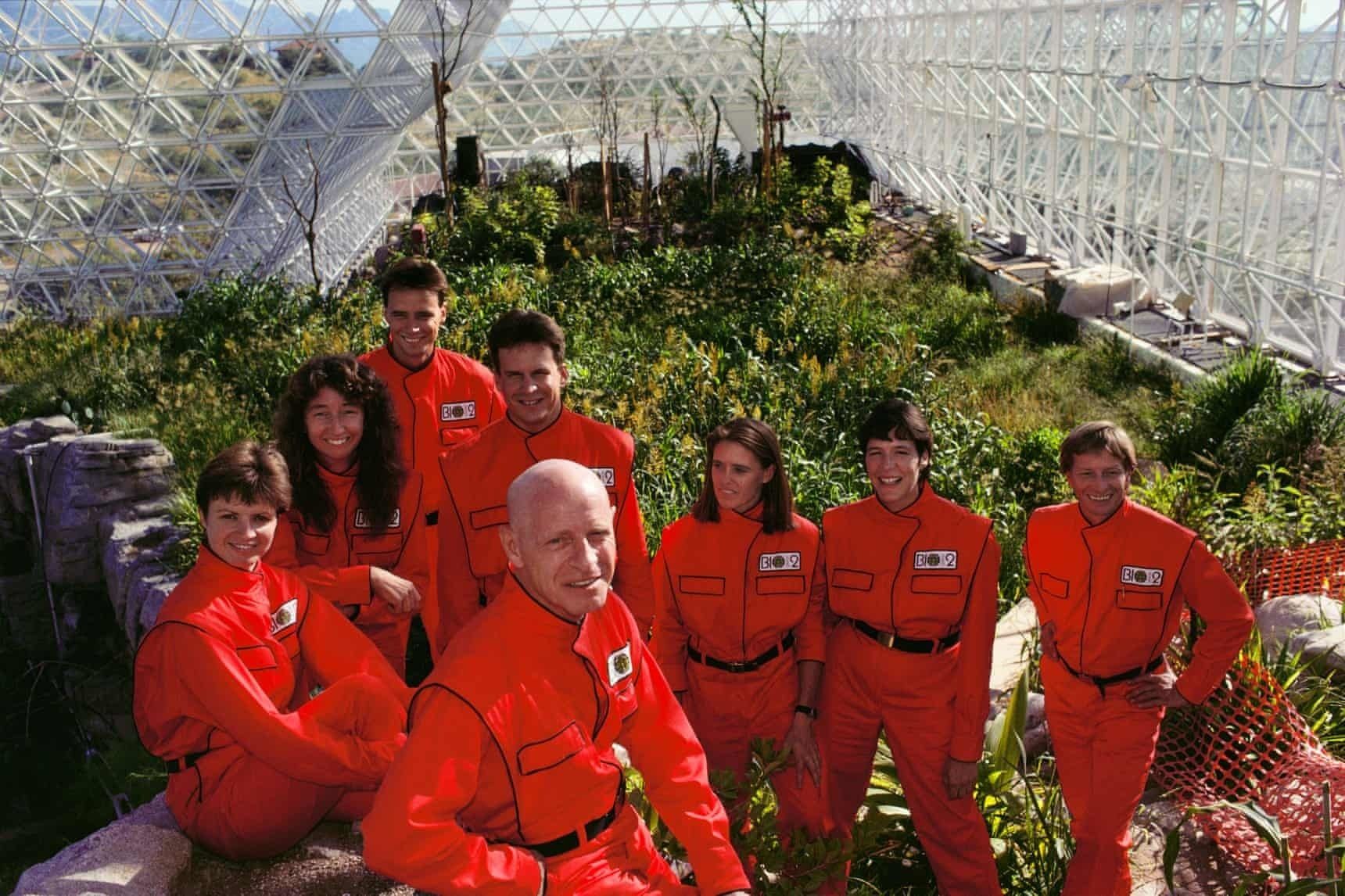
It sounds like a sci-fi movie, or the weirdest series of Big Brother ever. Eight volunteers wearing snazzy red jumpsuits seal themselves into a hi-tech glasshouse that’s meant to perfectly replicate Earth’s ecosystems. They end up starving, gasping for air and at each other’s throats – while the world’s media looks on.
But the Biosphere 2 experiment really did happen. Running from 1991 to 1993, it is remembered as a failure, if it is remembered at all – a hubristic, pseudo-scientific experiment that was never going to accomplish its mission. However, as the new documentary Spaceship Earth shows, the escapade is a cautionary tale, now that the outside world – Biosphere 1, if you prefer – is itself coming to resemble an apocalyptic sci-fi world. Looking back, it’s amazing that Biosphere 2 even happened at all, not least because the people behind it started out as a hippy theatre group.
“Just the fact that the same number of people came out as went in is a triumph,” says Mark Nelson, one of the original eight “biospherians”. Far from a failure, he regards Biosphere 2 as an unsung achievement in human exploration, as do many others. “I like to say we built it not because we had the answers. We built it to find out what we didn’t know.”
Biosphere 2’s origins lie in late-1960s San Francisco, and a man named John P Allen. Already in his 40s by then, Allen was something of a renaissance man: a Harvard graduate, a metallurgist, a union organiser, a beat poet, and a traveller studying indigenous cultures. He founded an idealistic performance group called the Theatre of All Possibilities. As the name suggests, they wanted to change the world but weren’t sure where to start. Art? Business? Ecology? Technology? In classic counterculture fashion, they decided: “Let’s do all of it!”
They didn’t actually know how to do any of it, save for staging somewhat freeform performances, but “learn by doing” was Allen’s philosophy – and it took them surprisingly far. In 1969, Allen’s troupe relocated to New Mexico and founded Synergia Ranch, named after the great architect Richard Buckminster Fuller’s concept of synergy, where the whole is greater than the sum of its parts.
“He was a ball of energy,” says Nelson, who joined Allen’s troupe around that time, when he was 22. “He had a great feel for both ecology and theatre. And frankly, he was a very charismatic guy. We’d accomplish one thing, then say, ‘What’s the new challenge?’ He was forever upping the ante.”
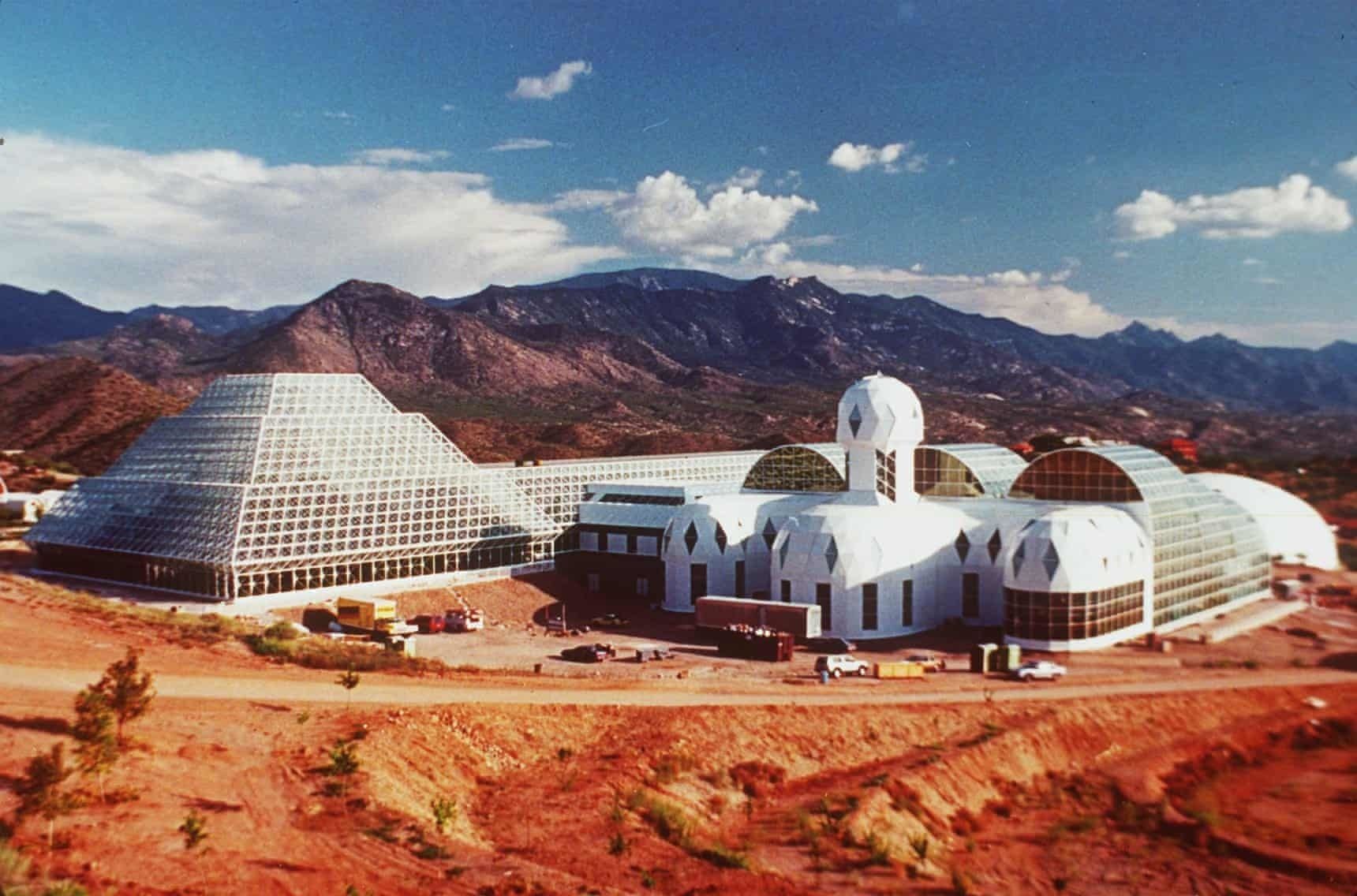
The Biosphere 2 launch was staged like a space mission. The media descended on the $150m Arizona facility, all gleaming white panels and ziggurats of glass, filled with forests, deserts, laboratories, recycling systems, pigs, chickens, hummingbirds, bush babies, and even a coral reef. There were speeches and fireworks as the jumpsuited volunteers (four women, four men, all white) sealed themselves in for the two-year journey into the unknown.
After a stable start, problems began to emerge. Food, for one. “We really could have used more calories,” says Linda Leigh, another biospherian. Leigh had been involved with stocking Biosphere 2 with wild plants, but many of the food crops were too slow or too labour-intensive to be worthwhile. The wild coffee bushes took a fortnight to produce enough for one cup.
Rather than luxuriating in a Garden of Eden, the biospherians became more like subsistence farmers. There was a lot of beetroot and sweet potato. “It was a challenge to make exciting meals,” says Leigh. “We’d rotate the cooking duties. Some people created new things like a taco-shaped like a dinosaur. Some people made horrible things like cold potato leaf soup.” Everyone lost a lot of weight.
On top of that, oxygen levels decreased faster than anticipated, with a corresponding build-up of carbon dioxide. Earth’s atmosphere is about 21% oxygen, but inside the biosphere it fell to 14.2 %. “It felt like mountain-climbing,” Nelson recalls. “Some of the crew started getting sleep apnoea. I noticed I couldn’t finish a long sentence without stopping and taking a breath of air. We worked in a kind of slow-motion dance, with no energy wasted. If the oxygen levels had dropped any lower, there could have been serious health issues.”
Understandably, morale deteriorated. Living under biosphere conditions was a challenge at the best of times. If the coronavirus lockdown feels restrictive, imagine spending two years with the same seven people and no internet. Nelson likens it to “a marathon group therapy session”. Added to which, true to their theatrical origins, the biospherians were on permanent display. Coachloads of tourists and schoolchildren arrived daily to tap on the glass and take pictures of the emaciated crew. Leigh remembers anthropologist Jane Goodall coming to visit. “She observed us like we were captive primates.”
Cups were thrown and people were spat at, but thankfully there was no violence. “It was more of a coldness,” says Leigh. “Of not wanting to be around each other.” The team split into two camps of four: “Our group was all for bringing in extra food and more oxygen just to keep things going, so our own suffering didn’t impact the work that needed to be done. The other group had other ideas.”
In other words, keep the biosphere closed and retain the purity of the experiment, no matter the cost. A similar debate was going on outside. Biosphere 2’s difficulties had not gone unnoticed, though Allen and the team had tried to conceal them. Eventually extra food was smuggled in and two oxygen pop-ups followed. The biospherians were overjoyed.
“I look at it as a story about human ambition, its possibilities and limitations,” says Matt Wolf, director of Spaceship Earth, a new documentary about Biosphere 2. “I think the experiment revealed that humans are the most unstable element of a closed system.” Like many, Wolf was only dimly aware of the project before he started looking into it. Many of the original biospherians still live together on Synergia Ranch, he discovered, including Nelson and Allen, now in his 90s. Fortunately, they recorded everything: Wolf had access to over 600 hours of 16mm film and video. Biosphere 2 is now managed by the University of Arizona. Linda Leigh runs a community garden project in Oracle, a few miles away.
Both Nelson and Leigh would happily volunteer to go back in. Both were transformed by the experience, in a way they wish society as a whole could emulate. “Inside Biosphere 2, everything made sense,” says Nelson. “Everything you did, you could see the impact of it. No anonymous actions. It was like my body suddenly got the message: every time you breathe, these plants are waiting for your CO2. They are your third lung. I thought, ‘My God, this is keeping me alive! I am absolutely metabolically connected to the life here.’”
1. Choose the best definition for each word:
a) snazzy:
old-fashioned
modern and stylish
b) starving:
very thirsty
very hungry
c) hubristic:
arrogant
humble
d) unsung:
not noticed and praised
receiving too much attention and praise
e) whole:
complete
divided
f) up the ante:
to decrease your risks to achieve a better result
to increase your risks to achieve a better result
g) fortnight:
two months
two weeks
h) emaciated:
very thin and weak
very strong and fat
2. Spaceship Earth is a documentary about the experiment called Biosphere 2. After all, what is Biosphere 1?
a previous experiment
Earth
Seite 6
Who are the Uyghurs and why is China being accused of genocide?
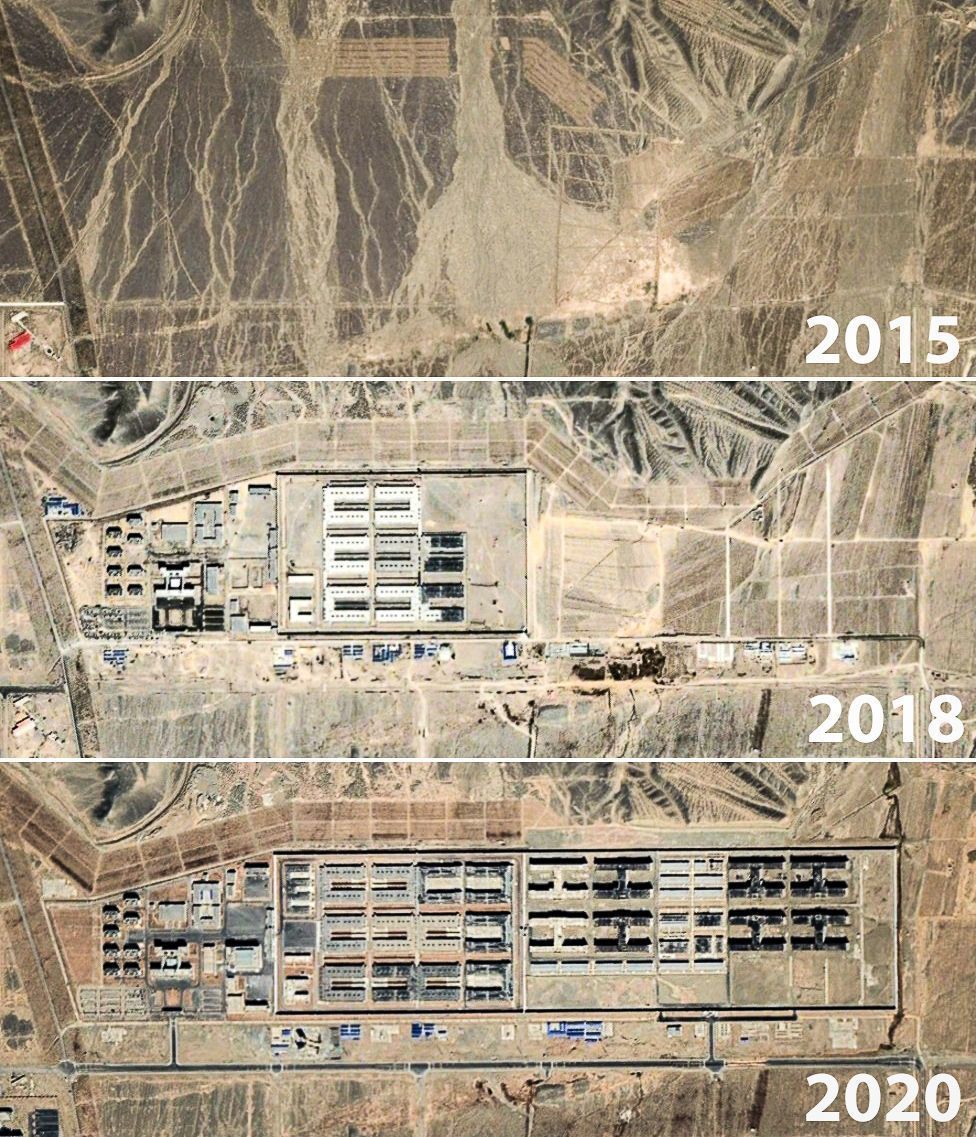
China has been accused of committing crimes against humanity and possibly genocide against the Uyghur population and other mostly-Muslim ethnic groups in the north-western region of Xinjiang.
Human rights groups believe China has detained more than one million Uyghurs against their will over the past few years in a large network of what the state calls "re-education camps", and sentenced hundreds of thousands to prison terms.
There is also evidence that Uyghurs are being used as forced labour and of women being forcibly sterilised. Some former camp detainees have also alleged they were tortured and sexually abused.
The US is among several countries to have accused China of committing genocide in Xinjiang. The leading human rights groups Amnesty and Human Rights Watch have published reports accusing China of crimes against humanity.
China denies all allegations of human rights abuses in Xinjiang, claiming its system of "re-education" camps are there to combat separatism and Islamist militancy in the region.
Who are the Uyghurs?
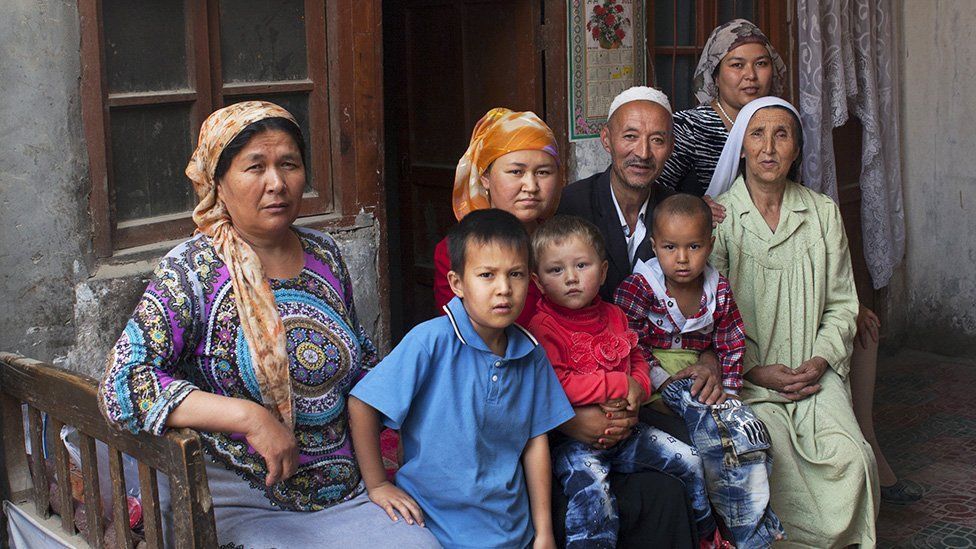
There are about 12 million Uyghurs, mostly Muslim, living in Xinjiang, which is officially known as the Xinjiang Uyghur Autonomous Region (XUAR).
The Uyghurs speak their own language, which is similar to Turkish, and see themselves as culturally and ethnically close to Central Asian nations. They make up less than half of the Xinjiang population.
Recent decades have seen a mass migration of Han Chinese (China's ethnic majority) into Xinjiang, allegedly orchestrated by the state to dilute the minority population there.
China has also been accused of targeting Muslim religious figures and banning religious practices in the region, as well as destroying mosques and tombs.
Uyghur activists say they fear that the group's culture is under threat of erasure.
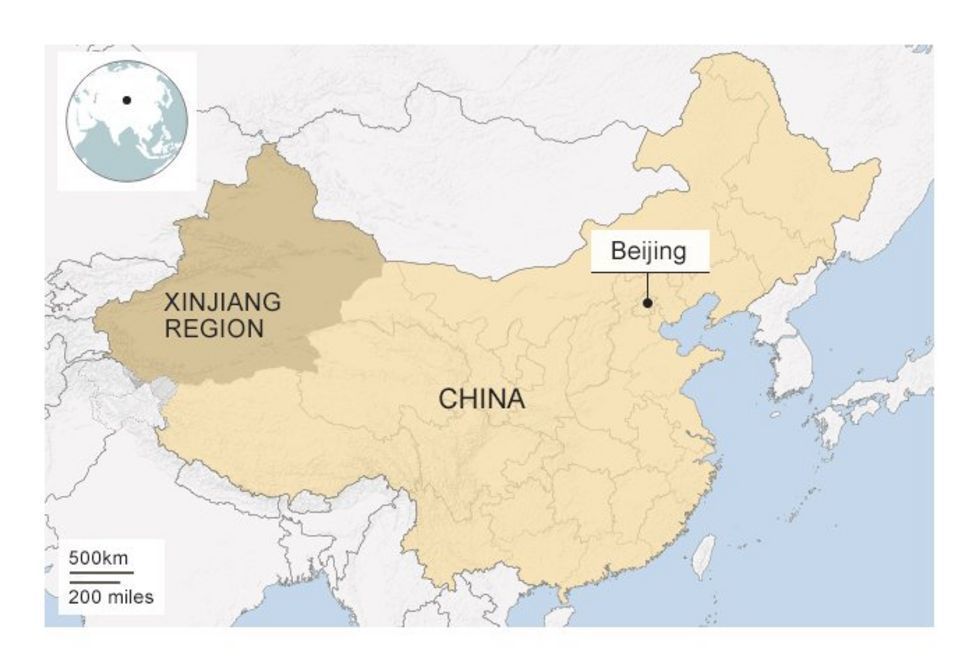
Where is Xinjiang?
Xinjiang lies in the north-west of China and is the country's largest region. Like Tibet, it is autonomous, meaning - in theory - it has some powers of self-governance. But in practice, both regions are subjected to major restrictions by the central government.
Xinjiang is a mostly desert region and produces about a fifth of the world's cotton. Human rights groups have voiced concerns that much of that cotton export is picked by forced labour, and in 2021 some Western brands removed Xinjiang cotton from their supply chains, leading to a backlash against the brands from Chinese celebrities and netizens.
In December 2020, research seen by the BBC showed that up to half a million people were being forced to pick cotton in Xinjiang. There is evidence that new factories have been built within the grounds of the re-education camps.
The region is also rich in oil and natural gas and because of its proximity to Central Asia and Europe is seen by Beijing as an important trade link.
In the early 20th Century, the Uyghurs briefly declared independence for the region but it was brought under the complete control of China's new Communist government in 1949.
What are the allegations against China?
Several countries, including the US, Canada and the Netherlands, have accused China of committing genocide - defined by international convention as the "intent to destroy, in whole or in part, a national, ethnical, racial or religious group".
The declarations follow reports that, as well as interning Uyghurs in camps, China has been forcibly mass sterilising Uyghur women to suppress the population, separating children from their families, and attempting to break the cultural traditions of the group.
The US Secretary of State, Antony Blinken, has said China is committing "genocide and crimes against humanity".
The UK Foreign Secretary, Dominic Raab, has said the treatment of Uyghurs amounts to "appalling violations of the most basic human rights", and the UK parliament declared in April 2021 that China was committing a genocide in Xinjiang.
A UN human rights committee in 2018 said it had credible reports that China was holding up to a million people in "counter-extremism centres" in Xinjiang.
The Australian Strategic Policy Institute found evidence in 2020 of more than 380 of these "re-education camps" in Xinjiang, an increase of 40% on previous estimates.
Earlier, leaked documents known as the China Cables made clear that the camps were intended to be run as high security prisons, with strict discipline and punishments.
People who have managed to escape the camps have reported physical, mental and sexual torture. Women have spoken of mass rape and sexual abuse.
What was the build-up to the crackdown?
Anti-Han and separatist sentiment rose in Xinjiang from the 1990s, sometimes flaring into violence. In 2009 about 200 people died in clashes in Xinjiang, which the Chinese blamed on Uyghurs who wanted their own state. But in recent years a massive security crackdown has crushed dissent.
Xinjiang is now covered by a pervasive network of surveillance, including police, checkpoints, and cameras that scan everything from number plates to individual faces. According to Human Rights Watch, police are also using a mobile app to monitor people's behaviour, such as how much electricity they are using and how often they use their front door.
Since 2017, when President Xi Jinping issued an order saying all religions in China should be Chinese in orientation, there have been further crackdowns. Campaigners say China is trying to eradicate Uyghur culture.
What does China say?
China denies all allegations of human rights abuses in Xinjiang. It said it 2019 that it had released everyone from its "re-education" camp system, though testimony from the region suggests many are still detained and many were transferred from camps to formal prisons.
China says the crackdown in Xinjiang is necessary to prevent terrorism and root out Islamist extremism and the camps are an effective tool for re-educating inmates in its fight against terrorism.
It insists that Uyghur militants are waging a violent campaign for an independent state by plotting bombings, sabotage and civic unrest, but it is accused of exaggerating the threat in order to justify repression of the Uyghurs.
China has dismissed claims it is trying to reduce the Uyghur population through mass sterilisations as "baseless", and says allegations of forced labour are "completely fabricated".
Source: https://www.bbc.com/news/world-asia-china-22278037
Seite 7
Beneath a Blanket of Stars
It isn’t as easy as it once was to find a dazzling night sky. In search of the Milky Way, our writer headed to Utah, which has the densest concentration of designated Dark Sky places in the world.
At 4:30 a.m. on Jan. 17, 1994, a magnitude 6.7 earthquake caused a citywide power outage in Los Angeles. I lived there at the time and was among the many Angelenos who made their way outside, looked up and found a spectacular sight: a vast blanket of stars that had been blotted out for generations by light pollution. It was reported that some people were so bewildered by the diaphanous Milky Way, they called 911 and the Griffith Observatory to report strange, unidentified objects in the sky. I only remember being awe-struck.
Roughly 99 percent of the people living in the United States and Europe see only a dim approximation of stars in the night sky, nothing close to the bright firmament that our ancestors witnessed before humans harnessed electricity. The New World Atlas of Artificial Night Sky Brightness, the study that reported the findings, also found that 83 percent of the world’s population cannot see a naturally dark sky because of the light emanating from cities.
Armed with those statistics, I found myself again looking skyward last October, this time lying face up on a long stone slab at Arches National Park in Utah. Surrounded by strangers, I was trying to locate the Pleiades star cluster, also known as the Seven Sisters, and our nearest spiral galaxy, Andromeda. My first trip in two years since the pandemic required a destination that felt new and otherworldly. As it turns out that is Utah with its biblical terrain and preternatural cobalt sky, a sky that also happens to be ablaze with stars at night.
Arches National Park is one of 200 International Dark Sky Places, each designated by the Arizona-based International Dark Sky Association (IDA), a group of astronomers, evolutionary biologists, and conservationists that promotes awareness of light pollution and its effects on wildlife, climate change and human health.
For Bettymaya Foott, an astrophotographer and the director of engagement for IDA, the detrimental effects of light pollution are profound: “To me one of the most significant ways it affects us as humans is that it decreases our connection with the universe,” she said. “With all of the divisions going on, looking up to the night sky connects us to the biggest mystery in our world and helps us get in touch with the fact that we are all humans on spaceship earth.”
In 2001, the IDA began awarding Dark Sky designations to communities, parks, reserves and sanctuaries. To receive the coveted designation, Dark Sky Places must pass through a rigorous application process that includes controlling the directional flow of outdoor lighting, the use of timers, limiting sign illumination and other policies, including ongoing community education.
There are now Dark Sky Places in 22 countries, including the United States, Canada, Britain, Taiwan, the Netherlands, Namibia, Chile, Denmark and the tiny island nation of Niue in the South Pacific. Several U.S. cities have been designated Dark Sky Communities, 26 in all, including Flagstaff and Sedona, Ariz., and Ketchum, Idaho, along with smaller towns such as Homer Glen, Ill., and Horseshoe Bay, Texas. The IDA also lists 89 designated parks, reserves, and sanctuaries in the United States. Among them is Arches National Park, one of Utah’s 15 officially designated Dark Sky Places, the most in one province, state or country in the world.
Beneath a waning moon
In planning my trip to Utah, I took some advice from Ms. Foott and scheduled my trip as close as I could to the new moon, when the sky is darkest.
“Light from the moon may seem dim, but it can dramatically alter the nighttime scene,” Ms. Foott said. “A new moon is the best time to see faint celestial objects that can be washed-out by moonlight like the Milky Way and faint stars. This can also be achieved when the moon has set, or when the moon is only partially illuminated.”
On the morning of Oct. 4 — as the moon was waning — I deplaned at Salt Lake City International Airport, and headed by car to the town of Moab, about 230 miles southeast and the gateway to Canyonlands and Arches, two of Utah’s “Mighty Five” national parks, which also include Bryce Canyon, Capitol Reef and Zion.
In my tiny Ford Fiesta with all the windows down, I got my first glimpse of Utah’s often-photographed sandstone formations, spires, buttes and hoodoos (or earth pyramids) as well as the undulating canyons and natural bridges that make the state so geographically vivid. With only a few days away from caring for an elderly parent, I was constrained for time, so I needed to bypass another nearby hub for stargazers, Canyonlands National Park, and concentrate solely on Arches, where I planned to meet up with an old friend, Thom Harrop, a Utah native and photographer.
After hours of driving, and a little grubby, I pulled into the former mining town of Moab, which acts as a base camp for tourists, rock climbers, mountain bikers, hikers and stargazers. A range of restaurants in Moab caters to a variety of tastes while a growing number of hotels serves the needs of those who want to kick about the sandstone and then sleep in crisp sheets, a demographic in which I squarely fall.
While still back home in Tennessee, I heard that a long-utilized ad hoc stargazing site at Arches called Panorama Point had recently been upgraded. Joette Langianese, the executive director of the Friends of Arches and Canyonlands Parks, the nonprofit organization that was critical in getting the dark-skies designation for both parks, confirmed that they had built an outdoor sky-viewing space with telescope pads and seating for 75 people.
“Lately, people are going there with their own telescopes, and sometimes a ranger will just come out and talk to them,” Ms. Langianese said. “Both Canyonlands and Arches have scheduled night sky programs, but, because of Covid, they were canceled, so they’ve been happening sort of automatically.”
I’d been keeping a wary eye on an increasingly moody weather forecast, with the most promising night for weather being the day I arrived; that night there would be just a sliver of moon — nearly perfect conditions for stargazing. If I had only one night to commune with the heavens, I was going to make sure I didn’t miss it, so, after unpacking — and a really good vegetable korma at Indo Grill in town — Thom and I made our way to Arches, the route taking us past some of the park’s most fantastic sandstone formations.
Fighting light pollution
During the winding drive, I relayed to Thom the conversation I had recently had with Dr. Jeffrey Hall about the effects of light pollution. Dr. Hall is chair of the American Astronomical Society’s Committee on Light Pollution, Radio Interference, and Space Debris. He said the light flooding from cities is making observing the universe more difficult for astronomers, but it also is increasingly impacting the planet’s ecosystems.
“This goes well beyond astronomy,” said Dr. Hall, who is also the director of the Lowell Observatory in Flagstaff, the first city to be designated a Dark Sky Community in 2001. “Indigenous peoples across the world understand themselves and their origins through stories of the stars, and there are many species that use the night sky for navigation and reproduction. Sea turtles rely on dark beaches to lay eggs; their offspring use the natural light of the ocean horizon to find the sea. If there are condos or townhouses close by, that natural navigation can get lost.”
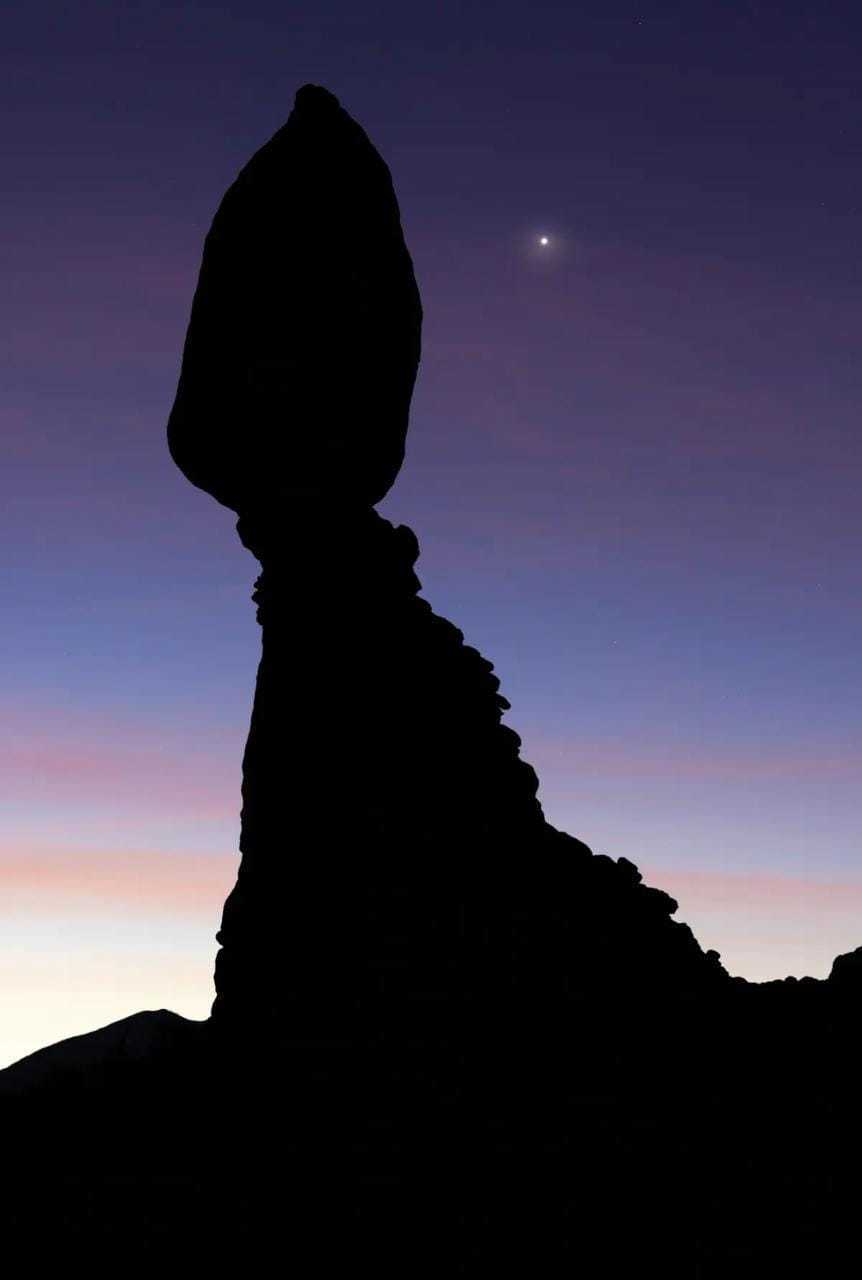
Five miles past the park’s entrance, we came upon the Courthouse Towers cluster: the Three Gossips, Sheep Rock, the Organ and the Tower of Babel, a 300-foot rock sentinel so close to the road it made me gasp. Utah is unlike any place I’d ever been, the topography so extraordinary it was impossible not to be in a constant state of astonishment. We drove until we got to the Balanced Rock — 128 feet of precariousness — and then made our way to our destination.
We arrived at Panorama Point with the setting sun saturating the sandstone’s varying hues of coral and burnt umber. The overlook is well-suited for stargazing because its position on a hill offers unencumbered views. With some sunlight left, we could see the La Sal Mountains and the Fiery Furnace, a collection of narrow canyons, fins and natural arches near the park’s center.
Stargazing is a year-round activity, Ms. Foott said. The cooler seasons are better for air clarity because cold air cannot hold as much moisture as warm air, and moisture-heavy atmosphere can make the sky hazy. The Milky Way’s galactic core is visible from March through November, when I was there. From November through February, she said, it’s the outer edge of our spiral galaxy that we see.
While Thom was setting up his camera, I talked with Grace and Jim Bishop, an amiable couple who were voyaging through Utah’s public lands.
“We’re here specifically for this,” Ms. Bishop said, motioning skyward. “We’ve wanted to do this for a long time, traveling though the national parks in southern Utah primarily for the night sky.”
They were not alone. People from South Dakota, Missouri, Oklahoma, Florida and New Mexico were there. Astrophotographers and weekend astronomers were setting up tripods. Groups were unfolding lawn chairs and pulling out blankets. We were all prepping for something people had taken for granted for thousands of years.
Twelve long stone slabs were available in the viewing area, long enough for an adult human to lie down on, which is what I did. A young family with two boys under 8 sat on the long stone next to me. They were looking at a tablet, then up at the sky, making use of, I gathered, this perfect confluence for a family outing during a pandemic: a beautiful setting, ideal weather and a little digital learning beneath the stars.
As the sun retreated below the horizon, my eyes began to adjust to dusk. Watching the night sky change is something I had never done, and it was more eventful than I expected. Every now and then someone would quietly say “wow” as a planet would come into view: Mercury, Venus, Saturn and massive Jupiter, so bright it looked counterfeit. It was as if we were all at a royal wedding waiting for the bride: the Milky Way.
I had downloaded an app called SkyView for $1.99 that, when held up to the sky, would show and name the planet or star within its view, every sky object imaginable, even the International Space Station. I found the Pleiades star cluster and the Andromeda galaxy. I’d heard that, with binoculars, one could see Andromeda’s spiral, so I brought them out; I couldn’t determine its shape, but then again. I didn’t know we had a “neighboring galaxy” we could see until about a month before my trip.
This sky was so lousy with stars it was difficult to make out anything specific, but my app easily found the constellations Pegasus, Leo, Capricorn and Virgo, my zodiac sign. Even with an overcast sky, or in a bright city, sky-charting apps work because our phones know the date, time and our location, and then, using their compass and gyroscope, they can show us what’s in the sky even if we can’t see it.
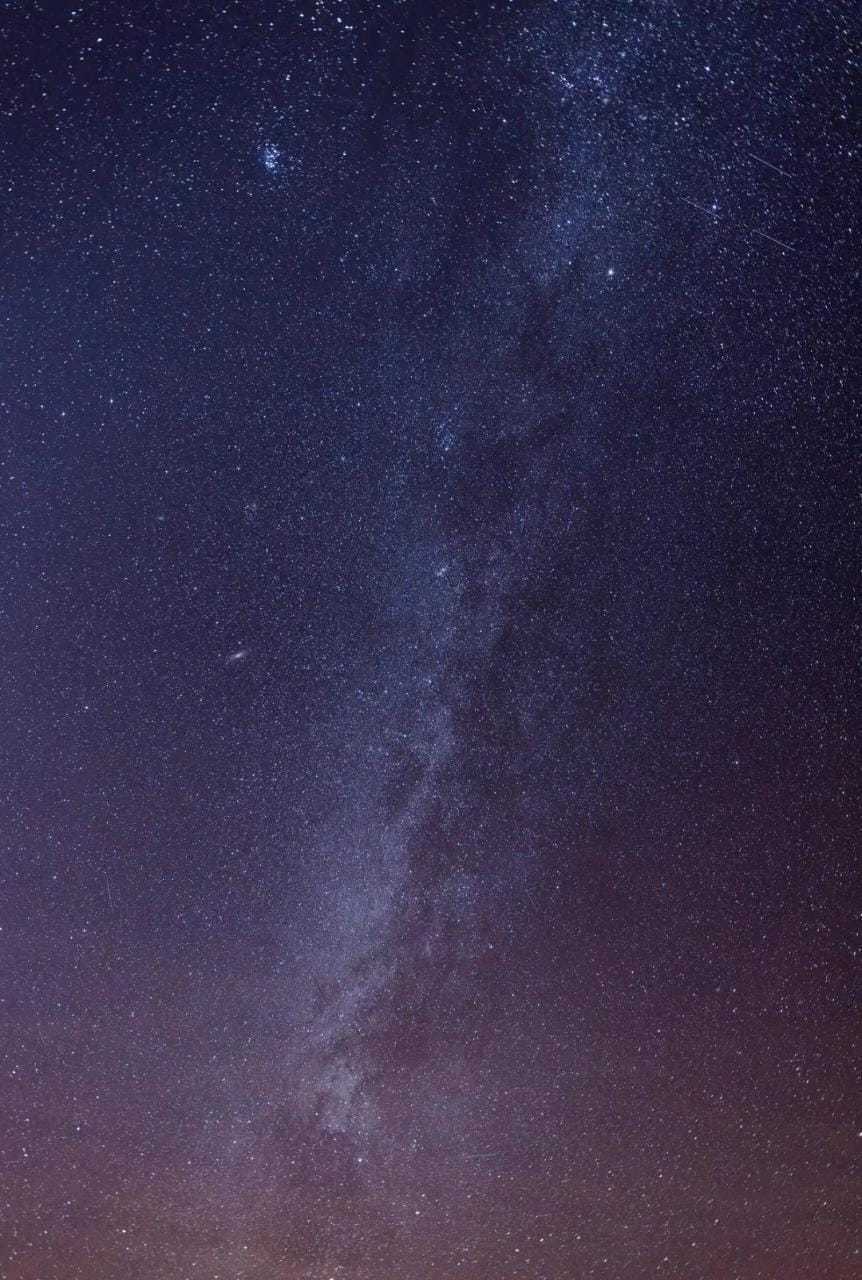
I put my phone down, gazed up and recognized that what I had thought was a long and high gossamer-like cloud was, in fact, the dust, gas and billions of stars that make up the Milky Way. Over the next hour it became so pronounced that it was one of the most heart-stoppingly beautiful things I’d ever seen, slightly white and effervescent in certain parts, in other places tributaries of purple and gray appeared to be emanating from its center; north, south, east and west were rendered arbitrary as Earth became irrelevant. I stayed for at least another hour because I knew I might not have a chance like this any time soon.
And I didn’t. The following night the rain released the earthy smell of Utah’s sandstone. The third night was expected to be cloudy, so I hung out with my friend who lives with his wife in Denver. Over lunch, we pulled up a light pollution map on my laptop. The map showed that the entire eastern half of the United States is seriously affected by sky glow. We wondered where our respective home cities were on The Bortle Scale, the widely used numerical system that rates the amount of light coming from any given place, 1 being the darkest and 9 being close to starless. The centers of our homes, Denver and Nashville, we discovered, are both 8 and 9 — as are large cities such as New York and Chicago. In our home cities, we could see only “some” stars and planets, and, of course, our moon.
In these larger cities, Ms. Foott told me, the association is reaching out with an awareness campaign called Urban Night Sky Places: outdoor spaces in, or adjacent to, urban areas where lighting practices serve as examples of best practices, like the Forest Preserves of Cook County near Chicago and Stacy Park, just west of St. Louis, Mo.
As individuals, she said, we can alter the outdoor lighting at our homes using the IDA’s five basic principles of outdoor lighting. Though the principles are specific, the main thrust is that outdoor lighting should be purposeful, intentionally directed, in the amount needed and no more, and the use of warm lighting instead of cooler, blue lighting is preferred.
Their hope is that the campaign will plant seeds now to help stem some of the light flooding the skies, so affected areas can recover.
A few weeks after I returned home, I drove an hour and a half west of Nashville into “the country” and looked up. It was a good night for stars, though chilly, but still not star-spangled.
I put my app to the sky and on my screen viewed the vast firmament of stars that I would have been able to see if it were not for the competing light from the surrounding communities. I wondered if viewing stars through smartphones would ultimately be how we would experience a vivid night sky.
For now, I’ll gladly travel.
Source: https://www.nytimes.com/2022/02/22/travel/arches-national-park-utah-star-gazing.html?utm_campaign=likeshopme&utm_medium=instagram&utm_source=dash%20hudson&utm_content=ig-nytimestravel
Informationen
- Beschreibung
- Idiomas Inglês Notiz am Advanced - Reading, erstellt von Teachers Thaiana and Thiago am 24/02/2022.
- Erstellt von
- Teachers Thaiana and Thiago
- Aufrufe
- 2
- Bewertung