
Reading Skills and Comprehension
497 resources created by 392 users
This Reading Skills and Comprehension page on GoConqr gathers community-made quizzes, mind maps, flashcards and notes, from skimming and scanning to TOEFL passages and close reading questions. It's built for school students practising reading, and for teachers after ready-made material, with a few university students and professional candidates dipping in too. There are over 2,600 resources here, including more than 800 quizzes and over 1,300 mind maps, mostly at secondary level. Try a quiz to find your gaps, then see what you can build.
Top Reading Skills and Comprehension resources
-
50 questionsREADING AND COMPREHENSION PRE TEST 1 Algae is a primitive form of life, a single-celled or simple multiple-celled organism that is able to condu...
-
20 questionsSporting Futures USA | SAT Prep | Critical Reading 1.3 For SAT Test Practice
-
40 questionsExamen General UNIVERSIDAD DE CALDAS FACULTAD DE ARTES Y HUMANIDADES DEPARTAMENTO DE LENGUAS Y LITERATURA EXAMEN GENERAL D...
-
32 questionsB2 Exam - Four Skills READING I. Read the article about the winter sports in the USA and choose the correct answer A, B, C or D. ...
-
25 questionsPET MOCK Look at the text in each question. Which one says the same? Click the correct box A, B or C.
-
13 questions1er Test Nanda :-) Read the following text and do the comprehension questions. The History of Pizza The modern pizza was origi...
-
13 questionsCOMPRENSIÓN DE LECTURA DEL IDIOMA INGLÉS UNACH 20017 Benjamin Franklin was one of the most important Americans in history. In the early part of his life, Frankl...
-
8 questionsImprove your evaluative essay skills n your responses to the evaluative questions it is important to remain focused on the big picture; the effe...
Quizzes
See all 310 quizzes-
50 questionsREADING AND COMPREHENSION PRE TEST 1 Algae is a primitive form of life, a single-celled or simple multiple-celled organism that is able to condu...
-
20 questionsSporting Futures USA | SAT Prep | Critical Reading 1.3 For SAT Test Practice
-
40 questionsExamen General UNIVERSIDAD DE CALDAS FACULTAD DE ARTES Y HUMANIDADES DEPARTAMENTO DE LENGUAS Y LITERATURA EXAMEN GENERAL D...
-
32 questionsB2 Exam - Four Skills READING I. Read the article about the winter sports in the USA and choose the correct answer A, B, C or D. ...
-
25 questionsPET MOCK Look at the text in each question. Which one says the same? Click the correct box A, B or C.
-
13 questions1er Test Nanda :-) Read the following text and do the comprehension questions. The History of Pizza The modern pizza was origi...
-
13 questionsCOMPRENSIÓN DE LECTURA DEL IDIOMA INGLÉS UNACH 20017 Benjamin Franklin was one of the most important Americans in history. In the early part of his life, Frankl...
-
8 questionsImprove your evaluative essay skills n your responses to the evaluative questions it is important to remain focused on the big picture; the effe...
Mind maps
See all 80 mind maps-
Strategies for reading comprehension Strategies fore reading comprehension
-
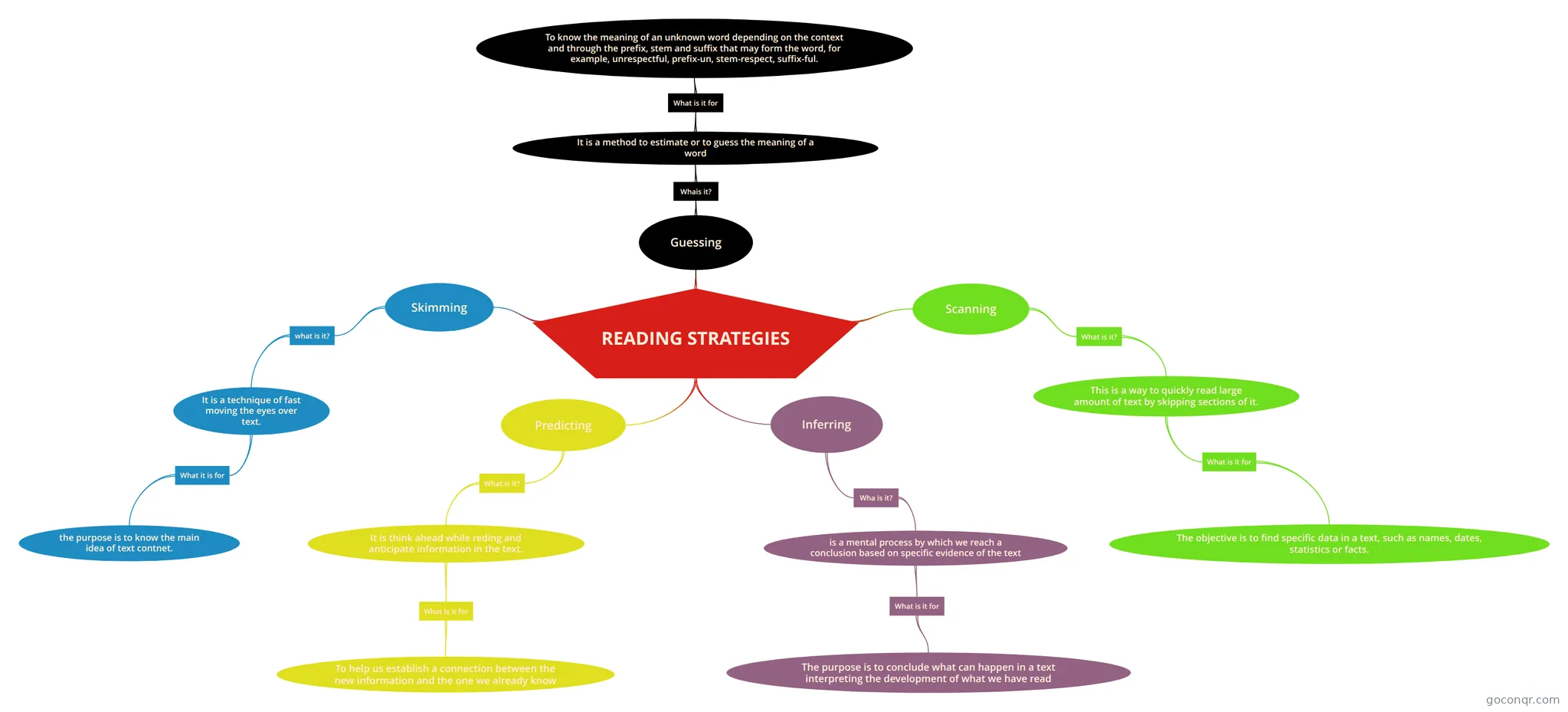 READING STRATEGIES mind map, about the reading strategies
-
Skimming reading skill
-
Responsible and Responsive Readers
-
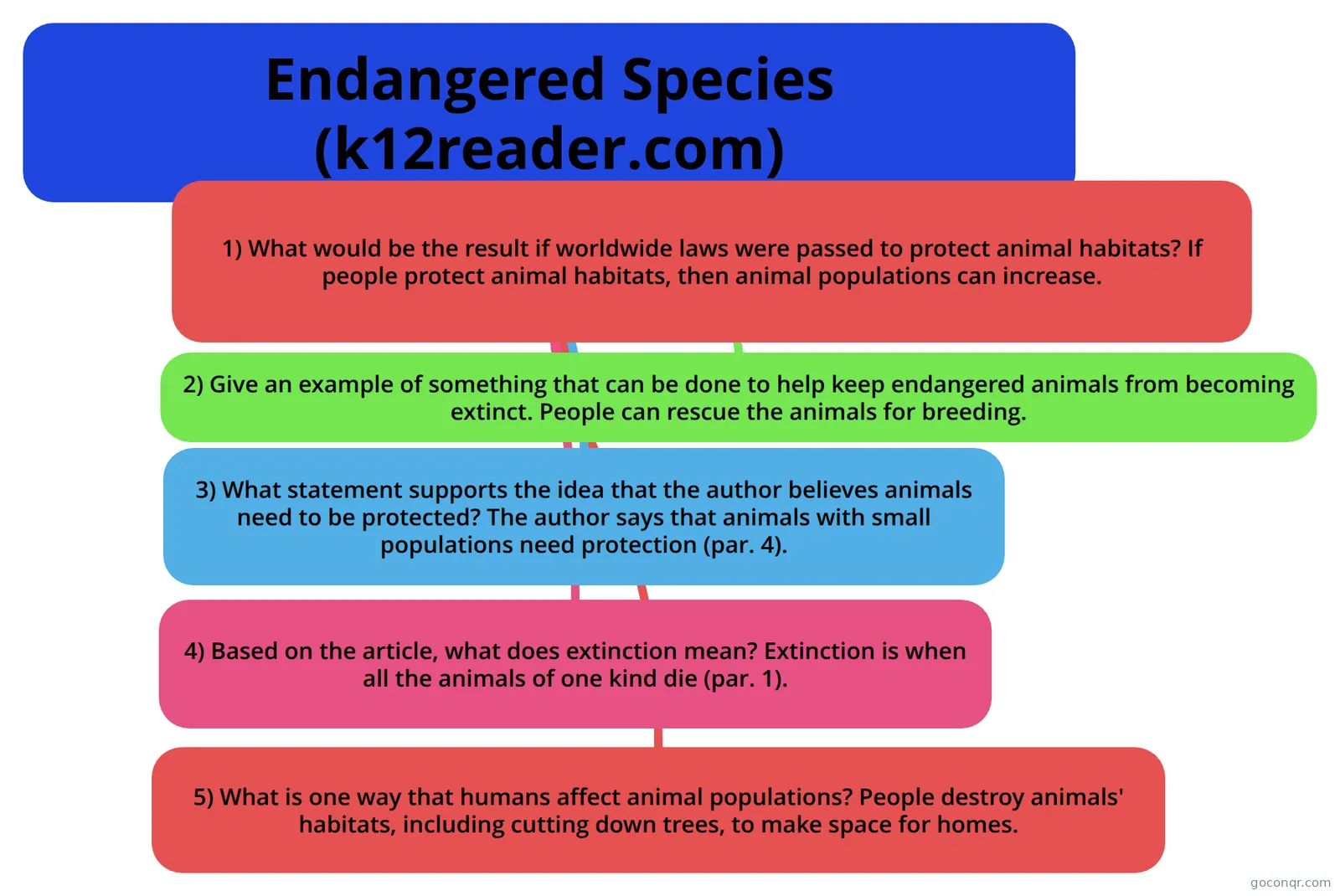 Endangered Species (k12reader.com) http://www.k12reader.com/reading-comprehension/Gr4_Wk11_Endangered_Species.pdf
-
EXCALIBUR Mapa Mental sobre EXCALIBUR, creado por Lorena Hernández el 04/03/2017.
-
Skimming jaja
-
Tattoos in fashion and for life This mind map is used to sum up the reading called tattoos in fashion and for life
Flashcards
See all 59 flashcards-
28 cardsFoundations of Academic Success Reading Strategies, Using Reference Materials, Context Clues,Denotation and Connotation, Paraphrasing and S...
-
19 cardsTA - NA - E - KA Flashcards to check reading comprehension.
-
15 cardsLet's Go to the Moon! What is the title of the story? Who is the author of the story?
-
6 cardsTypes of Context Clues Learn about types of Context Clues!
-
14 cardsSkimming and Scanning DO YOU KNOW WHAT SKIMMING AND SCANNING IS?
-
10 cardsSnow White What’s the name of the protagonist?
-
6 cardsstory "Two sisters and the cat " Two sister and the cat
-
5 cardsEnglish Literal language- Means exactly what it says at the simplest level Figurative language has a more imaginati...
Flowcharts
-
Home of the penguins Trabajo de ingles de lectura de la casa de los pinguinos
-
Reading Skills Group work Group 8 Carrera Pachacama Sanches Reisancho Trujillo 2"E" English
-
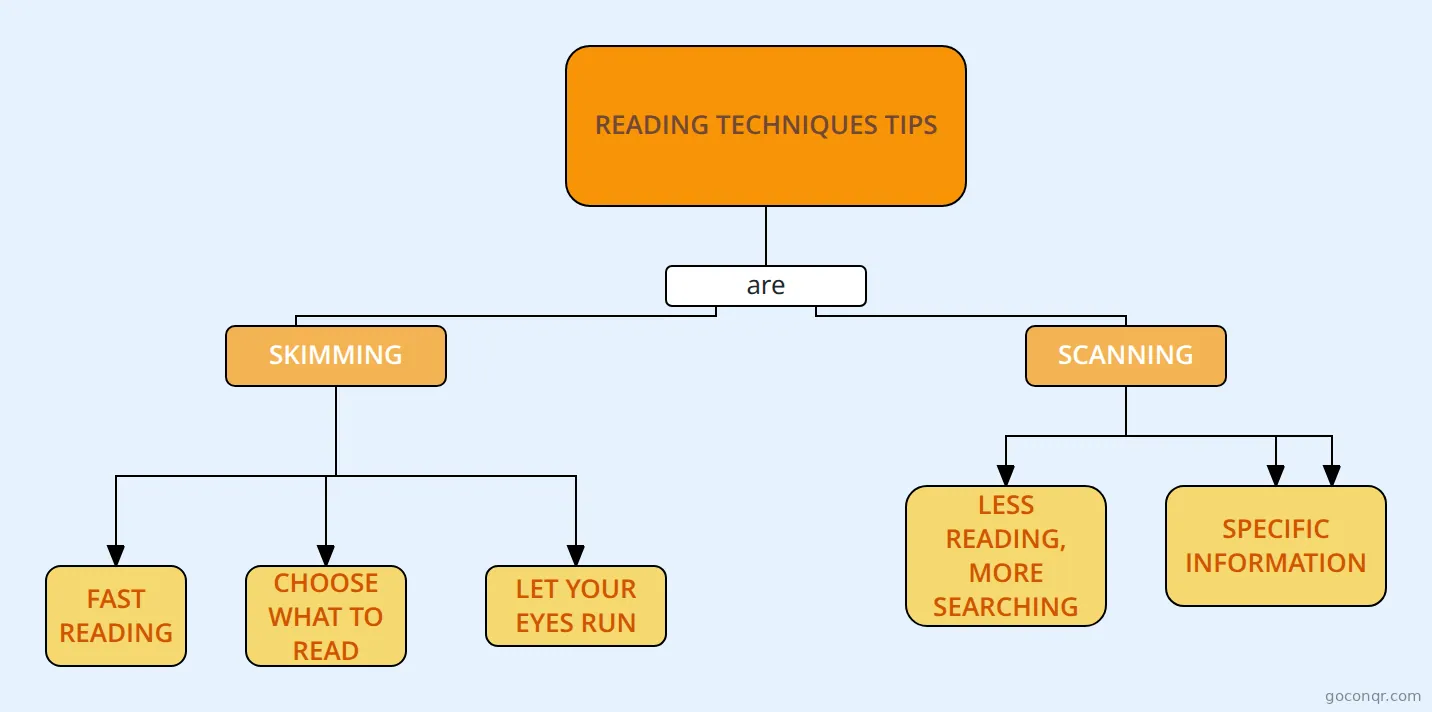 TECHNIQUES READING TECHNIQUES
-
Scanning for Specific Details This simple flowchart describes the three steps of scanning a text to find specific details or information.
-
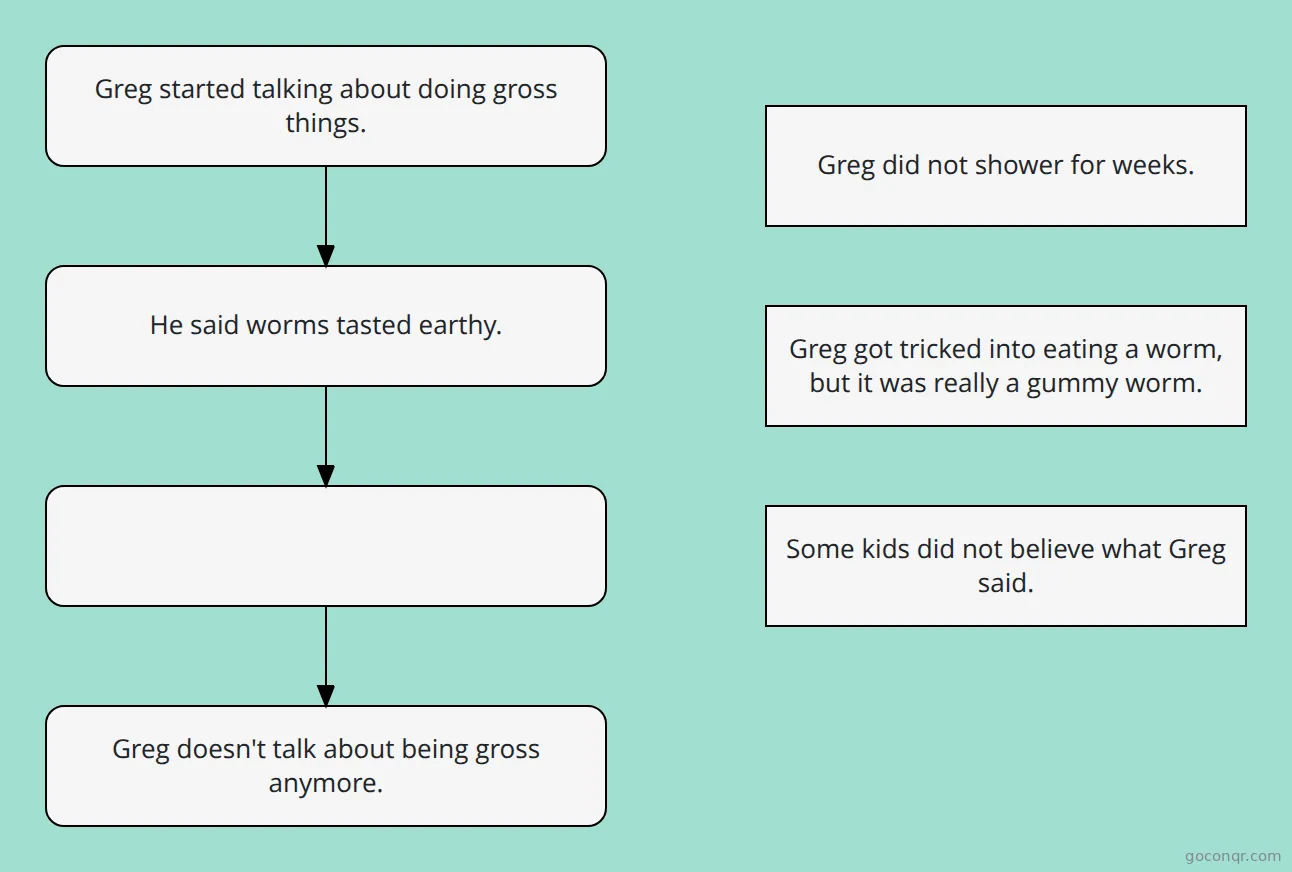 Gross-Out Greg Sequence using flowcharts
-
READING GENRES
Notes
See all 27 notes-
TOEFL Sample Passages (See Quizzes After) Meteorite Impact and Dinosaur Extinction (1) There is increasing evidence that the impacts of meteorites have had important effects on Earth, particularly in the field of biological evolution. Such impacts conti...
-
Reading activities LEARNING IS FUN!!! Before you read, answer these questions · Do you like to study? · What do you like about your school? · What are you studying for? · Who would you like to become in? A school is a place where people...
-
Reading about Canada - Intermediate Level CANADA - IT'S NOT the USA Imagine yourself sitting in a café one day in your home town, when on the next table you hear some people speaking English with a strong North American accent. Being a friendly person, you le...
-
Short Story (The Hasty Act) - Beginners The Hasty Act - Marc Brandel I didn't get into this thing on purpose. I'm not tough; I'm a coward. I'm not ashamed to say it. And I'm not ashamed to say that I'm frightened and confused. I don't know what to do....
-
Reading Comprehension Practice Questions for CAHSEE Read the passage and answer the questions that follow. Daniel Boone will always occupy a unique place in our history as the archetype of the hunter and wilderness wanderer. He was a true pioneer, and stood at the head...
-
Reading Comprehension - Levi's Blue Jeans Levi's Blue Jeans Vocabulary emigrate- (v) to move permanently from one's country to another. dry goods- (n) clothing, fabric, and other items to sell miner- (n) a person who searches for gold, diamonds, etc. durable-...
-
La Felicidad Read the article about two sisters. Are the sentences ‘Right’ or ‘Wrong’?If there is not enough information to answer ‘Right’ or ‘Wrong’, choose ‘Doesn’t say’. Something very strange happened to Tamara. She never knew...
-
questions about listening job 1. Choose TRUE or FALSE: 1. Ligaya lives in the Phlipines. 2. She teaches French. 3. She drives to work. 4. She doesn´t like her job. 5. She´s marr...
Slides
See all 15 slidesMore English language topics
About Reading Skills and Comprehension
GoConqr OriginalWhat you will find
This unit sits in the Communication Skills strand of English language. It mixes short reading passages with the techniques for answering questions on them. Notes such as Short Story (The Hasty Act) - Beginners and Reading about Canada - Intermediate Level give you simple texts to read. Quizzes then test what you took in.
Where to start
Begin with the strategy material. The mind maps on skimming and scanning, intensive and extensive reading, and reading strategies are quick to read. The flashcard decks Skimming & Scanning and Types of Context Clues help the ideas stick.
- Read a short note or story for a gentle warm-up.
- Look at a strategy mind map.
- Take a quiz such as READING PART 4 or Fact, Opinion or Bias?
- Move on to a full exam-style passage.
Exam-style practice
Many resources are tied to named exams. TOEFL is well covered, with quizzes like TOEFL Reading Comprehension. and slide sets on TOEFL reading. Cambridge-style practice includes PET MOCK, C1 English Test and a flowchart of CAE reading strategies. For GCSE English Language and National 5 English, look for the flashcards on close reading question types and key language techniques. The RUAE Quiz asks about the steps for understanding, word choice and imagery questions.
Using quizzes and maps together
Use a map to learn the method, then a quiz to try it on a real text. If you miss a question, go back to the map or flashcards and note which question type tripped you up. Teachers can set a passage quiz as classwork and use a mind map to recap the method.
Next step
Pick one passage that suits your level and give it a go. When you are ready, you can make your own maps and flashcards from what you find.
Frequently asked questions
Which resource should I open first?
If you are new to the topic, start with a strategy mind map on skimming and scanning, or a gentle note such as Short Story (The Hasty Act) - Beginners. Then try a short quiz like READING PART 4 to see how the techniques work on a real text.
Which exams do these resources mention?
The listed resources mention TOEFL, IELTS, GCSE English, GCSE English Language, National 5 English, SAT, TOEIC, Aptis and several Cambridge exams such as KET, B1 Preliminary, B2 First and CAE. Check each resource's own description to see which part of the exam it targets.
Are the resources free to use?
Yes. Every resource listed here is free to open, study and take, with no account needed. They were made by GoConqr users rather than by GoConqr itself, so styles and depth vary from one quiz, map or note to the next.
What do the mind maps cover?
The mind maps focus on reading methods. You will find several on skimming and scanning, others on intensive and extensive reading, and maps on reading strategies, close reading and unprepared non-fiction. Some also break down a single text, such as Kakenya Ntaiya: A Girl Who Demanded School.
Can I save my quiz scores or make my own material?
A free account saves your quiz scores and lets you create your own quizzes, mind maps, flashcards and notes. That is useful if you want to turn a tricky passage into a set of flashcards or a map of question types.
What if I cannot find the exact text or exam I need?
Try a nearby resource first. Question-type flashcards and strategy maps work across many passages, so they can help even when your exact exam is not listed. You can also make your own quiz or notes on the text you are studying.