
Notizen
Waterfalls - Long question
Inhalt der Notizen (2)
Seite 1
A waterfall is a vertical interruption in the river
It occurs due to vertical erosion in the youthful stage of the river.
The river has a very high velocity, it is very powerful, therefore vertical erosion occurs into the river bed.
Soft rock such as sandstone erodes faster than hard rock such as granite. This is called differential erosion.
Hollows are causes by hydraulic action
Abrasion then occurs as broken rocks become trapped in these hollows.
This causes the hollows in the river bed to widen and become deeper. The hollows eventually spread out to form a vertical drop in the river bed, which the river plunges over.
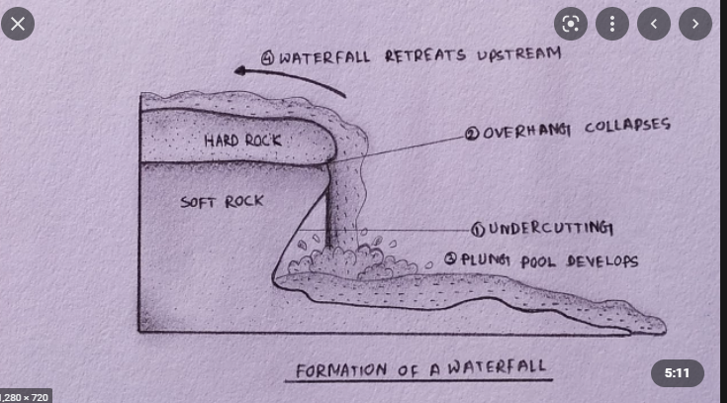
Hydraulic action continues to occur as the impact and force of the water flowing over the drop breaks the rock at the base, eventually creating a plunge pool.
An undercut is then formed when Abrasion combined with hydraulic action widens and deepens the plunge pool and also erodes into the back wall of the waterfall.
This undercutting creates an overhang because the soft rock is eroded and the hard rock is left elevated above the plunge pool.
Eventually, the overhang collapses into the plunge pool.
The undercutting and collapsing repeats, causing the river to retreat upstream – headward erosion occurs
A steep sided valley known as a gorge is created downstream.
A famous example of a waterfall is Niagara Falls in Canada
Seite 2
Informationen
- Beschreibung
- Leaving Certificate Geography ( Fluvial Processes ) Notiz am Waterfalls - Long question , erstellt von James Benson am 17/10/2022.
- Erstellt von
- James Benson
- Aufrufe
- 1
- Bewertung