
Notizen
3. Using the Electromagnetic Spectrum
Inhalt der Notizen (7)
Seite 1
3. Recent technological developments have allowed greater use of the electromagnetic spectrum
3.1 - Electromagnetic waves do not require a medium
Describe electromagnetic waves in terms of their speed in space and their lack of requirement of a medium for propagation
The link between electricity and magnetism was first discovered by Hans Oersted in 1820
The oscillations of magnetic and electric fields induce the other field perpendicular to themselves, and therefore they are able to self-propagate
Because they are able to self-propagate, they do not require a medium and are able to travel through a vacuum of space
The speed of light in a vacuum is approximately 3x10^8 m/s, or 300,000km/s
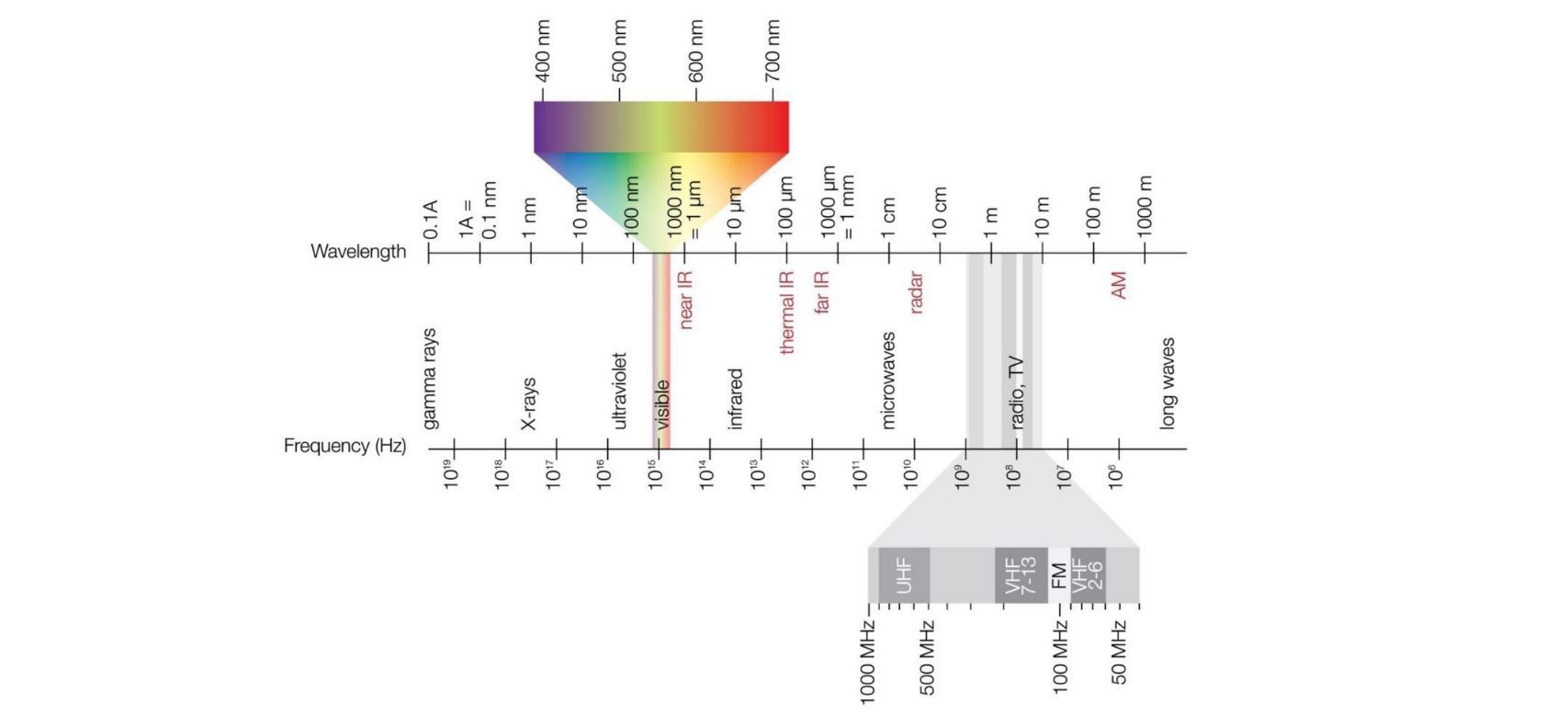
The wavelengths and frequencies of the wide range of waves within the spectrum vary, as the speed does not change
Visible light ranges from red light to violet light - red light has the longest wavelength of 700nm and a smaller frequency than violet light which has a higher frequency and shorter wavelength of 400nm
Seite 2
3.2 - The Earth's atmosphere filters the most dangerous radiation
Identify the electromagnetic wavebands filtered out by the atmosphere, especially UV, X-rays and gamma rays
The sun is the main source of energy on Earth, emitting radiation over most of the electromagnetic spectrum
The Earth is continuously exposed to this radiation, which includes dangerous ultraviolet, x-ray and gamma ray radiation
The Earth's atmosphere prevents transmission of x-ray and gamma ray wavebands
UV radiation is not fully absorbed, but ozone gas produced naturally in the upper atmosphere absorbs a sufficient proportion of the UV radiation to allow life to survive
Visible light is not filtered by the atmosphere
The Earth's atmosphere contains water vapour, carbon dioxide and small amounts of methane which combine to absorb a significant proportion of the infrared radiation
3.3 - Identifying the electromagnetic wavebands
Identify methods for the detection of various wavebands in the electromagnetic spectrum
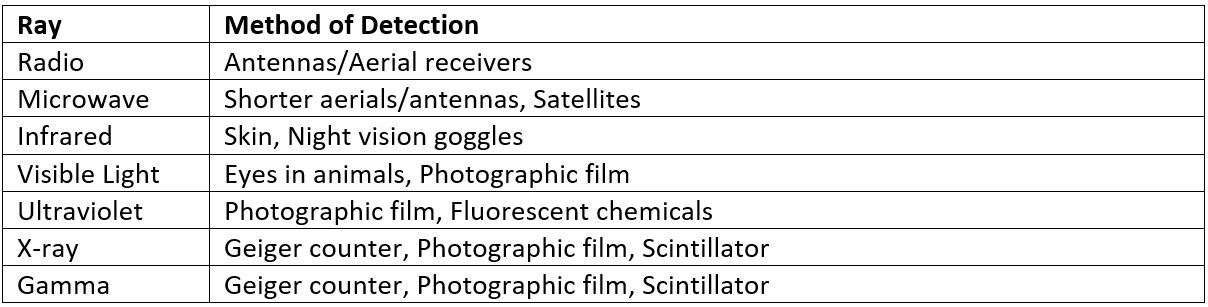
Longer wavelengths are detected using wires that have a weak electrical signal induced in them
Very short wavelengths are detected using scintillators - materials that fluoresce when excited by ionising radiation
Radio, microwave, infrared and light wavebands are non-ionising radiation, and are considered safe for use in sufficiently low intensities
Seite 3
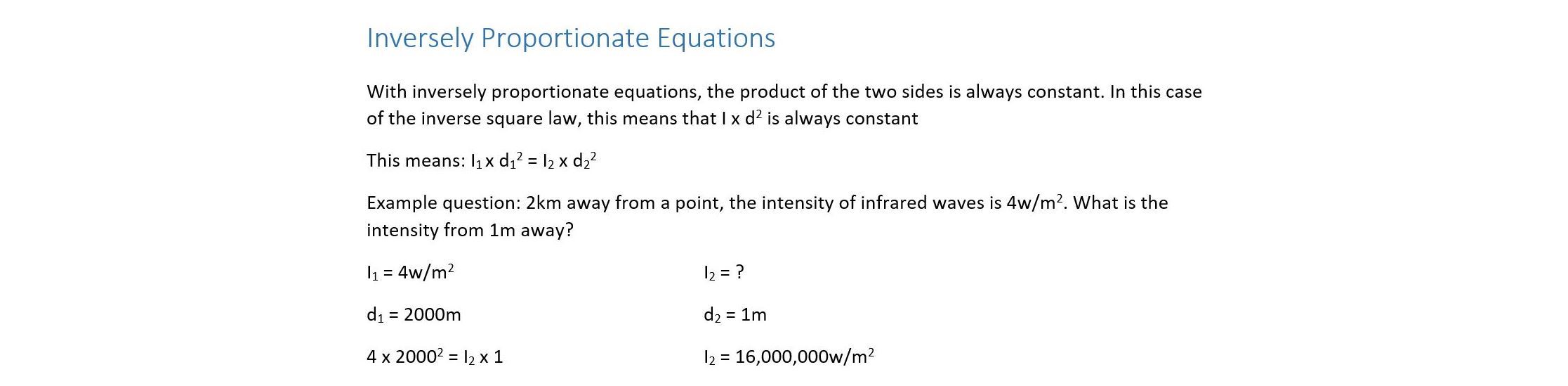
3.4 - Intensity of radiation and the inverse square law
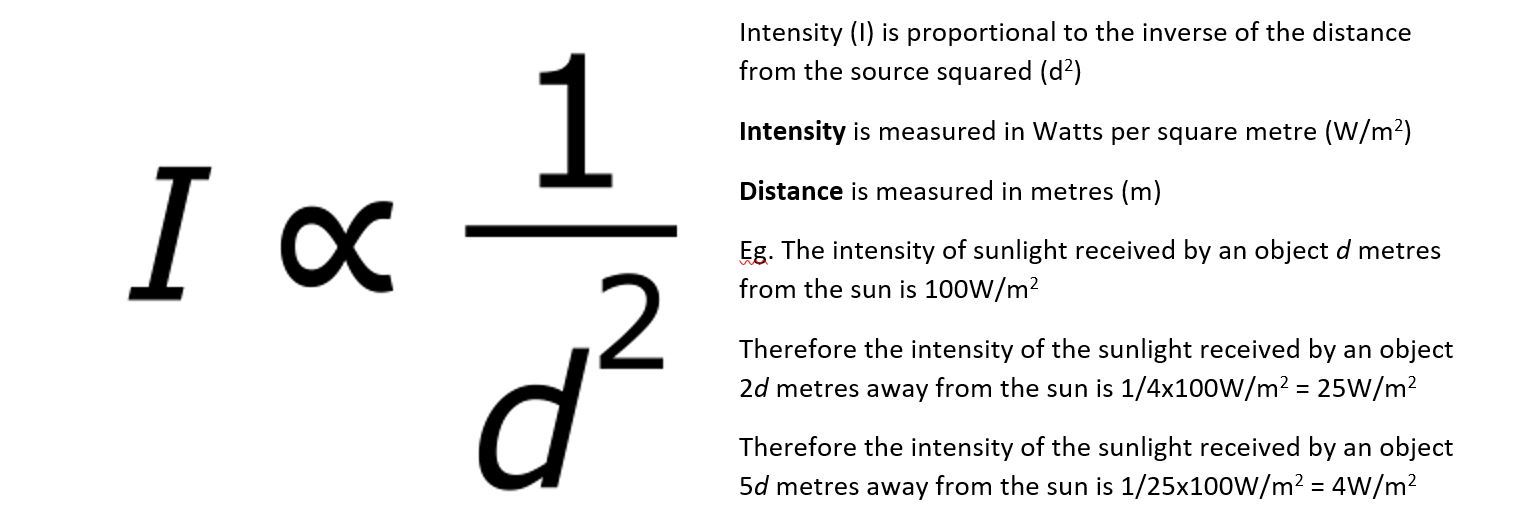
Explain that the relationship between the intensity of electromagnetic radiation and distance from a source is an example of the inverse square law
With certain exceptions, most sources of electromagnetic radiation will radiate energy in all directions, being a 3D wave
As the distance increase from the source, the intensity decreases in proportion to the inverse square of the distance
Seite 4
3.5 - Modulation
Outline how the modulation of amplitude or frequency of visible light, microwaves and/or radio waves can be used to transmit information
- Energy can be varied/modulated in order to transmit information
- Information is carried by modulating/superimposing a carrier wave which has been set to a tuning frequency
- The bandwidth is the range of frequencies around the carrier/tuning frequency
- The waves can be either amplitude modulated or frequency modulated
- AM waves are varied through their amplitude
- FM waves are varied through their frequency
Radio Waves
- A carrier wave is either amplitude modulated or frequency modulated
- This is transmitted, and the receiver subtracts the carrier wave from the signal and interprets its amplitude/frequency modulations (demodulation)
- These do not require a line of sight and can be transmitted long distances without much interference
Microwaves
- These can also be modulated to transmit information, and are used in mobile phones and wifi
- These have a larger bandwidth because they have a higher frequency, and are able to transmit more information at a time
- Higher frequency microwaves require a line of sight between transmitting and receiving antennae, due to their shorter range and ability to be more easily interfered with
Visible Light
- Modulated light (usually amplitude modulated) is used in fibre optic communications
- It has a very high bandwidth and can transmit a large amount of information very quickly
- Due to its narrow frequency range, it can be very easily interfered with, so fibre optic cables are required in order to ensure no interference
Seite 5
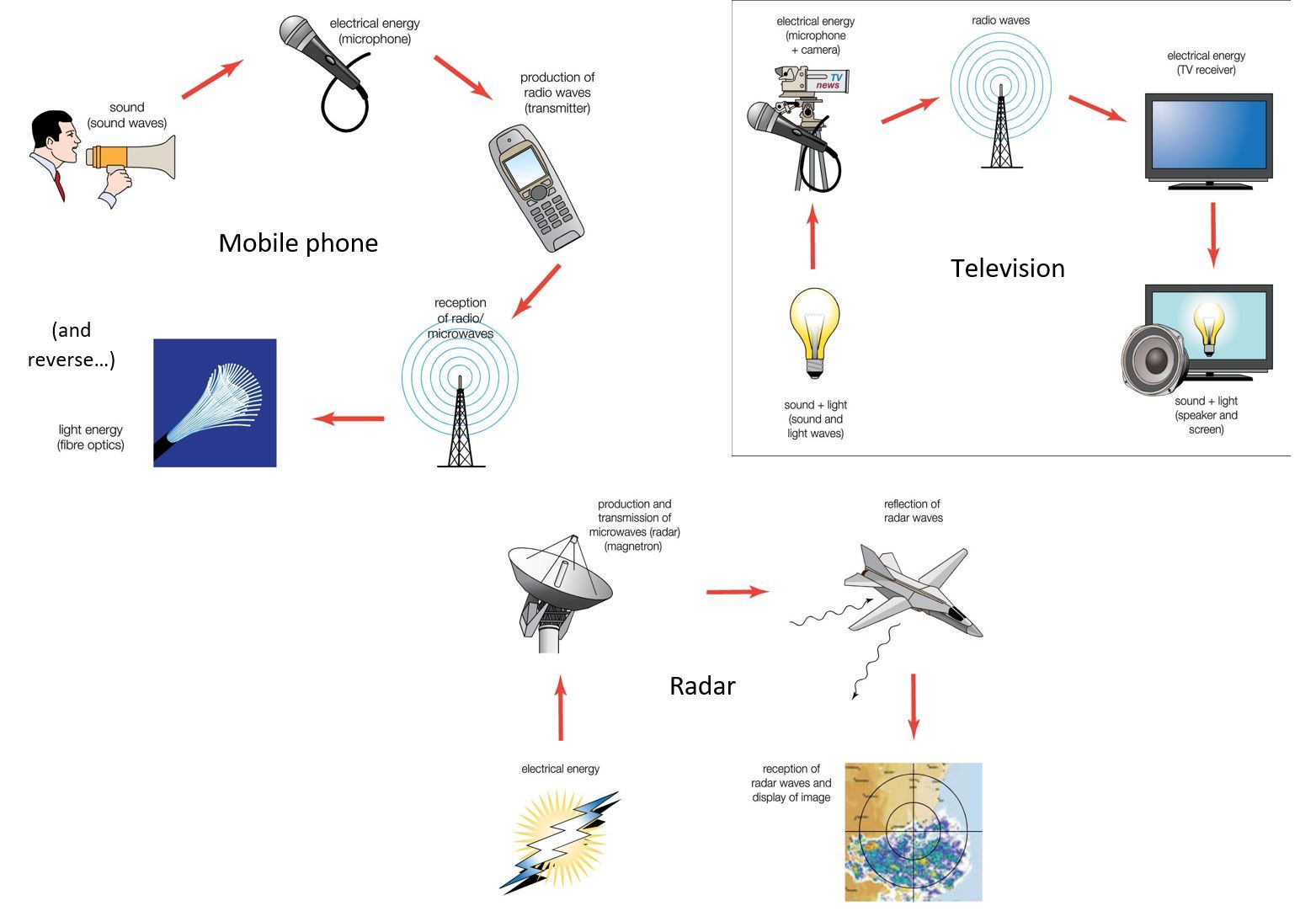
3.2P - The energy transfers in modern technology
Analyse information to identify the waves involved in the transfer of energy that occurs during the use of one of the following: mobile phone, television, radar
Seite 6
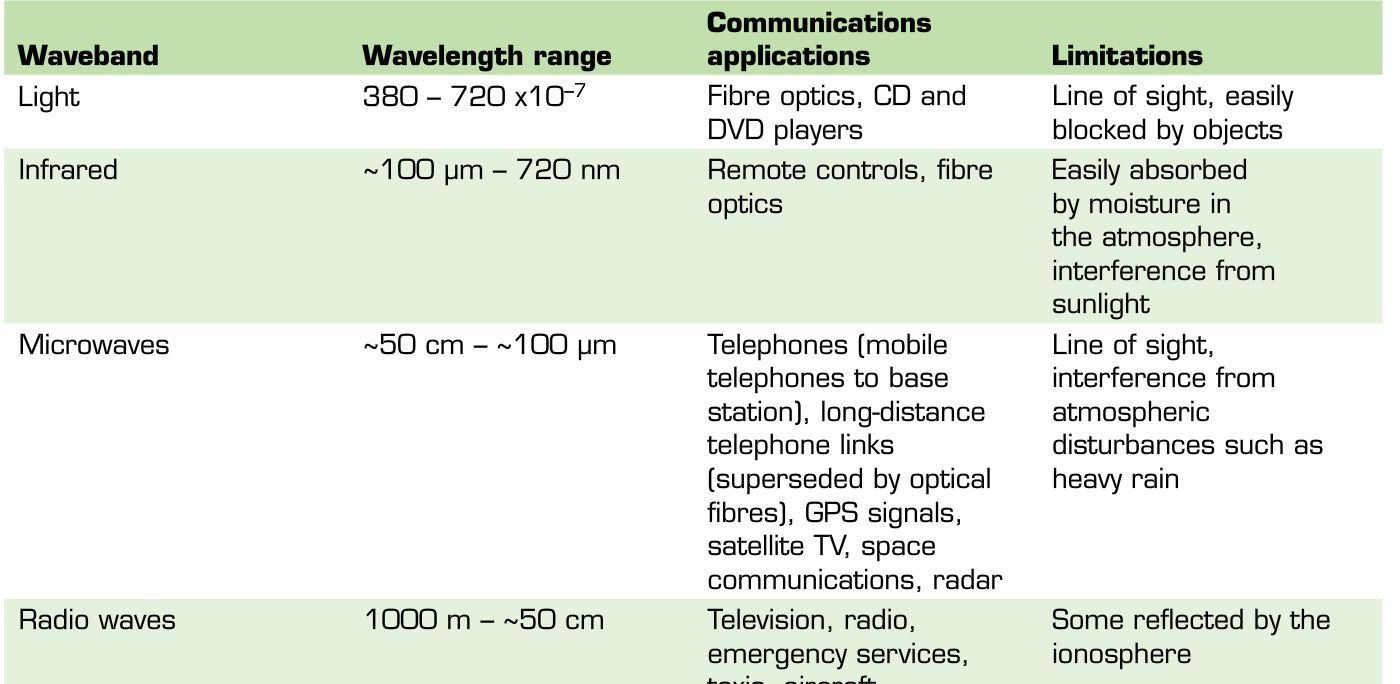
3.3P - Communications
Analyse information to identify the electromagnetic spectrum range utilised in modern communication technologies
UV rays, X-rays and Gamma rays generally present too much danger due to their high energy and are only used under extreme care and supervision
The Electromagnetic spectrum range used in modern communication technologies includes light and all other wavebands with longer wavelengths and less energy
Within each waveband there are many smaller sub-bands that each have their own specialised applicatications
Seite 7
3.6 - The many uses for the available electromagnetic spectrum can lead to overcrowding
Discuss problems produced by the limited range of the electromagnetic spectrum available for communication purposes
Selecting wavelengths and frequencies for a specialised application is made according to the characteristics of the radiation and the nature of its application
Successful TV broadcasts need to be transmitted within a certain range of wavelengths, because the receiver must be relatively uncomplicated, tuned to a limited range of wavelengths
Transmission wavelengths used for mobile phones must be restricted to the size of their antennae, as well as the range and portability of the devices
If 20 million mobile phones were each allocated their own unique frequency, the limited range would be easily exceeded or the frequencies would be so close that the phones would become confused, as signals meant for one phone would be received by others
The bandwidth (the maximum rate of information) transfer for mobile phone frequencies far exceeds that required for one voice or video call. This allows multiplexing (the sophisticated encoding of the signals), so that many telephones are able to use the same frequency at the same time, with each telephone only decoding the information addressed uniquely to it
Other crowded frequency ranges include those used for emergency services, taxis, public transport and CB radios, which typically require clear, several kilometre range two-way voice communications that will work with practical antennae
The UHF radio band is ideal for this purpose, providing hundreds of channels with specialised frequencies, allocated to all these groups without interfering with each other
Users must have a license to use their allocated frequency so that there is correct operation without interference
Informationen
- Beschreibung
- Year 12 Physics (1. The World Communicates) Notiz am 3. Using the Electromagnetic Spectrum, erstellt von Phillip Kristyono am 18/02/2017.
- Erstellt von
- Phillip Kristyono · Feb 2017
- Aktualisiert
- 1 Mär 2017
- Aufrufe
- 0
- Bewertung