
Notizen
Assignment 2
Inhalt der Notizen (2)
Seite 1
Company and Industry Background
Pfizer
1849 in Brooklyn, New York
Charles Pfizer and Charles Erhard
167 years old
International Revenue of $49 Billion
2nd largest manufacturer in world
Challenges:
Pharmaceutical industry issues with legal, political, technological forces, the industry will continue to face challenges
FDA
Started in 1906 - limited scope
Increased scope from 1938 when President expanded federal oversight to include pre market review, drug labelling and advertising
1992 - Prescription Drug User Fee Act to allow FDA to collect fees from drug manufacturers to aid in funding in pre market review process
These meant increased time and cost needed to be invested from drug manufacturers for new drugs
2006 - est cost of new drug was $802 million to $2 billion
60% of cost due to pre-market clinical trials
2012 - est cos of new drug is $5.5 billion, with inflation
Pfizer = R&D cost billion between 1997 and 2011- forced R&D budgets to be cut to control costs
Stifled innovation and revealed looming crisis
Many drug blockbuster drugs have gone off-patent recently, reduction in R&D resulted in failure to produce any drug with sig value
New drugs approved by FDA has halved every 9 years since 1950
This means that many consider the current, fully integrated business model of large pharmaceutical companies to be unsustainable
Business and Strategies
Pfizer - "blockbuster" business model
Heavily reliant on R&D pipeline to consistently develop and launch high volume drugs (with expected annual revenues of $1 billion or greater)
2012 - restructuring operations to new commercial operating model
Divested its infant nutrition business for $11.9 billion and spun-off its animal health unit, Zoetis
Restructured operations into 2 primary business segments:
Innovative Products
Global Innovative Pharma (GIP)
Global Vaccines, Oncology and Consumer Healthcare (VOC)
Established Products
"Our new commercial model will provide each business with an enhanced ability to respond to market dynamics, greater visibility and focus, and distinctive capabilities"
Innovative Products Business
Global Innovative Pharma (GIP) Business
Focuses on developing, registering and commercialising novel, value-creating medicines that improve patients' lives
Therapeutic areas include inflammation, cardiovascular/metabolic, neuroscience and pain, rare diseases and women's/men's health
Robust pipeline of medicines in inflammation, cardiovascular/metabolic disease, pain and rare diseases
Global Vaccines, Oncology, and Consumer Healthcare Business (VOC)
Three businesses with key elements:
Poised for high, organic growth
Distinct specialisation and operating models in science, talent, and market approach
Structured to ideally position Pfizer to be a market leader on a global basis
Established Products Business
Global Established Pharma (GEP) Business
This area consists of three primary product segments:
Peri-LOE products which are losing or approaching a losing position in market exclusivity
Legacy established products in developed markets that have lost market exclusivity and those with growth opportunities
Emerging market products with growth opportunities such as organic initiatives, partnerships, product enhancements, sterile injectables, and biosimilars
Pricing Strategy
Pfizer's revenue growth has been largely dependent on raising the price of older drugs, particularly those nearing patent expirations
34% of revenue growth over the past three years has come from increasing prices on existing drugs
Drug pricing scandals and increased media and societal attention on drug pricing, in general, makes Pfizer's reliance on a pricing strategy to drive top-line revenue growth unsustainable
Drug industry's flat net pricing in 2015
Growth Strategy
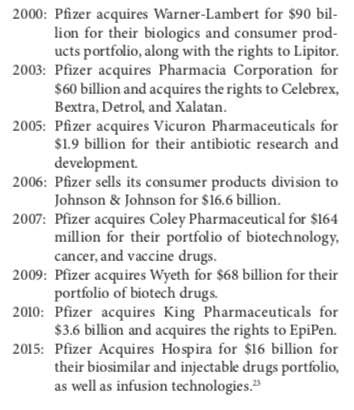
Became one of the biggest in the industry due to aggressive mergers and acquisitions (M&A)
Focus on 2 main strategies
Expanding its capabilities
Acquiring brands with strong revenues
Acquisitions provide new capabilities
2400614598 - library number
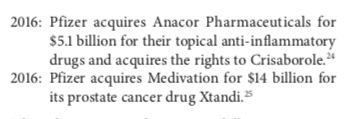
Unsuccessfully attempted to acquire foreign drug company and relocate HQ overseas for a tax break
Tried to move to Ireland with AstraZeneca but couldnt because of new law in congress that meant the company wasn't big enough
Innovation Strategy
Blockbusters were relied upon but are now believed to be rare
Opportunities for revolutionary drugs mostly been exploited, very few areas of medicine in which breakthrough drugs can have a huge impact
Shifted to strategy of maintaining an industry-leading drug pipeline from in-house development to being more reliant on strategic partnerships and mergers and acquisitions
Support its interest in strategic partnerships, in 2004 Pfizer Venture Investments (PVI) was founded
Goal: to identify and invest in companies which are developing compounds and technologies that will enhance Pfizer's drug pipeline and help drive the future of the pharmaceutical industry
2016 - announced would be expanding investment strategy to include investments in early-stage scientific innovation in immuno-oncology, gene therapy and other cutting-edge fields
$46 million invested in 4 companies
Partnership provides world-class resource in start-up organisations to accelerate the pace of scientific innovation and to help develop their pipeline of drugs
Inside Pfizer
Management team
Ian C Read - CEO
Laurie J Olso - Executive VP Strategy Portfolio and Commercial Operations
Rod MacKenzie, PhD - Executive VP Chief Development Officer
Frank D'Amelio - Executive VP Business Operations and CFO
Major Shareholders
Publically traded company with 6.2 billion shares in December 31, 2015
Primary shareholders are institutional investment companies:
Vanguard Group, Inc.
BlackRock Institutional Trust Company
JP Morgan Chase & Co
Only non-institutional shareholders are executive-level leadership within org
Human Resource
Led by Charles H. Hill III - ex Executive Vice President of Worldwide Human Resources since December 2010
In 2007 UK manufacturing site had globally recognised Explorer Training Program
Year long and covered dynamics that included purpose, leadership, motivation, meetings and the environment
Also had traditional techniques to develop personnel
Mentor Match
Organisational Culture
2010 - Read took over company and discovered many broken processes
FDA applications were sometimes not reviewed because of how bad it was
Empowered employees to speak out with coins (engraved with "Straight talk" and "ownit!", also to create accountability
"OWNIT!" has become a part of the companies culture
Mission, Purpose and Values
Mission: "To be the premier, innovative biopharmaceutical company"
Purpose: "Innovate to bring therapies to patients that significantly improve their lives"
Core values: "Customer focus; Community; Respect fro people; Performance; Collaboration; Leadership; Integrity; Quality; Innovation
Operations and Supply Chain
Innovative Products + Established Products businesses are led by single manager responsible for:
Commercial productivity
Research and development activities that meet proof-of-concept requirements
Innovative Products Business tasked with:
Development and commercialisation of new medicines and vaccines
Established Product Business focuses on:
Branded generic medicines and legacy brands that have lost or will lose market exclusivity in short term
Both have geographic footprints that span developed and emerging markets
Global supply chain network:
64 internal manufacturing facilities
Over 200 supply chain partners
134 logistics centres in 2015
850 major product groups
Serialisation program employed in supply chain
Highly Orchestrated Supply Network (HOSuN) to connect in an integrated system
Inventory
Transportation
Logistics
Associated security
Compliance
Environmental health
Safety
Also used for continuity risk assessment and resolution
56% of 2015 revenue from operations outside the US which represented $27.1 billion
Marketing and Distribution
Marketing organisation is responsible for educating a wealth of stakeholders regarding product approved uses, benefits and risks
Uses direct-to-consumer advertising campaign in the US
Provides similar info and suggests interested customers have discussions with docs
"Global Consumer Healthcare" business uses its own sales and marketing organisation to promote its products and occasionally uses distributors in smaller markets
All products must be approved by FDA before marketing campaigns. Oversight includes:
"regulations that govern the testing, manufacturing, safety, efficacy, labelling and storage of our products, record-keeping, advertising and promotion"
Several federal and state laws enacted to prevent fraud and abuse
Has been criticized in the past regarding some of its foreign marketing practices
August 2012, SEC fined $45 million for violating US Foreign Corrupt Practices Act
Were bribing foreign officials to gain the approval of sales and prescriptions
Concealed under marketing and promo expenses
Reported violations voluntarily in 2004 and implemented anti-corruption training
Distribution perspective:
Prescription pharmaceutical products primarily are sold primarily to wholesalers
2015 top three biopharmaceutical wholesalers accounted for approximately 34%of our total revenues and (74% of total US revenues)
Direct shipments to
Retailers
Hospital
Pharmacies
Clinics
Vaccines, sells directly to
Individual provider officies
CDC
Wholesaler
Financial Condition
Over past 5 years - revenues been steadily decreasing and reducing net income to $6.96 billion
The primary cause is decreasing revenue of continuing operations
Spin-off Zoetis had compounding effects on decrease in revenue and cost of sales post 2013
Current assets - steady over past 3 years but a recent dip in short term investments
Goodwill increasing, reflecting in premium paid for acquisitions in recent years
Short term borrowing has increased almost twofold in past 5 years
Total liabilities are higher and total equity lower
Competitive Landscape
Major competitors:
Pharmaceutical industry invests heavily in research and clinical trials and relies on obtaining FDA approval and patent protection for products
Ensures prolonged profits while next drug is in research
High payoffs for successful drugs but also costs of time and investment for failures if isn't successful
Largest competitors are Merck, Novartis, Bristol-Myers and Johnson & Johnson
Examples:
Merck & co. (MRK)
1891, $39.5B in 2015 revenues
Zetia is cholesterol-lowering drug branded Zetia - direct competitor of Lipitor from Pfizer
Novartis AG (NVS)
1996 Switzerland
Industry world leader in sales
$50.4B in 2015 revenue
Several directly competing products
Bristol-Myer Squibb (BMY)
New York 1887
$18.8B 2015 revenues
Johnson & Johnson (JNJ)
1886 American multinational meidcal devices, pharmaceutical (40% by revenues)
External Environment
Heavily influenced by legal, political and technological forces
Also influenced by societal views on issues like drug prices and tax evasion
Regulation
FDA primary oversight
Office of Pharmaceutical Quality (OPQ) created by FDA in 2015 and enhances oversight of drug quality
Affordable Care Act
Drug Pricing Concerns
Looking Forward
Ian Read - CEO for 6 years
Patent for Lipitor has expired, best selling drug in history is no longer contributing as much to Pfizer's bottom line
Is firm still capable of delivering a susttainable pipeline of profitable durgs or are major changes to strategy and operations necessary
Is pfizer's opp for sig inversions over with the failed takeover attempts of AstraZeneca and Allergan
Drug pricing scandals and healthcare reform have created an environment of active political reform
How can Pfizer navigate the upcoming challenges taht growing societal discontent with "Big pharma" and the rising cost of health care present
Do threats also provide opportunities
How can Pfizer best be positioned for growth and profitability in this challenging business environment?
Seite 2
Other analysis models
GAP analysis - topic 7
Carroll’s Pyramid - https://www.tutor2u.net/business/reference/carrolls-csr-pyramid#:~:text=Carroll's%20CSR%20Pyramid%20is%20a,should%20meet%20their%20social%20responsibilities.&text=CSR%20is%20built%20on%20the,complies%20with%20all%20laws%20%26%20regulations
Generic Strategies Framework -
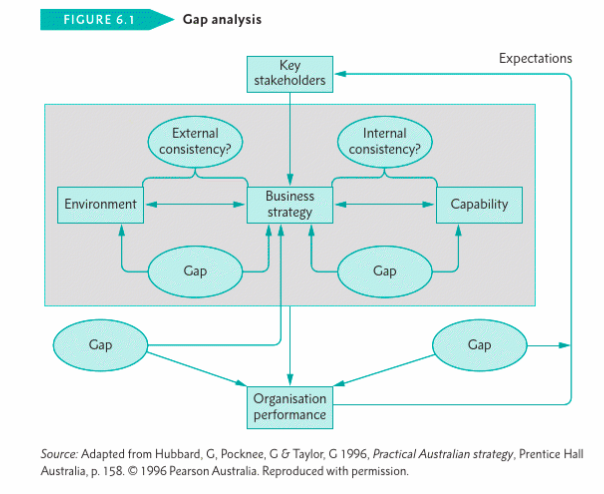
GAP Analysis
Assesses the ‘fit’ between an organisation’s strategy and: § its environment (external) § its capabilities (internal)
Assesses fit between strategy, performance and stakeholder expectations
Aims to ensure that all elements of strategic analysis are considered
Both positive and negative ‘ gaps ’ can be revealed
Macro-environmental GAP
Informationen
- Beschreibung
- 3rd year IBA312 Management Strategy and Decision Making Notiz am Assignment 2, erstellt von Juliette Cross am 14/07/2020.
- Erstellt von
- Juliette Cross
- Aufrufe
- 1
- Bewertung