
Quiz
PHSI3011 12-2 Comparative Physiology and Thermal #2
Dieses Quiz enthält Fragetypen, die sich im gewohnten Player öffnen.
Fragen in diesem Quiz (33)
1What is Tb?
(just imagine the "b" is subscript)
[blank_start]__________[blank_end]- ABody Temperature
2What is Ta?
(just imagine the "a" is subscript)
[blank_start]__________[blank_end]- AAmbient Temperature
3"Homeotherm" means:
- A"one body temperature"
- BHomeoerotically "hot"
- CSelf-heating
4Tb varies with circadian rhythm by up to 1 degree. When is it lowest and highest?
(again, imagine the "b" is subscript)- A3-6am lowest; 3-6pm highest
- B3-6am highest; 3-6pm lowest
- C12-3am lowest; 12-3pm highest
- D12-3am highest; 12-3pm lowest
5Tb varies with the menstrual cycle, usually increasing ~0.5-1°C during the:
(again, imagine the "b" is subscript)- APost-ovulatory phase
- BPost-menstrual phase
- CFollicular phase
- DPost-follicular phase
6Babies are less able to maintain Tb. Why?
(just imagine the "b" is subscript)
(select all that apply)- ADon’t readily shiver or sweat
- BHigh surface-mass ratio
- CThey’re dumb
7During a fever (or exercise), the normal Tb is:
(just imagine the "b" is subscript)- A34-36°C
- B36-38°C
- C38-40°C
- D40-42°C
8True or false: Old people also have less effective regulation, due in part to their reduced ability to dissipate heat. One reason for this is sweat gland atrophy.
- ARichtig
- BFalsch
9True or false: Old people also have less effective regulation, due in part to their reduced ability to generate heat. One reason for this is sweat gland atrophy.
- ARichtig
- BFalsch
10E = G + T*S
E = [blank_start]___[blank_end]
G = [blank_start]___[blank_end]
T = [blank_start]___[blank_end]
S = [blank_start]___[blank_end]- ATotal internal energy
- BEnergy emitted from a system
- Cdisposable ("Good") energy
- Denergy Gained by a system
- Eabsolute Temperature
- FThermodynamic energy within a system
- GTemperature increase
- Hentropy
- Itotal energy within a System
11True or false: an Endotherm is an organism that can generate its own heat.
- ARichtig
- BFalsch
12True or false: Metabolism is defined as all the chemical processes involved in energy production, energy release, and growth.
- ARichtig
- BFalsch
13Anabolic vs Catabolic:
- AAnabolic = FORMATION of substances
- BAnabolic = BREAKDOWN of substances
- CCatabolic = FORMATION of substances
- DCatabolic = BREAKDOWN of substances
14Metabolic Rate (MR) = the rate at which energy is consumed during:
(select all that apply)- Ainternal work
- Bexternal work
- Cenergy expenditure / unit of time
- Denergy expenditure (independent of a unit of time)
15BMR vs RMR
The difference between BASAL metabolic rate and RESTING metabolic rate is:- ABoth are idling, but Basal is during minimal part of the day
- BBoth are idling, but Resting is during minimal part of the day
16Metabolic Rate (MR) depends on:
(select all that apply)- AMuscle activity (voluntary)
- BMuscle activity (involuntary)
- CCertain hormones
- DA rise in tissue temperature itself
17Hormones that can influence Metabolic Rate (MR) include Thyroxine and Adrenaline. What effect can they have?
- AAdrenaline increases MR; Thyroxine decreases MR.
- BAdrenaline decreases MR; Thyroxine increases MR.
- CBoth DECREASE MR.
- DBoth INCREASE MR.
18Under resting conditions, the rate of heat production is:
- A~80 kcal/h
- B~400-600 kcal/h
- C~80-120 kcal/h
- D~120-160 kcal/h
- E~800 kcal/h
19During a fast walk or jog, Metabolic Rate (MR) is increased to 400-600 kcal/h. In the absence of compensatory heat loss (sweating etc), this extra thermal load would increase Body Temperature by how much?
- A1°C every 8-10 minutes
- B1°C every minute
- C1°C every hour
- D1°C every 10-20 minutes
- E1°C every 1-2 hours
20The most common method to measure metabolic rate is:
- AIndirect calorimetry
- BGuesswork?
21Animals including the stripe-faced dunnart (Sminthopsis macroura) are heterothermic. Heterotherms are:
- AAble to maintain homeothermic thermoregulation, but sometimes can enter torpor.
- BAnimals which maintain thermoregulation collectively.
22Torpor vs Hibernation.
What's the difference?- ATorpor lasts less than a day; Hibernation lasts longer than a day.
- BTorpor lasts less than a day; Hibernation is a multiday series of torpor bouts.
23Torpor and hibernation use are found in which groups:
(select all that apply)- AArtiodactyls (even toed ungulates - e.g. sheep, cattle, pigs, camels, goats)
- BCertiodactyls (marine mammals - e.g. whales, dolphins, porpoises)
- CPerissodactyls (odd-toed ungulates - e.g. horses, rhinoceroses)
- DMonotremes (e.g. echidnas)
- EMarsupials (e.g. pygmy possums)
- FPrimates (e.g. Antivaxxers)
- GInsectivores (Eulipotypla: European shrews and hedgehogs; Afrotheria: tenrecs and elephant shrews)
- HCarnivores (badgers and bears)
- IRodents (e.g. ground squirrels and hamsters)
- JBats
24Are there Aussie birds which hibernate?
- AYeah
- BNah
25"Super-hibernator":
This is fucking awesome - the arctic ground squirrel hibernates at body temperatures of ~0°C! around the lips is at (or slightly above) zero, while some other parts (including colon) get BELOW 0°C.
Yeah, this is true. So cool, though (geddit?? ...sigh).- ARichtig
- BFalsch
26Current view of the efferent mechanisms of thermoregulation.
Label the three appropriate areas.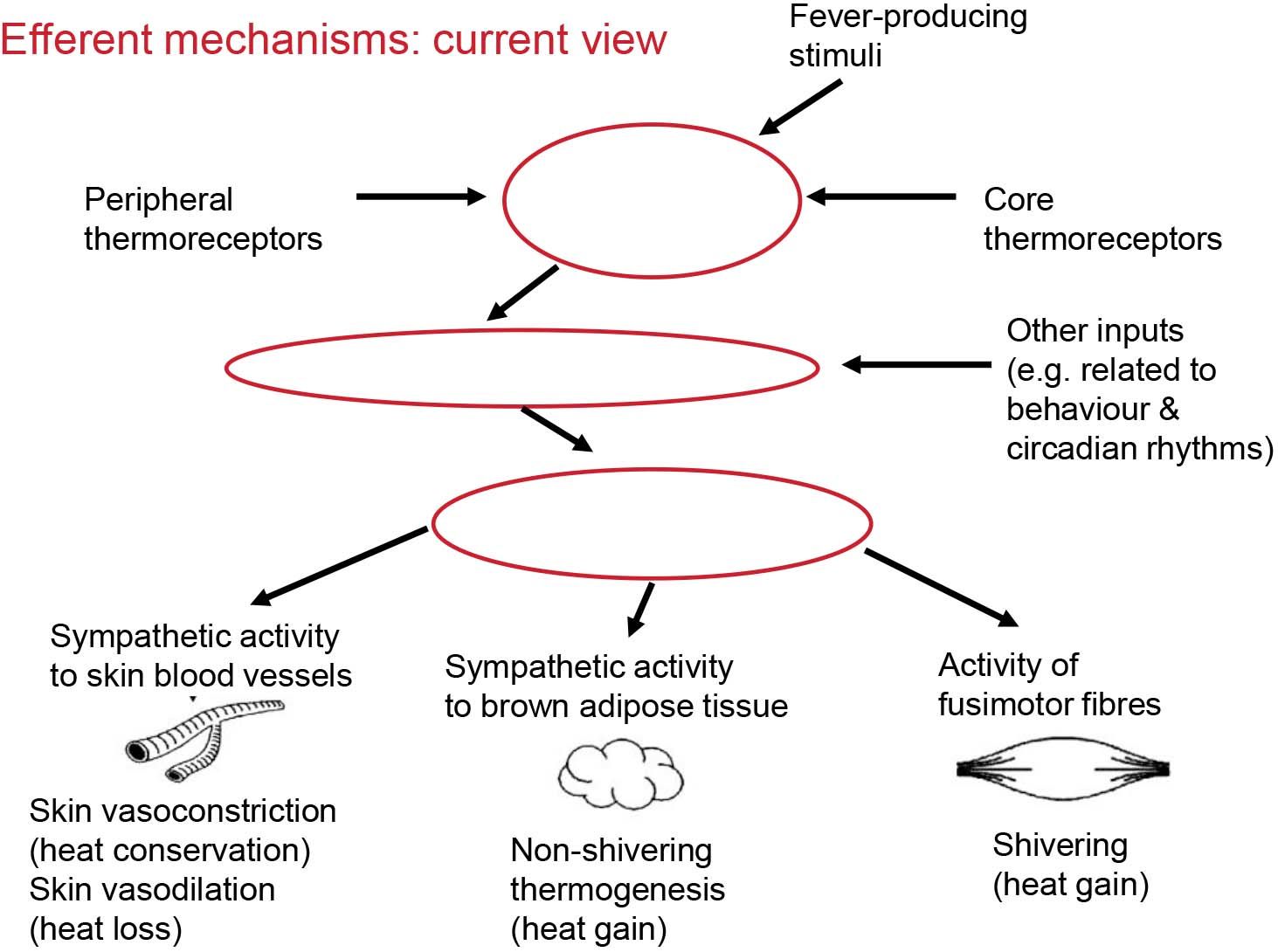
- AHypothalamic preoptic area
- BDorsomedial hypothalamus
- CRaphe nuclei in medulla oblongata
- DHypothalamic preoptic area
- EDorsomedial hypothalamus
- FRaphe nuclei in medulla oblongata
- GHypothalamic preoptic area
- HDorsomedial hypothalamus
- IRaphe nuclei in medulla oblongata
27True or false: Brown Fat / Brown Adipose Tissue (“BAT”) can induce non-shivering thermogenesis in the absence of muscle stimulus.
- ARichtig
- BFalsch
28During cold exposure, [blank_start]__________[blank_end] [blank_start]__________[blank_end] release activates BAT by stimulation of lipolysis and “futile” UCP1-dependent mitochondrial respiration.
- ASympathetic
- BParasympathetic
- CNorepinephrine (/noradrenaline)
- DEpinephrine (/adrenaline)
29True or false: UCP1 is found in significant levels in the cortex of non-torpor mammals.
- ARichtig
- BFalsch
30UCP1 is:
[blank_start]_____[blank_end] [blank_start]_____[blank_end] [blank_start]_____[blank_end] 1- AUn-
- BUniversal
- CProgenitor
- DProtein
- ECoupling
- FCold-sensitive
- GClimate-sensitive
31Which of the 4 ways of heat loss is the most physiologically significant (under normal conditions)?
- ARadiation
- BConduction
- CConvection
- DEvaporation
32Hot flushes usually last how long?
- A1-5 min
- B5-10 min
- C10-15 min
- D15-30 min
- E30-60 min
33Hot flushes are believed to occur because of:
- AOestrogen withdrawal
- BProgesterone withdrawal
- CChanges in the uterine epithelium
Informationen
- Beschreibung
- PHSI3011 12-2 Comparative Physiology and Thermal Physiology #2
- Autor
- Gelöschter Nutzer
- Sprache
- English
- Aufrufe
- 25
- Verlauf
- Erstellt am 29 Okt 2017 · aktualisiert am 10 Nov 2017
- Schlagwörter
- Bewertung
- Noch keine Bewertungen Bewerte dieses Quiz