
Quiz
Childhood Year 1: Pathology focus :)
Dieses Quiz enthält Fragetypen, die sich im gewohnten Player öffnen.
Fragen in diesem Quiz (121)
1What is characteristic of the Paget's disease?
- Aincreased osteoblast and osteoclast activity
- B"bone pain" generally in one area, commonly pelvis and spine
- Cstructurally disorganized bone matrix with both excessive bone mass and bone resorption
- Dincreased osteoblast but decreased osteoclast activity
- Euniform concentric rings of organized bone matrix
- F"bone pain" spreading out to different areas of the body
2Osteoblasts mature into these cells [blank_start]osteocytes[blank_end] once trapped in the bone matrix; they activate bone formation via [blank_start]altered signalling[blank_end] and apoptosis.
- Aosteocytes
- Baltered signalling
3What do osteoblasts do?
- Asynthesize new bone matrix
- Babsorb and resorb more bone matrix
- Ccontrol bone metabolism
4What is characteristic of osteoclasts?
- Afrom hematopoeitic stem cells
- Bacts as macrophages
- Cresorb bone
- Dmake more bone matrix
- Eacts as fibroblasts
- Ffrom mesenchymal stem cells
5Where would you have the most interstitial growth?
- Aepiphysis
- Bmetaphysis
- Cdiaphysis
- Depiphyseal growth plates
- Eperiosteum
6[blank_start]Interstitial[blank_end] growth is [blank_start]lengthening[blank_end] growth. This is due to increased number of matrix-depositing cells. [blank_start]Appositional[blank_end] growth is [blank_start]widening[blank_end] growth. This is due to increased matrix deposition by the same number cells.
- AInterstitial
- BAppositional
- Cwidening
- Dlengthening
7In terms of calcium metabolism, the thyroid releases what hormone?
- Acalcitonin
- BTSH (thyroid-stimulating hormone)
- CT4
- DT3
- EPTH (parathyroid hormone)
8Calcitonin causes increased calcium deposition in bone by inhibiting bone resorption.
- ARichtig
- BFalsch
9What does parathyroid hormone do?
- Aincrease osteoclast activity
- Bincrease osteoblast activity
- Cincrease osteocyte activity
- Ddecrease osteoclast activity
- Edecrease osteoblast activity
- Fdecrease osteocyte activity
10Falling onto an outstretched hand/wrist causes what type of fracture most commonly?
- Ascaphoid fracture
- Bradial styloid fracture
- Chumeral fracture
- D3rd metacarpal fracture
- Eulnar styloid process
- Flunate fracture
11What are bones of the hand?
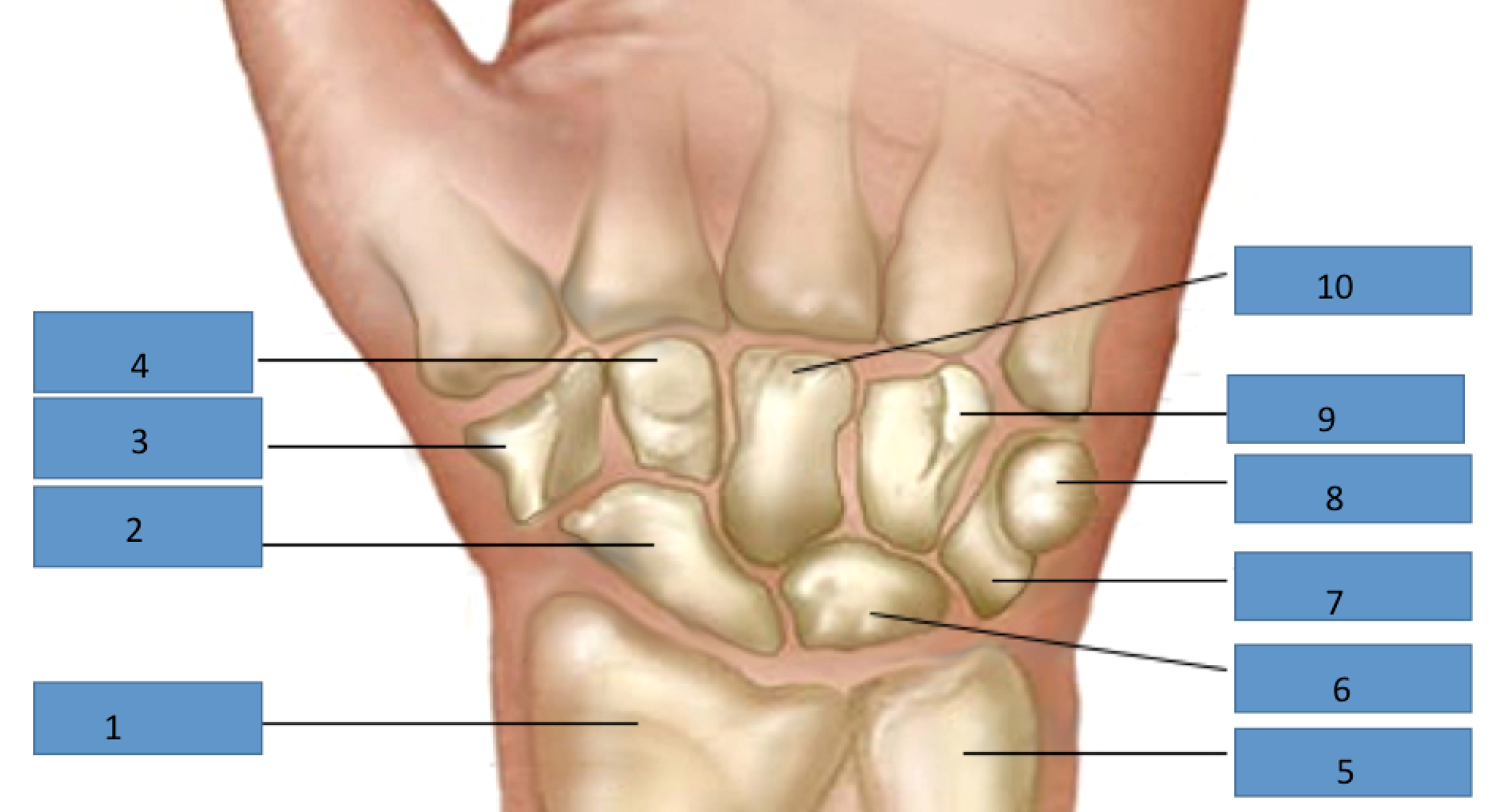
- Ascaphoid
- Blunate
- Ctriquetrum
- Dpisiform
- Etrapezium
- Ftrapezoid
- Gcapitate
- Hhamate
12What nerve would you damage if you were to break the shaft of the humerus?
- Aradial
- Baxillary
- Cmusculocutaneous
- Dmedial
- Eulnar
13If the radial nerve is damaged, how might it present?
- Awrist drop even with fully extended forearm/arm
- Binability to abduct arm
- Cinability to flex elbow
- Dinability to flex shoulder
- EBenedict claw with fully extended forearm/arm
14What does the musculocutaneous innervate muscle-wise?
- Aflexor muscles of the arm
- Bflexor muscles of the forearm
- Cextensor muscles of the arm
- Dextensor muscles of the forearm
- E3.5 fingers of the hand
15What does the axillary innervate muscle-wise?
- Adeltoid, teres minor (shoulder muscles)
- Bposterior arm flexor muscles
- Cposterior forearm extensor muscles
16What does the radial nerve NOT innervate muscle-wise?
- Aposterior arm
- Bposterior forearm
- Cposterior medial 2 fingers of the hand
17What does musculocutaneous innervate muscle-wise?
- Aanterior forearm
- Banterior arm
- Canterior 3 medial fingers
- Dposterior 3 medial fingers
- Eposterior arm
18What does ulnar nerve innervate muscle-wise?
- Aposterior forearm muscles
- Bposterior arm muscles
- Canterior forearm muscles
- Danterior arm muscles
- Eanterior medial 2 fingers
- Fposterior lateral 2 fingers
19If there is loss of elbow flexion (can't flex biceps), there is damage to the [blank_start]musculocutaneous[blank_end] nerve.
- Amusculocutaneous
20if there is shoulder weakness or you're unable to abduct shoulder, then there is damage to the [blank_start]axillary[blank_end] nerve.
- Aaxillary
21A hand of benediction is sign of damage to the [blank_start]median[blank_end] nerve.
- Amedian
22Being unable to abduct or adduct the last 2 fingers is indicative of damage to the [blank_start]ulnar[blank_end] nerve.
- Aulnar
23What does the ulnar provide sensory innervation to?
- Aposterior and anterior 1.5 medial fingers
- Bposterior and anterior lateral 2.5 fingers
24What does the median provide sensory innervation to?
- Aanterior 3.5 lateral fingers
- Bposterior 3.5 lateral fingers
- Canterior 1.5 lateral fingers
- Dposterior 1.5 lateral fingers
25What does radial nerve provide sensory innervation to?
- Alateral arm
- Bposterior forearm
- Cposterior hand
- Danterior hand
- Eanterior forearm
- Fmedial arm
26The axillary nerve innervates the...in sensory wise
- Aregimental badge area
- Banatomical snuffbox area
- Cradial styloid badge area
27Musculocutaneous provides sensory innervation to lateral forearm down to the thenar prominence (at the base of the thumb.)
- ARichtig
- BFalsch
28Numbness at the back of the wrist and hand is due to damage to the sensory innervation by the [blank_start]radial[blank_end] nerve.
- Aradial
29Damage to the [blank_start]median[blank_end] nerve will lead to parethesia to the lateral 3 anterior fingers.
- Amedian
30Loss of sensation in the median of the hand and the medial first 2 fingers is damage to the [blank_start]ulnar[blank_end] nerve.
- Aulnar
31Damage to the radial nerve leads to wrist drop. What are some pathologies in which the radial nerve gets hurt?
- ARadial nerve palsy
- BSaturday night nerve palsy
- CHumerus shaft fracture
- DErb's palsy
- EBell's palsy
- FKlumpke's palsy
32How might you injure the axillary nerve?
- Adislocation of the humeral head
- Bsurgical neck of the humerus fracture
- Cdislocation of the clavicle
- Dpulling the deltoid muscle
33You might harm the musculocutaneous nerve via a medial epicondyle fracture.
- ARichtig
- BFalsch
34A winged scapula is indicative of damage to the [blank_start]long thoracic nerve[blank_end] (spinal roots C5-C7.)
- Along thoracic nerve
35The spinal roots of the musculocutaneous nerve are (in numerical order from least to greatest) are [blank_start]C5[blank_end], [blank_start]C6[blank_end], and [blank_start]C7[blank_end].
- AC5
- BC6
- CC7
36The Axillary nerve is from the roots [blank_start]C5[blank_end] and [blank_start]C6[blank_end] (in numerical order.)
- AC5
- BC6
37The radial nerve is from the spinal roots [blank_start]C5[blank_end] to [blank_start]T1[blank_end].
- AC5
- BT1
38The ulnar nerve is from the spinal roots of [blank_start]C8[blank_end] and [blank_start]T1[blank_end].
- AC8
- BT1
39The spinal roots of the median nerve is [blank_start]C5[blank_end] or [blank_start]C6[blank_end] to [blank_start]T1[blank_end].
- AC5
- BC6
- CT1
40Which of these myotomes and action pairings are correct?
- AC4: shoulder elevation
- BC5: chicken abduction (wings)
- CC6: elbow flexion
- DC6: wrist extension
- EC7: elbow extension
- FC7: wrist flexion
- GC8: thumb extension (thumbs up)
- HT1: finger abduction (fanned fingers)
- IC6: wrist flexion
- JC6: elbow extension
41What is true regarding Erb's palsy?
- Adamage to the upper part of the brachial plexus (C5 and C6)
- Bdamage to the lower part of the brachial plexus (C7 C8 and T1)
- Cmotorbike accidents can cause this
- Dimproper birthing techniques (pull baby's head against pelvic bones while labor) can cause this
- Elanding on an outstretched arm from a big height can cause this
- Fresults in a "waiter's tip"
- Gresults in a "clawed hand"
- Hdamage to the axillary nerve
- Idamage to the suprascapular nerve
- Jdamage to the musculocutaneous nerve
42What is the myasthenia gravis?
- AAt the neuromuscular junction, the body produces antibodies against the acetylcholine receptors
- BIntense morning sickness that needs anti-emetics as treatment
- Cthe gradual degradation of muscle fibers, starting from top of the head to bottom of the feet
- Dloss of sensation in some or all motor units of certain muscles
43How might myasthenia gravis present?
- Aptosis
- Bfluctuating fatiguability
- Cdysphagia
- Dlimb weakness
- Efever
- Fconstant fatigue
- Gslow reaction times
44How would you manage myasthenia gravis?
- Aacetylcholine esterase inhibitors
- Bacetylcholine reuptake enhancers
- Cacetylcholine esterase activators
- Dacetylcholine agonists
45The [blank_start]abdominal aorta[blank_end] bifurcates into the [blank_start]right common illiac[blank_end] and the [blank_start]left common illiac[blank_end]. The right illiac again bifurcates into the [blank_start]internal illiac[blank_end] and the [blank_start]external illiac[blank_end]. The external illiac becomes the [blank_start]right femoral[blank_end], which is the deep artery of the right thigh. In the popliteal fossa, the right femoral becomes the right [blank_start]popliteal[blank_end] artery. The right popliteal further bifurcates into the [blank_start]right anterior tibial[blank_end] and the [blank_start]right posterior tibial.[blank_end] The right posterior tibial, which is the pulse felt at the ankle, becomes the [blank_start]posterior right fibular.[blank_end] The right anterior tibial becomes the right [blank_start]dorsalis pedalis[blank_end].
- Aabdominal aorta
- Bcommon thoracic aorta
- Cright common illiac
- Dright mesenephric
- Eleft common illiac
- Fleft mesenephric
- Ginternal illiac
- Hinternal femoral
- Iexternal illiac
- Jexternal femoral
- Kright femoral
- Lright fibular
- Mpopliteal
- Ntibial
- Oright anterior tibial
- Pright anterior popliteal
- Qright posterior tibial.
- Rright posterior popliteal
- Sposterior right fibular.
- Tanterior right fibular.
- Udorsalis pedalis
- Vdorsis plantaris
46Which of the following could cause carpal tunnel syndrome?
- Apregnancy
- Brheumatoid arthiritis
- Crepetitive use of hands
- Dseptic arhritis
- Eosteomalacia
- Fosteoporosis
47Compression of the [blank_start]median[blank_end] nerve as it travels through the [blank_start]carpal[blank_end] [blank_start]tunnel[blank_end] in the wrist is Carpal Tunnel Syndrome.
- Amedian
- Bcarpal
- Ctunnel
48How does Carpal Tunnel Syndrome present?
- Anumbness
- Bparasthesia/pain over median nerve area
- Cthumb muscle atrophy
- Dworse at ngiht
- Eworse at day
- Fredness
- Gswelling
49What are management options of the carpal tunnel syndrome?
- Alocal corticosteroids
- Bnight time splinting
- Cday time splinting
- Danabolic steroids
- Ealways surgical decompression
- Fif severe surgical decompression
- Gavoid further injury via strain
50What are the nerves of the lower limb?
- AFemoral
- BSciatic
- CObturator
- DCommon fibular
- Ecommon fibular deep branch
- Fcommon fibular superficial branch
- Gtibial
- Hsural
- Ifibial
- Jcommon femoral
51The [blank_start]sural[blank_end] nerve only innervates sensory-wise. It innervates the skin of the [blank_start]posterior[blank_end] leg and [blank_start]lateral[blank_end] foot.
- Asural
- Bposterior
- Clateral
52What does the sciatic innervate muscle-wise?
- Athe posterior compartment of the thigh
- Bthe anterior compartment of the thigh
- Clateral compartment of the thigh
- Dthe medial compartment of the thigh
53What does the femoral nerve innervate muscle-wise?
- Aanterior thigh
- Bposterior thigh
- Clateral thigh
- Dmedial thigh
54What does the obturator nerve innervate muscle wise?
- Aanterior thigh
- Bposterior thigh
- Clateral thigh
- Dmedial thigh
55What does the common fibular deep branch innervate muscle wise?
- Aanterior leg
- Bposterior leg
- Clateral leg
- Dmedial leg
56What does the superficial branch of the common fibular innervate muscle-wise?
- Aanterior leg
- Bposterior leg
- Clateral leg
- Dmedial leg
57What does the tibial nerve innervate muscle-wise?
- Aposterior leg
- Banterior leg
- Cmedial leg
- Dlateral leg
- Esole of the foot
- Ftop of the foot
58The femoral nerve's sensory innervation includes the [blank_start]anterior[blank_end] thigh and [blank_start]medial[blank_end] leg.
- Aanterior
- Bmedial
59The obturator nerve's sensory innervation is the [blank_start]medial[blank_end] thigh.
- Amedial
60The [blank_start]deep[blank_end] branch of the common fibular's sensory innervation is the skin of the upper lateral leg.
- Asuperficial
61The deep branch of the common fibular's sensory innervation is the [blank_start]lower[blank_end] [blank_start]lateral[blank_end] leg and [blank_start]dorsal[blank_end] foot.
- Adorsal
- Blower
- Clateral
62Both the [blank_start]sciatic[blank_end] nerve (which bifurcates in the [blank_start]popliteal[blank_end] fossa into the [blank_start]tibial[blank_end] nerve and the common fibular nerve) and the [blank_start]tibial[blank_end] nerve innervate (sensory-wise) the [blank_start]posterior[blank_end] thigh and [blank_start]posterior[blank_end] leg and [blank_start]plantar[blank_end] foot.
- Asciatic
- Bpopliteal
- Ctibial
- Dtibial
- Eposterior
- Fposterior
- Gplantar
63The sciatic nerve's spinal roots are [blank_start]L4-S3[blank_end].
- AL4-S3
- BL2-S3
- CL1-L2
- DL3-S2
- EL4-S2
64Dorsiflexion is a sign of damage to what nerve?
- Atibial
- Bdeep branch of the common fibular
- Ccommon fibular
- Dfemoral
- Esural
65Inability to dorsiflex (so basically having a foot drop) is indicative of damage to what nerve?
- Acommon fibular
- Bsciatic
- Cfemoral
- Dsural
- Eobturator
- Fsuperficial branch of the common fibular
66What movements does the femoral nerve allow?
- Aflexion of hips
- Bextension of the knee
- Cextension of the hips
- Dflexion of the knees
- Eabduction of the leg
- Fadduction of the leg
67What innervates hip extension and knee flexion?
- AInferior gluteal
- Bsciatic nerve
- Csuperior gluteal
- Dtibial
- Ecommon fibular
68The [blank_start]obturator[blank_end] nerve allows hip adduction. On the other hand, the [blank_start]superior[blank_end] [blank_start]gluteal[blank_end] nerve allows hip abduction.
- Aobturator
- Bsuperior
- Cgluteal
69What are the main types of arthritis?
- Aosteoarthritis
- Binflammatory arthritis
- Cseptic arthritis
- Drheumatoid arthritis
- Ecrystal-induced arthritis
70[blank_start]Primary[blank_end] osteoarthritis and [blank_start]secondary[blank_end] osteoarthritis are the two types of osteoarthritis.
- APrimary
- Bsecondary
71The three types of inflammatory arthritis: rheumatoid, [blank_start]crystal-induced,[blank_end] and [blank_start]psoriatic[blank_end].
- Acrystal-induced,
- Bpsoriatic
72What are the two types of crystal-induced arthritis?
- Agout
- Bpseudogout
- Crheumatoid
- Dpsoriatic
- Enone of the above
73What is a degenerative disease that affects the joints, often due to wear and tear of articular cartilage?
- Aosteoarthritis
- Bsynovitis
- Ccrepitus
- Djoint stiffness
- Esubarticular sclerosis
74How might osteoarthritis present?
- Ajoint stiffness in the evening/morning
- Bgenerally worse after walking
- Cpalpable bony swelling on the hands' interphalangeal joints
- Dreduced range of motion
- Ecrepitus in the joints
- Finsomnia
- Ggeneralized swelling around major joints
- Hlocked joints
- Isynovitis
75An X-ray investigation of osteoarthritis will show...
- Areduced joint space
- Bsubarticular sclerosis
- Costeophytes
- Dbony cysts
- Eglued up joint space
- Fcartilage cysts
- Gosteocytes
76For osteoarthritis, the only management is supportive/palliative.
- ARichtig
- BFalsch
77What is an autoimmune disease that also ends in joint destruction?
- Arheumatoid arthritis
- Bseptic arthritis
- Costeoarthritis
- Dgout
78What is characteristic of rheumatoid arthritis?
- Aspecific joint pain in the morning
- Bspecific joint pain in the evening
- Cjoints affected symetrically
- Djoint inflammation
- Ejoints affected asymetrically
79All of these are part of the management of rheumatoid arthritis BUT
- ANSAIDs
- Bphysiotherapy
- CMethtrexate
- DDMARDs
- EAntibiotics followed by corticosteroids
80Which of the following regarding the investigation of rheumatoid arthritis is true?
- Awill find rheumatoid factor in serum
- Bx-ray will reveal bone erosion
- Cx-ray will reveal reduced joint space
- Dperiarticular osteopenia
- Evisible deformity
- Fx-ray will reveal
- Gexcessive bone growth
81The deposition of monosodium urate crystals in joints is a type of arthritis called [blank_start]gout[blank_end]. This usually happens if there are high levels of [blank_start]uric[blank_end] acid in the blood. The risk factors are [blank_start]obesity[blank_end] and [blank_start]purine[blank_end] (one of the building blocks of DNA) rich food. The most common occurence is at the big [blank_start]toe[blank_end] joint. Symptoms include [blank_start]synovitis[blank_end] (swelling of the joint), [blank_start]malaise[blank_end] (general ill-feeling), and [blank_start]tophi[blank_end] [blank_start]lumps[blank_end] (crystals.) These crystals are visible under polarized light microscopy. The primary way to test for this is to take [blank_start]aspirate[blank_end] fluid in the joint, gram stain it to rule out septic arthritis, and test the fluid for levels of uric acid.
- Agout
- Buric
- Cpurine
- Dobesity
- Etoe
- Fsynovitis
- Gmalaise
- Htophi
- Ilumps
- Jaspirate
82The treatment plan is for what?
1. NSAIDs
2. Colchicine
3. Corticosteroids- Achronic gout
- Bacute gout
- Cgoutisis
- Dpseudogout
83Other than lifestyle changes to reduce urate levels, we give those with [blank_start]chronic[blank_end] [blank_start]gout[blank_end] the drug allopurinol.
- Agout
- Bchronic
84Accumulation of monosodium urate monohydrate crystals in joints causes pseudogut as well.
- ARichtig
- BFalsch
85What is of clinical importance regarding septic arthritis?
- Amedical emergency
- Btake the aspirate fluid in join and gram stain it
- Ctake a blood culture (full blood count) and see if there's a high amount of leukocytes
- Dtake a blood culture (full blood count) and see if there's a high amount of c-reactive protein
- Ex-ray will show increased joint space
- Fx-ray will show decreased joint space
- Gchronic/gradual development
- Hto manage, should drain aspirate fluid
- Ito manage, should give antibiotics
- Jpresents like an infection plus reduced joint functionality and synovitis
86Prostacyclin is prostaglandin [blank_start]12[blank_end], which is produced by the [blank_start]epithelium[blank_end]. Prostacyclin prevents excess [blank_start]platelet[blank_end] [blank_start]aggregation[blank_end] during the platelet plug.
- A12
- Bepithelium
- Cplatelet
- Daggregation
87[blank_start]Thrombocytoplenia[blank_end] is when there are too few platelets in the body. It can be treated with [blank_start]thrombopoietin[blank_end], which will increase the platelet number. It takes [blank_start]6[blank_end] days for progress to be apparent though.
- AThrombocytoplenia
- Bthrombopoietin
- C6
88Platelets only adhere to smooth epithelial surfaces.
- ARichtig
- BFalsch
89[blank_start]Von[blank_end] [blank_start]Willebrand[blank_end] Disease is when a person is missing vWF and therefore have difficulty with [blank_start]hemostasis[blank_end] (the stopping of bloodloss.)
- AWillebrand
- BVon
- Chemostasis
90If there is a suspicion of liver disease, one should check if [blank_start]coagulation[blank_end] is affected because it very well could be.
- Acoagulation
91Coagulation can be affected in:
diseases affecting [blank_start]protein[blank_end] [blank_start]formation[blank_end]
[blank_start]genetic[blank_end] diseases of the clotting [blank_start]factors[blank_end]- Aprotein
- Bformation
- Cgenetic
- Dfactors
92There are 2 coagulation pathways: they meet up at factor [blank_start]10[blank_end].
The intrinsic pathway begins with factor [blank_start]12[blank_end]. This is when the [blank_start]inside[blank_end] of the blood vessel gets damage without any necessary external damage. Ex: [blank_start]hypertension[blank_end] (erodes.)
The extrinsic pathways begin with factor [blank_start]3[blank_end]. Damage from [blank_start]outside[blank_end] to the blood vessel. Usually accompanies tissue damage.- A10
- B12
- C3
- Dhypertension
- Einside
- Foutside
93The outside aspect of a scab is called an [blank_start]eschar[blank_end].
- Aeschar
94What is true regarding vitamin K?
- Aproduces anticoagulant protein c
- Bproduces coagulant protein z
- Cproduces anticoagulant protein s
- Dproduces factor 7
- Eproduces factor 9
- Fproduces prothrombin
- Gproduces factor 10
- Hproduces fibrinogen
- Iproduces factor 5
95Vitamin K helps with bone metabolism by increasing calcification.
- ARichtig
- BFalsch
96Vitamin K is from kale and kiwi.
- ARichtig
- BFalsch
97Vitamin K is stored in muscle
- ARichtig
- BFalsch
98The "tea and toast" diet is associated with vitamin [blank_start]B[blank_end][blank_start]12[blank_end] deficiency. Patients can present as [blank_start]weakness[blank_end], paresthesia (tingliness), and [blank_start]irritability[blank_end]. Vegetarians and [blank_start]vegans[blank_end] often have this. B12 helps make the [blank_start]myelin[blank_end] [blank_start]sheath[blank_end] in neurons.
- AB
- B12
- Cweakness
- Dirritability
- Emyelin
- Fsheath
- Gvegans
99[blank_start]Allodynia[blank_end] is when the patient complains that "everything" is painful, even stimuli that are not usually painful.
- AAllodynia
100[blank_start]Hyperalgesia[blank_end] is when you have an increased pain response to painful stimulus.
- AHyperalgesia
101Primary healing is when you actively bring together both edges of the wound to stimulate heealing.
- ARichtig
- BFalsch
102Secondary healing is when you leave the wound alone to heal
- ARichtig
- BFalsch
103Warfarin is given following
- Aa prothrombin time test
- Ba K reductase time test
- Ca Synacthen test
- Da plasmin time test
- Ea water deprifation test
104Warfarin is an anticoagulant.
- ARichtig
- BFalsch
105Warfarin works essentially by blocking the enzyme [blank_start]vitamin[blank_end] [blank_start]K[blank_end] [blank_start]reductase[blank_end], and thus blocks all the stuff said vitamin makes. It is prescribed for heart conditions--such as [blank_start]atrial[blank_end] [blank_start]fibrillation[blank_end]--and for thrombotic conditions--[blank_start]deep[blank_end] [blank_start]vein[blank_end] thrombosis and [blank_start]pulmonary[blank_end] embolisms are the classics. Also, it is given post [blank_start]orthopedic[blank_end] surgery.
- Avitamin
- BK
- Creductase
- Datrial
- Efibrillation
- Fdeep
- Gvein
- Hpulmonary
- Iorthopedic
106Vitamin K enhances the functionality of Warfarin.
- ARichtig
- BFalsch
107Antithrombin III deficiency is a hereditary, relatively harmless, and common condition.
- ARichtig
- BFalsch
108DVT and pulmonary embolisms are both complications of Antithrombin III deficiency.
- ARichtig
- BFalsch
109Warfarin acts on the thrombus by dissolving it.
- ARichtig
- BFalsch
110TPA ([blank_start]tissue[blank_end] [blank_start]plasminogen[blank_end] [blank_start]activator[blank_end]) is used in drugs dealing with thrombotic problems. It [blank_start]dissolves[blank_end] the clot.
- Atissue
- Bplasminogen
- Cactivator
- Ddissolves
111What causes Hemophilia A?
- AFactor 8 deficiency
- BFactor 9 deficiency
- CFactor 12 deficiency
- DFactor 5 deficiency
112What is Hemophilia B due to?
- AFactor 7 deficiency
- BFactor 5 deficiency
- CFactor 9 deficiency
- DFactor 11 deficiency
113[blank_start]Vasculogenesis[blank_end] is the formation of new blood vessels completely from scratch from [blank_start]endothelial[blank_end] precursor cells.
- AVasculogenesis
- Bendothelial
114Myofibroblasts need a lot of extracellular matrix.
- ARichtig
- BFalsch
115Mature tissue contains [blank_start]dense[blank_end] collagen (collagen [blank_start]I[blank_end]) and blood channels. It is [blank_start]acellular[blank_end] connective tissue.
- Adense
- BI
- Cacellular
116What is true regarding Hypertrophic scars?
- Afollowing physical injury
- Bcan be itchy
- Cslightly raised
- Dlimit ability to move
- Eappear shiny
117What is true regarding contracture scars?
- Aextremely tight skin
- Bcan limit ability to move
- Ccommon with burns
- Dshiny
- Every fine white line
118What is true regarding keloid scars?
- Areally noticeable
- Braised
- Cshiny
- Dusually after minor skin damage
- Enot raised
- Ffine white line
- Gitchy
119Sunken scars have a [blank_start]pitted[blank_end] kind of appearance. An example: [blank_start]chickenpox[blank_end] scars.
- Apitted
- Bchickenpox
120Scar treatment is often unecessary.
- ARichtig
- BFalsch
121Which of these are ways to treat scars?
- Atopical silicone gel
- Bpressure dressings
- Csteroids
- Dmake- up
- Ecosmetic surgery
- Fplastic surgery
- Gflucloxacillin
- Hacupuncture
Informationen
- Beschreibung
- Der Nutzer hat seine Fachbereichs-Information gelöscht. Quiz am Childhood Year 1: Pathology focus :), erstellt von Gelöschter Nutzer am 07/03/2018.
- Autor
- Gelöschter Nutzer
- Sprache
- English
- Aufrufe
- 21
- Verlauf
- Erstellt am 7 Mär 2018 · aktualisiert am 13 Mär 2018
- Schlagwörter
- Bewertung
- Noch keine Bewertungen Bewerte dieses Quiz