
Karteikarten
Concepts in Biology
Karten in diesem Stapel (65)
- 1What is life? What must something have to be alive?Homeostasis
Organisation
Metabolism
Evolution
Reproduction - 2What is HomeostasisThe maintenance of internal balance even if the external environment changes significantly
- 3What is OrganisationA certain degree of complexity
- 4What is MetabolismChemical reactions involved in maintaining the living state of the cells and the organism.
- 5What are the two categories of Metabolism?Catabolism: The breakdown of molecules to obtain energy
Anabolism: the synthesis of all compounds needed by the cells - 6What is EvolutionThe change of heritable characteristics of biological populations over generations
- 7What is ReproductionThe production of offspring by a sexual or asexual process
- 8What is pollen?A sperm delivery system
- 9Where is pollen found?only in plants with seeds
- 10How do flowers reproduce?Pollen is produced in anther
Pollen is dispersed by wind or insects
The pollen needs to land on the stigma
Pollen then germinates and grows a pollen tube, transporting two sperm cells to the ovule
Once the sperm and the egg get together then you get fertilization
Seed forms - 11How would using animals to deliver pollen make reproduction more successful?It is very directed, pollen from one flower is taken straight to another, it doesn’t muck around with any other species
- 12What does the animal get out of the deal?Pollen is edible, bees depend on pollen as a source of nutrition
It’s a great little example of co-evolution - 13Are pollen grains multi-cellularYes
- 14Where does meiosis occur in a flowermeiosis occurs in the anther
Meiosis will take one cell, divide it twice into four cells
One cell is a spore
· A single cell will divide once into two cells
- A tube cell
- A generative cell
Cell will divide again, making three cells within a hard protective layer
Protective layer helps pollen survive in a dry, desiccating environment - 15What is a parasite?An organism that feeds on the cell content, tissues, or body fluids of another species (the host) while in or on the host organism. Parasites harm but usually do not kill their host.
- 16What are the different categories of parasitic plants?· Holoparasites: non-photosynthetic –cannot live without their host. (obligate)
· Hemiparasites: photosynthetic. some cannot live without their host so are called obligate
Some Hemiparasites can live without their host and so are called facultative. - 17What happens if a plant can't produce their own carbon molecules?They need a host plant
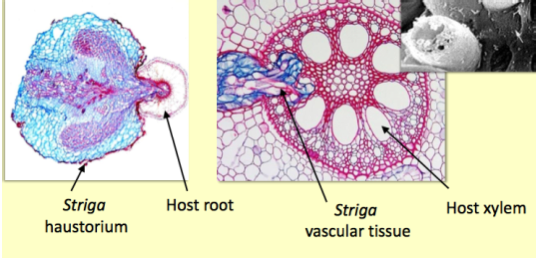
- 18How do parasites obtain resources from the host?· Access host's vascular (vessels) tissue via haustorium
· Haustorium connects into the host's vascular systems - 19What is a Haustorium?Attachment points from the host to the parasite
Remove water and nutrients from host - 20Example of the Striga Haustorium Parasite attaches to the outside of the host plant and grows into the cortex of the host plant, where it searches for the host plants vessels
- 21What is extreme parasitism?The parasite attaches to the parasite that attaches to the host plant
Other words for extreme parasitism = epiparasitism or hyperparasitism - 22Are parasitic plants all bad for the hostMistletoes can enhance nutrient availability in soils beneath host trees
Could influence redistribution of nutrients between species
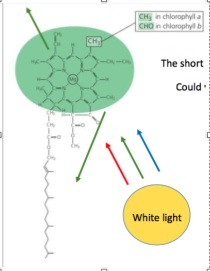
Insects provide pollination services are maintain for the host - 23Why are plants Green?plants contain a pigment called chlorophyll and chlorophyll is green
- 24What is a pigment?Pigment = a material that changes colour of reflected or transmitted light as the result of wavelength
The arrangement of elements in the chlorophyll molecules absorbs longer red wavelengths and shorter blue wavelengths but not the immediate green. - 25How does pigment work?
- 26Where is the chlorophyll situated in a plant?Chlorophyll is in photosynthetic tissue which is mostly leaves
Chlorophyll is found in the centre of the leaf (cross-section)
The cells in the centre of the leaf are spotty little organelles called chloroplasts
Within these tiny organelles called chloroplasts, if you zoom in on the bumps you can see a chlorophyll organelle within its three membranes - 27Why do plants not use green light?Life evolved in the oceans first. The surface bacteria were purple therefore it used green light and let the red and blue pass through – bacteria below the surface had to then be good at absorbing the red and blue light. These red and blue light absorbing bacteria are the ancestors of the plants we see today.
- 28What do plants need to grow?· Sunlight - photosynthesis
· Water - cells are mostly composed of water
· Soil/ nutrients such as: Magnesium, Calcium, Iron, Nitrogen, Sulphur, Phospherous
· Carbon dioxide is taken up through leaves and is transferred into sugar and oxygen - 29what is limiting plant growth if a plant recieves optimal amounts of light, water and nutrientsCO2 is limiting plant growth.
- 30what are the three special groups of tissueEmbryonic tissue
Developing tissues
Mature tissues - 31In which tissue do the cells continually divide?Embryonic Tissues
These cells will develop to become the mature plant - 32What is the name given to plant tissue that remains embryonicMeristems
- 33Where will you find Meristemsthe tip or the apex
(Apical Meristems) - 34where are the primary meristems locatedin the shoot tip
in the roots
Additional primary meristems allows new branches, leaves
and flowers, as well as additional roots - 35Why didn't the branches and the trunk of big trees come from meristems?There's another group of meristems called lateral meristems
Grow thicker, wider and more massive - 36What is interminate growth?Continuous growth – all plants grow continually throughout their life span
- 37Why are plants shaped the way they are?A plant is shaped the way it is to help it to survive and reproduce in the environment in which it has evolved
- 38What is evolution?The unifying force that has produced the staggering diversity of life on Earth.
→ Bacteria
→ Flowering Plants
→ Mammals - 39What does a phylogenic tree showThe branching patterns of all life on earth
- 40What is Darwin's theory of Evolution?Organisms share many characteristics
All organisms descend from a common ancestor in the past
There's a match between organisms and their environment - 41What is biological evolution?1. Any change in heritable traits (not acquired traits)
2. Of biological populations (not individuals)
3. Over successive generations (not in one lifetime) - 42What is a heritable trait?Any feature that is genetically inherited from parent to offspring
- 43What is an aquired trait?Something that is picked up during a lifetime e.g. loss of a limb/ broken bone
- 44Why does evolution occur in biological populations, not individuals?Individuals cannot evolve, groups of individuals evolve
- 45What are the three ingredients for evolution?There must be variation for a trait within a population
The variation in the trait must be heritable
There must be a variation in reproductive success amongst individuals - 46What is reproductive success?the number of offspring that an individual produces but themselves need reproductive aid
This may be:
→ Random (= genetic drift in populations)
→ Non-random (= natural selection e.g. birds eat the green beetles before they can reproduce therefore less green beetles and more brown) - 47what are the 5 processes that act as the basic mechanisms for evolutionMutation
Migration
Sex/recombination
Genetic drift
Natural selection - 48What is a mutationMutation = 'random' change in the DNA sequence of an individual that can be beneficial, neutral or harmful.
- 49What is migration/gene flowGene flow = migration = movement of individuals from one population to another
- 50What is sex/recombination?Sexual reproduction generates new combinations of genes by shuffling genetic variation
- 51What is genetic driftA random process that occurs in all populations but is more important in small populations
- 52What is natural selection?Individuals vary in their inherited traits
Not all individuals survive and reproduce to their full potential
Those with inherited traits give them a greater chance of surviving and reproducing (more offspring)
non-random survival and reproduction will lead to the accumulation of favorable traits - 53What is adaptation?Process - the evolutionary process where an organism becomes better suited to its habitat
Product - Inherited characteristics of organisms that enhance their survival and reproduction - 54What is the artificial selection?Natural selection caused directly by humans
- 55What are sponges?Sponges are basal animals that lack true tissues
- 56What are cnidarians?An ancient group of eumetazoans
(hydras, jellyfish, sea anemonies and corals)
unique stinging structures housed in specialised cells, radially symmetrical, gastrovascular cavity - 57What are LophotrochozoansLophotrochozoans have the widest range of animal body forms
(flatworms, rotifers, snails, clams and squid)
No digestive tract
head with ciliated crown
Feeding structured with ciliated tentacles
three body parts (muscular foot, visceral mass, mantle)
segmented body wall and internal organs - 58What are the Ecdysozoansthe most species rich animal group
Segmented body, jointed appendages, exoskeleton made out of protein and chitin
Cylindrical bodies with tapered ends, no circulatory system - 59Why are Echinoderms and chordates deuterostomes?Starfish, sea urchins (Echinodermata)
Lancelets, tunicates and vertebrates (Chordata)
Have a norochord, dorsal hollow nerve cord, pharyngeal slits, post-anal
Bilaterally symmetrical larvae, five part radial organisation as adults, unique water vascular system, endoskeleton - 60What do chordates have?Notochord and a dorsal, hollow nerve cord
- 61Are vertebrates chordates?Vertebrates are chordates that have a backbone
- 62What are Gnathostomesvertebrates that have jaws
- 63What are tetrapodsGnathostomes that have limbs
- 64What are amniotes?○ Amniotes are tetrapods that have a terrestrially adapted egg with four chambers and a hard shell
- 65Are Mammals amniotes?Mammals are amniotes that have hair and produce milk
Informationen
- Beschreibung
- Der Nutzer hat seine Fachbereichs-Information gelöscht. Karteikarten am Concepts in Biology, erstellt von Gelöschter Nutzer am 14/06/2018.
- Erstellt von
- Gelöschter Nutzer · Jun 2018
- Aktualisiert
- 14 Jun 2018
- Aufrufe
- 24
- Tags
- Verlauf
-
- Erstellt von Olivia Gniadek · 26 Mär 2018
- Kopiert von Olivia Gniadek · 14 Jun 2018
- Bewertung