
Quiz
BVetMed3: Signs of Respiratory Disease
Dieses Quiz enthält Fragetypen, die sich im gewohnten Player öffnen.
Fragen in diesem Quiz (44)
1Which of the following causes bronchodilation of the smooth muscle in a dog's airway?
- AAcetylcholine binding to muscarinic receptors 1 and 3
- BBeta-2 antagonists
- CAdrenal medulla releasing epinephrine to bind to beta-2 receptors
- DCholinergic agonists
2Which of the following is FALSE regarding the cough reflex?
- AIt involves enkephalins and endoprhins binding to opioid receptors in the cough center
- BActivation of irritant receptors stimulates the phrenic nerve.
- CThe cough centre is in the brain steam.
- DThere is no differentiation between pathogens or dust binding to irritant receptors in the respiratory tract.
3Which of the following is NOT a opioid receptor agonist?
- AButorphanol
- BCodeine
- CMethadone
- DAcepromazine
4Which of the following are NOT resident cells in the respiratory tract?
- AAlveolar macrophages
- BLymphocytes
- CMast cells
- DNeutrophils
5Which immunoglobulin is involved in the lower respiratory airways?
- AIgA
- BIgG
- CIgM
- DIgE
6Which immunoglobulin is involved in the upper respiratory airways?
- AIgG
- BIgA
- CIgM
- DIgE
7Which of the following cough characteristics is more typical of an lower airway issue?
- Asoft, muted, productive
- Bharsh, loud non-productive
- Cswallowing after coughing
- Dharsh, loud, productive
- Esoft, muted, non-productive
8A harsh, non-productive cough is indicative of a problem in the
- Alower respiratory tract
- Bupper respiratory tract
9What is the normal respiratory rate for adult horses?
- A8-15
- B10-30
- C25-35
- D24-42
- E20-40
- F30-60
10What is the normal respiratory rate for adult cows, sheep and pigs?
- A8-15
- B10-30
- C25-35
- D20-40
- E24-42
- F30-60
11What is the normal respiratory rate for foals and calves?
- A8-15
- B10-30
- C25-35
- D20-40
- E24-42
- F30-60
12Which of the following would not cause inspiratory distress?
- ALaryngeal hemiplegia
- Bpleural effusion
- Csoft palate disorder
- DRecurrent airway obstruction
13Which of the following would cause BOTH inspiratory and expiratory distress?
- Atracheal collapse
- Bfarmer's disease
- Cpleural effusion
- Dextrathoracic intraluminal mass
14Orthopnoea refers to
- Adifficult breathing while recumbent
- Brespiratory distress
- Ca decreased respiratory rate
- Dcommunication between oral and nasal cavities
15Unilateral nasal discharge tends to originate in
- Astructures rostral to the caudal end of the nasal septum
- Bcaudal structures in the nasal septum
- Cthe oropharynx
- Dtrachea
16Food or milk in the nasal discharge can be indicative of
- Adysphagia
- Bepistaxis
- Chaemoptysis
- Dorthopnoea
17The presence of blood at the external nares is known as
- Ahaemoptysis
- Bepistaxis
- Cdysphagia
- Dorthopnoea
18Which of the following is TRUE regarding cyanosis?
- AIs is only evident if hemoglobin levels are abnormal
- Boften seen with anaemia
- Cit only causes blue discolouration of the mucous membrane
- Dit occurs due to poor peripheral perfusion
19In horses, breathing and stride rate are independent when trotting.
- ARichtig
- BFalsch
20An owner notices their horse has very loud, intense respiratory sound at gallop whenever its limbs are extending. This suggests
- Ainspiratory stridor
- Bexpiratory stridor
- Cepistaxis
- Dorthopnoea
21Which of the following is most indicative of infected sinuses?
- Aasymmetrical facial symmetry
- Bepistaxis
- Corthopnoea
- Dnasal discharge
22Which of the following is NOT an important point of auscultation in ruminants?
- A6th intercostal space
- B3rd intercostal space
- C9th intercostal space
- D11th intercostal space
23Hearing crackles when auscultating small animals indicates
- Aissues with the upper respiratory tract
- Bissues with small airways and alveoli
- Cpartial obstruction of larger airways
- Dpossible pleural effusion
24Which of the following diagnostic techniques uses general anaesthesia?
- Atranstracheal aspirate
- Bendoscopically-guided tracheal aspirate
- Cthoracocentesis
- Dtrans-tracheal wash
25Trans-tracheal washes involves direct access to a patient's airway via
- Apuncture of cricothyroid ligament
- Bpuncture of thyrohyoid membrane
- CET tube placed down oral cavity
- Dpuncture between first and second tracheal rings
26Which of the following diagnostics allows characterisation of pleural effusion?
- Athoracocentesis
- Bbronchoalveolar lavage
- Ctrans-tracheal wash
- Dlung aspiration
27You suspect a horse has recurrent airway obstruction but its owner is low on funds. Which of the following diagnostics would you therefore suggest to confirm RAO?
- Abronchoalveolar lavage
- Bthoracocentesis
- Clung aspirate
- Dnasopharyngeal swab
28Which of the following imaging is most useful for characterising pleural effusion?
- AThoracic ultrasonography
- BThoracic CT scan
- CThoracic radiography
29The mucociliary escalator extends from
- Aterminal bronchioles to the larynx
- Balveoli to the pharynx
- Cbronchioles to the trachea
- Dbronchioles to nasal cavity
30Failure of lung tissue to expand at birth is known as
- Aprimary atelectasis
- Bsecondary atelectasis
- Cemphyesma
- Dorthopnoea
31A tumor in the pleural cavity outside the lung compresses the lung and causes it to partially collapse. This is
- Aprimary atelectasis
- Bsecondary atelectasis
- Cemphysema
- Danthracosis
32Which of the following can cause this type of lung pathology?
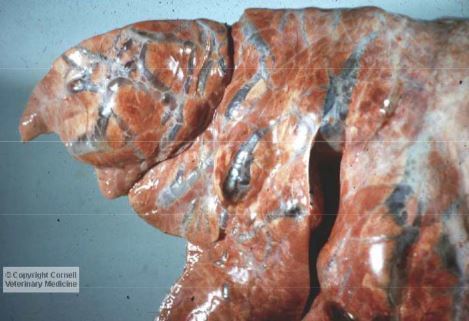
- Aemphysema
- Bhydrothorax
- Cprimary atelectasis
- Dpulmonary oedema
33What type of emphysema does recurrent airway disease cause in horses?
- Aalveolar
- Binterstitial
- Ccompensatory
34What is the difference between hyperaemia and congestion?
- AHyperemia involves increased arteriole inflow while venous outflow is maintained. Congestion involves normal arteriole inflow but increased venous outflow.
- BHyperemia involves increased arteriole inflow while venous outflow is increased. Congestion involves normal arteriole inflow but decreased venous outflow.
- CHyperemia involves increased arteriole inflow while venous outflow is maintained. Congestion involves normal arteriole inflow but decreased venous outflow.
- DHyperemia involves decreased arteriole inflow while venous outflow is maintained. Congestion involves normal arteriole inflow but decreased venous outflow.
35In aspirational pneunoma, the hyperaemia typically affects which lung lobes?
- Acaudodorsal
- Bcranioventral
- Ccaudoventral
- Dcraniodorsal
36Which of the following is NOT a major factor that prevents pulmonary oedema?
- Atight junctions between alveolar epithelium
- Bintra-alveolar pressure being greater than interstitial pressure
- Clymphatic drainage
- Dhydrostatic pressure
37Which of the following is unlikely to cause pulmonary oedema?
- Aleft-sided heart failure
- Bright-sided heart failure
- Cacute brain damage
- Dexcessive fluid therapy
38Pneumonia can be classified based on location. Label the following image with the most likely type of pnuemonia to cause the pathology pattern.
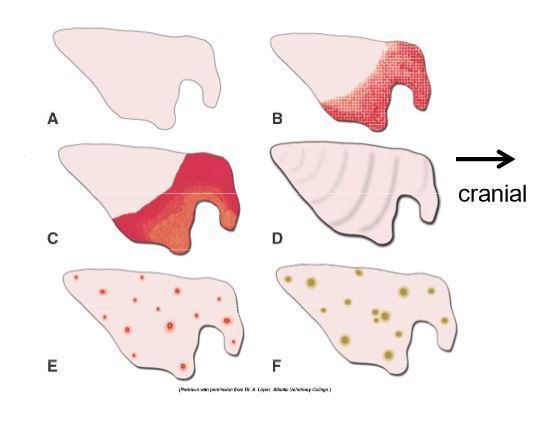
- Anormal lung
- Bsuppurative bronchopneumonia
- Cfibrinous bronchopneumonia
- Dinterstitial pneumonia
- Eembolic pneumonia
- Fgranulomatous pneumonia
- Ggranulomatous pneumonia
- Hembolic pneumonia
- Iinterstitial pneumonia
- Jfibrinous bronchopneumonia
- Ksuppurative bronchopneumonia
- Lnormal lung
- Mnormal lung
- Nsuppurative bronchopneumonia
- Ofibrinous bronchopneumonia
- Pinterstitial pneumonia
- Qembolic pneumonia
- Rgranulomatous pneumonia
- Sgranulomatous pneumonia
- Tembolic pneumonia
- Ufibrinous bronchopneumonia
- Vinterstitial pneumonia
- Wsuppurative bronchopneumonia
- Xnormal lung
- Ynormal lung
- Zsuppurative bronchopneumonia
- AAfibrinous bronchopneumonia
- ABinterstitial pneumonia
- ACembolic pneumonia
- ADgranulomatous pneumonia
39Which of the following is a possible sequel of persistent bronchopneumonia?
- Abronchiectasis
- Bmelanosis
- Calveolar emphysema
- Dsecondary atelectasis
40Which of the following animals would you be more likely to see lobar pneumonia?
- Acattle
- Bsheep
- Chorses
- Ddogs
41Interstitial pneumonia often involves "cuffing" or proliferation of what type of cell around airways?
- Alymphocytes
- Bneutrophils
- Cmacrophages
- Deosinophils
- Emast cells
42Paraquat is a pneumotoxin and cause what type of pneumonia in small animals?
- Ainterstitial
- Bsuppurative
- Cfibrinous
- Dembolic
- Egranulomatous
43What type of pneumonia is often secondary to endocarditis?
- AEmbolic
- BGranulomatous
- CFibrinous
- DInterstitial
- ESuppurative
44Tuberculosis can cause what type of pneumonia?
- Agranulomatous
- Bembolic
- Cinterstitial
- Dfibrinous
- Esuppurative
Informationen
- Beschreibung
- Der Nutzer hat seine Fachbereichs-Information gelöscht. Quiz am BVetMed3: Signs of Respiratory Disease, erstellt von Gelöschter Nutzer am 13/04/2019.
- Autor
- Gelöschter Nutzer
- Sprache
- English
- Aufrufe
- 13
- Verlauf
- Erstellt am 13 Apr 2019 · aktualisiert am 13 Apr 2019
- Schlagwörter
- Bewertung
- Noch keine Bewertungen Bewerte dieses Quiz