
Quiz
BVetMed3: Signs of Respiratory Disease
Este quiz tem tipos de pergunta que abrem no player de sempre.
Perguntas do quiz (44)
1Which of the following causes bronchodilation of the smooth muscle in a dog's airway?
- AAcetylcholine binding to muscarinic receptors 1 and 3
- BBeta-2 antagonists
- CAdrenal medulla releasing epinephrine to bind to beta-2 receptors
- DCholinergic agonists
2Which of the following is FALSE regarding the cough reflex?
- AIt involves enkephalins and endoprhins binding to opioid receptors in the cough center
- BActivation of irritant receptors stimulates the phrenic nerve.
- CThe cough centre is in the brain steam.
- DThere is no differentiation between pathogens or dust binding to irritant receptors in the respiratory tract.
3Which of the following is NOT a opioid receptor agonist?
- AButorphanol
- BCodeine
- CMethadone
- DAcepromazine
4Which of the following are NOT resident cells in the respiratory tract?
- AAlveolar macrophages
- BLymphocytes
- CMast cells
- DNeutrophils
5Which immunoglobulin is involved in the lower respiratory airways?
- AIgA
- BIgG
- CIgM
- DIgE
6Which immunoglobulin is involved in the upper respiratory airways?
- AIgG
- BIgA
- CIgM
- DIgE
7Which of the following cough characteristics is more typical of an lower airway issue?
- Asoft, muted, productive
- Bharsh, loud non-productive
- Cswallowing after coughing
- Dharsh, loud, productive
- Esoft, muted, non-productive
8A harsh, non-productive cough is indicative of a problem in the
- Alower respiratory tract
- Bupper respiratory tract
9What is the normal respiratory rate for adult horses?
- A8-15
- B10-30
- C25-35
- D24-42
- E20-40
- F30-60
10What is the normal respiratory rate for adult cows, sheep and pigs?
- A8-15
- B10-30
- C25-35
- D20-40
- E24-42
- F30-60
11What is the normal respiratory rate for foals and calves?
- A8-15
- B10-30
- C25-35
- D20-40
- E24-42
- F30-60
12Which of the following would not cause inspiratory distress?
- ALaryngeal hemiplegia
- Bpleural effusion
- Csoft palate disorder
- DRecurrent airway obstruction
13Which of the following would cause BOTH inspiratory and expiratory distress?
- Atracheal collapse
- Bfarmer's disease
- Cpleural effusion
- Dextrathoracic intraluminal mass
14Orthopnoea refers to
- Adifficult breathing while recumbent
- Brespiratory distress
- Ca decreased respiratory rate
- Dcommunication between oral and nasal cavities
15Unilateral nasal discharge tends to originate in
- Astructures rostral to the caudal end of the nasal septum
- Bcaudal structures in the nasal septum
- Cthe oropharynx
- Dtrachea
16Food or milk in the nasal discharge can be indicative of
- Adysphagia
- Bepistaxis
- Chaemoptysis
- Dorthopnoea
17The presence of blood at the external nares is known as
- Ahaemoptysis
- Bepistaxis
- Cdysphagia
- Dorthopnoea
18Which of the following is TRUE regarding cyanosis?
- AIs is only evident if hemoglobin levels are abnormal
- Boften seen with anaemia
- Cit only causes blue discolouration of the mucous membrane
- Dit occurs due to poor peripheral perfusion
19In horses, breathing and stride rate are independent when trotting.
- AVerdadeiro
- BFalso
20An owner notices their horse has very loud, intense respiratory sound at gallop whenever its limbs are extending. This suggests
- Ainspiratory stridor
- Bexpiratory stridor
- Cepistaxis
- Dorthopnoea
21Which of the following is most indicative of infected sinuses?
- Aasymmetrical facial symmetry
- Bepistaxis
- Corthopnoea
- Dnasal discharge
22Which of the following is NOT an important point of auscultation in ruminants?
- A6th intercostal space
- B3rd intercostal space
- C9th intercostal space
- D11th intercostal space
23Hearing crackles when auscultating small animals indicates
- Aissues with the upper respiratory tract
- Bissues with small airways and alveoli
- Cpartial obstruction of larger airways
- Dpossible pleural effusion
24Which of the following diagnostic techniques uses general anaesthesia?
- Atranstracheal aspirate
- Bendoscopically-guided tracheal aspirate
- Cthoracocentesis
- Dtrans-tracheal wash
25Trans-tracheal washes involves direct access to a patient's airway via
- Apuncture of cricothyroid ligament
- Bpuncture of thyrohyoid membrane
- CET tube placed down oral cavity
- Dpuncture between first and second tracheal rings
26Which of the following diagnostics allows characterisation of pleural effusion?
- Athoracocentesis
- Bbronchoalveolar lavage
- Ctrans-tracheal wash
- Dlung aspiration
27You suspect a horse has recurrent airway obstruction but its owner is low on funds. Which of the following diagnostics would you therefore suggest to confirm RAO?
- Abronchoalveolar lavage
- Bthoracocentesis
- Clung aspirate
- Dnasopharyngeal swab
28Which of the following imaging is most useful for characterising pleural effusion?
- AThoracic ultrasonography
- BThoracic CT scan
- CThoracic radiography
29The mucociliary escalator extends from
- Aterminal bronchioles to the larynx
- Balveoli to the pharynx
- Cbronchioles to the trachea
- Dbronchioles to nasal cavity
30Failure of lung tissue to expand at birth is known as
- Aprimary atelectasis
- Bsecondary atelectasis
- Cemphyesma
- Dorthopnoea
31A tumor in the pleural cavity outside the lung compresses the lung and causes it to partially collapse. This is
- Aprimary atelectasis
- Bsecondary atelectasis
- Cemphysema
- Danthracosis
32Which of the following can cause this type of lung pathology?
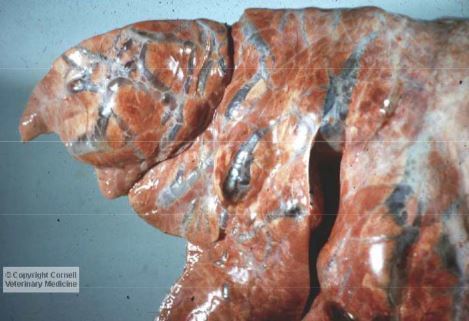
- Aemphysema
- Bhydrothorax
- Cprimary atelectasis
- Dpulmonary oedema
33What type of emphysema does recurrent airway disease cause in horses?
- Aalveolar
- Binterstitial
- Ccompensatory
34What is the difference between hyperaemia and congestion?
- AHyperemia involves increased arteriole inflow while venous outflow is maintained. Congestion involves normal arteriole inflow but increased venous outflow.
- BHyperemia involves increased arteriole inflow while venous outflow is increased. Congestion involves normal arteriole inflow but decreased venous outflow.
- CHyperemia involves increased arteriole inflow while venous outflow is maintained. Congestion involves normal arteriole inflow but decreased venous outflow.
- DHyperemia involves decreased arteriole inflow while venous outflow is maintained. Congestion involves normal arteriole inflow but decreased venous outflow.
35In aspirational pneunoma, the hyperaemia typically affects which lung lobes?
- Acaudodorsal
- Bcranioventral
- Ccaudoventral
- Dcraniodorsal
36Which of the following is NOT a major factor that prevents pulmonary oedema?
- Atight junctions between alveolar epithelium
- Bintra-alveolar pressure being greater than interstitial pressure
- Clymphatic drainage
- Dhydrostatic pressure
37Which of the following is unlikely to cause pulmonary oedema?
- Aleft-sided heart failure
- Bright-sided heart failure
- Cacute brain damage
- Dexcessive fluid therapy
38Pneumonia can be classified based on location. Label the following image with the most likely type of pnuemonia to cause the pathology pattern.
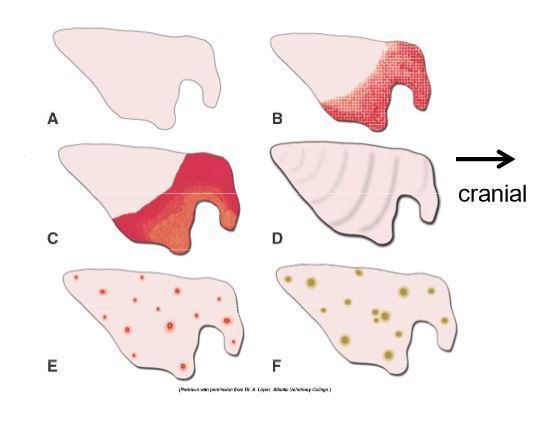
- Anormal lung
- Bsuppurative bronchopneumonia
- Cfibrinous bronchopneumonia
- Dinterstitial pneumonia
- Eembolic pneumonia
- Fgranulomatous pneumonia
- Ggranulomatous pneumonia
- Hembolic pneumonia
- Iinterstitial pneumonia
- Jfibrinous bronchopneumonia
- Ksuppurative bronchopneumonia
- Lnormal lung
- Mnormal lung
- Nsuppurative bronchopneumonia
- Ofibrinous bronchopneumonia
- Pinterstitial pneumonia
- Qembolic pneumonia
- Rgranulomatous pneumonia
- Sgranulomatous pneumonia
- Tembolic pneumonia
- Ufibrinous bronchopneumonia
- Vinterstitial pneumonia
- Wsuppurative bronchopneumonia
- Xnormal lung
- Ynormal lung
- Zsuppurative bronchopneumonia
- AAfibrinous bronchopneumonia
- ABinterstitial pneumonia
- ACembolic pneumonia
- ADgranulomatous pneumonia
39Which of the following is a possible sequel of persistent bronchopneumonia?
- Abronchiectasis
- Bmelanosis
- Calveolar emphysema
- Dsecondary atelectasis
40Which of the following animals would you be more likely to see lobar pneumonia?
- Acattle
- Bsheep
- Chorses
- Ddogs
41Interstitial pneumonia often involves "cuffing" or proliferation of what type of cell around airways?
- Alymphocytes
- Bneutrophils
- Cmacrophages
- Deosinophils
- Emast cells
42Paraquat is a pneumotoxin and cause what type of pneumonia in small animals?
- Ainterstitial
- Bsuppurative
- Cfibrinous
- Dembolic
- Egranulomatous
43What type of pneumonia is often secondary to endocarditis?
- AEmbolic
- BGranulomatous
- CFibrinous
- DInterstitial
- ESuppurative
44Tuberculosis can cause what type of pneumonia?
- Agranulomatous
- Bembolic
- Cinterstitial
- Dfibrinous
- Esuppurative
Informações
- Descrição
- O usuário eliminou as informações de disciplina Quiz sobre BVetMed3: Signs of Respiratory Disease, criado por Usuário eliminado em 13-04-2019.
- Autor
- Usuário eliminado
- Idioma
- English
- Visualizações
- 13
- Histórico
- Criado em 13 abr 2019 · atualizado em 13 abr 2019
- Etiquetas
- Avaliação
- Ainda sem avaliações Avalie este quiz