
Notizen
Reading Skills
Inhalt der Notizen (11)
Seite 1
Vocab.
1.1
Article - a complete piece of writing in a newspaper or magazine
Previewing - picking up clues about written matter
Fiction - story that's the product of the author's imagination
Novel - long work of fiction
Nonfiction - writing about real events and facts
Specific - anything of a particular kind
1.2
Scanning - a process that involves running your eyes quickly over lines of print looking for specific info
Passage - part of an article or portion of a book. Can be a sentence, a few sentences, or one or more paragraphs
Proper Nown - person place or thing
1.3
Multiple meanings - when a word has more than one meaning
Synonym - a word with the same or similar meaning as another word
Antonym - a word with the opposite meaning of another word
Thesaurus - source that provides both synonyms and antonyms
Context - the way a word is used in a sentence or paragraph
2.1
Details - small facts the present info about a topic
Topic Sentence - the main idea of a particular paragraph
Stated Idea - when the writer says specifically what they mean
Implied Idea - when the writer hints at what he or she means
Introduction - the first paragraph of an essay, where the writer presents the main idea of the essay
Conclusion - the last paragraph of an essay, where the author summarizes the idea and details of the essay
Paragraph - a group of sentences that relate to the central or main topic
2.2
Fact - info that can be proved to either be true or false
Opinion - what someone believes or thinks that can't be proved
Source - the person or group making a claim or statement
Furtive - secretive or sly
Body - the second, third, and fourth paragraphs of an essay, where the author discusses supporting details to prove the main idea
Supporting details = bits of info that elaborate on the main topic
2.3
Compare - to show how things are alike
Contrast - to show how things are different
General idea - an idea that can be applied to other more specific ideas
Sentence Organization - when ideas in a sentence are arranged in a way that makes them easier to understand and read
Explanation - something is happening in a sentence
2.4
Cause - why something happens
Effect - what happens as a result of a cause
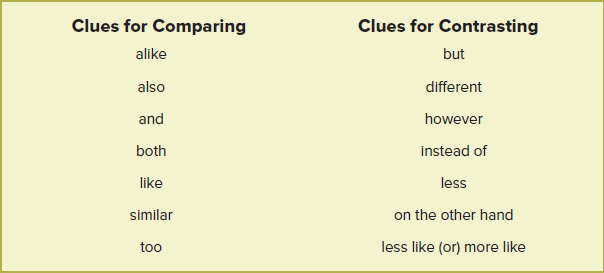
Clue Words - words that help the reader spot comparisons and contrasts
Chronological Order - a way to organize your writing; tells events or ideas in the order in which they occurred
Indirect Causes - a cause that produces and effect, which causes another effect
3.1
Conclusion - what you decide based on evidence or opinion
Fact - info that can be proved with evidence
Influence - to try and convince someone of something
Neutral - a word or statement that isn't meant to make readers feel a strong emotion
Opinion - what someone thinks or believes about something
Evidence - info that supports a conclusion
3.2
Vivid - a word that produces a strong or clear impression on the senses
Stanza - two or more lines of poetry that create divisions within a poem
Literal Meaning - the meaning of a word that's the same as its dictionary meaning
Poetry - a form off writing that uses imagery to make it's readers feel certain things
Imagery - a literary tool that suggests mental pictures of sights, sounds, smells, tastes, feelings, and actions; also conveys emotions and moods
Rhyme - similarity in the sound of the ends of words
Figures of Speech - suggests meaning or effects that go beyond the literal meaning of a word or phrase
Simile - the comparison of two unlike things using the words like or as
Metaphor - the comparisons of two unlike things without using the words like or as
3.3
Short Story - a tale with a fully developed theme, which can be read in one sitting
Novella - a tale that's longer than a short story but shorter than a novel
Novel - a lengthy fictional story
Protagonist - the main character in a story
Abbe - a member of the french clergy
Petrified - turned to stone
Seite 2
1.1 Previewing
When you preview, you use the info you already know to guess what info is most likely to follow.
Printed and online magazines - TITLES. Table of contents.
Fiction -
- Read the title
- Read the back cover or inside book flap. Often find the summary of main ideas and plots, as well as quotes about the book and author.
- Chapter title list. Most modern novels don'y have a table of contents. Classic books were often divided into chapters with main titles. Listed in the front, along with a page number on which the chapter begins.
Nonfiction - can preview the same way you would fiction
Key Points
Previewing is the process of picking up clues from written material
Previewing magazines involves scanning their titles and tables of contents
Fictional material is the product of an author's imagination, not a factual account.
A novel is a long work of fiction
Previewing a work of fiction involves studying the title, reading the back cover or inside book flap, and looking at the chapter titles (if the book has them).
Nonfiction is material that describes real events or facts.
Nonfiction books can be previewed in the same way as fiction books
Seite 3
1.2 Scanning
Scanning is a way to get the info you're looking for without reading every word.
Elements that commonly stand out when scanning
- Capitol letters
- Numbers
- Proper nouns
Scanning a passage can often be helpful during a test
Seite 4
1.3 Working with Words
Word Meaning - It's not unusual to come across a word you don't understand or know the meaning of:
- Author may have used a word incorrectly
- A word may be new to you/a word you've never seen before
- You've seen the word before, you just don't know it's meaning
- You once knew the definition, but you've forgotten.
- Words have more than one meaning.
Using a dictionary - the best and most reliable way to find the meaning of a word. Make a habit of looking up new words in a dictionary. Doing so with increase vocab and reading comprehension. Most dictionaries include the following:
- Instructions on the best way to use the dictionary
- History of the English language
- Guide to pronunciation
- Abbreviations
- Foreign words and phrases and their definitions
- Biographical names
- Geographical names
- Signs and symbols
- Handbook of style (helpful for writing assignments)
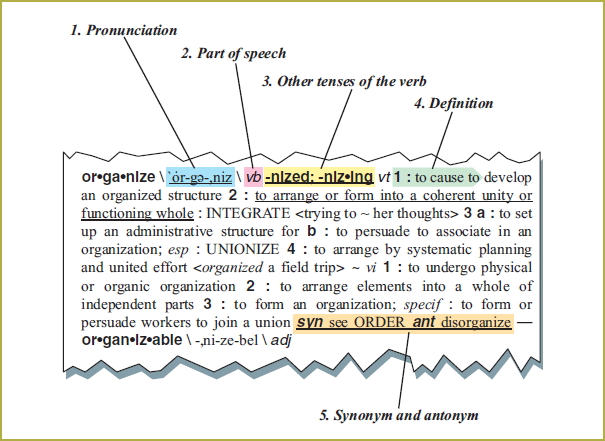
Context Clues - When you figure out the meaning of a word from the way it's used in a sentence, you're using the context! When you see a dash (-) or a comma in a sentence, it often means that more info follows. Look for these marks when looking for context clues.
Multiple Meanings - to determine which meaning is intended, look for context clues.
Key Points
Dictionary is the best way too look up definitions
Seite 5
2.1 Paragraphs
- The Essay:
Introduction - tell your readers what you're going to tell them. Designed to grab attention.
Body - made up of a variety of supporting details to prove the main idea such as statistics, stories, researching studies, quotations, and whatever else the author wants to use to support the main idea
Conclusion - summarize what was demonstrated or discussed in the essay
- Paragraph - While all paragraphs have a main topic, not all of them have a clear topic sentence. The main idea is what the entire piece is about, whereas the topic sentence is a statement in each paragraph that tells you what will be discussed in that particular paragraph.
The first line of a paragraph is indented to show when a new one beings. Sometimes there is an added space between the paragraphs instead of indents. This is known as "block style"
Location of Topic Sentences - a topic sentence can show up anywhere in a paragraph.
- Beginning. Usually easier to identify
- Middle. Often separates two kinds of details. Least common method.
- End. In such cases, the writer wants to build up the idea.
Key points
Essay = into, body, and conclusion
Paragraph definition
topic sentence definition
INDENTING
Topic sentence can be anywhere in a paragraph
stated vs implied ideas
Seite 6
2.2 Supporting Details
Each sentence you in your paragraph should add supporting details to your description.
Purpose of supporting details:
- Describe something
- Explain how to do or make something. Some of the supporting ideas are found in sentences that begins with words like first, next, and finally.
- Explain or support a point of view or opinion about a topic
Consider the source - before you accept what any writer has to say, you should question the ideas to see if they are facts. In a good argument, main kind of supporting idea should be evidence based on facts, rather than opinions or guesses. Authors can be biased and tend to present only one side of an argument, or they may manipulate facts to better support their point of view.
Key Points
Supporting details are bits of info that clarify the main point of a paragraph
Supporting details can describe something, explain how to make or do something, or support a point of view or opinion
A fact is info that can be proved to either be true or false. An opinion is simply what someone believes or thinks. An opinion can't be proved.
In any written material, a source is the person or group supplying information.
Seite 7
2.3 Organizing Ideas
The order in which events are presented in a paragraph is important.
Three ways readers benefit from organized paragraphs:
- Can make comparisons and contrasts (to contrast two things means to show how they're d,while to compare means to show how they're the same or similar)
- Can see the time order of events.
- Can see how one thing causes another thing to happen.
Explain with examples
Explain ideas with explanations - provide info on why and how. Added to make writing clearer and give more complete info to the readers.
Key Points
The order in which events are presented in a paragraph are important.what happens first, next, and so on.
Paragraphs that compare show how things are the same, contrasts show how they are different
Paragraphs that explain something can use examples, explanations, or both.
Seite 8
2.4 Time Order and Cause and Effect
Chronological Order - arranges sentences or ideas in the order in which they occurred (first, second, third, and so on). Readers should have no problem understanding how and when events occurred.
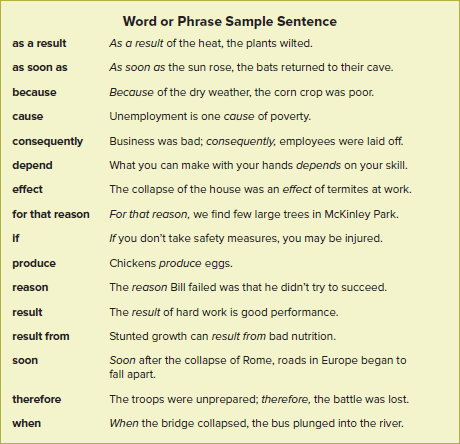
Cause and Effect - cause is why something happens. effect is what happens.
Indirect causes - a cause that produces an effect, which in turn causes another effect.
Key Points
Paragraphs can be organized in chronological order- that is, in the order in which events occurred
Paragraphs can be organized to illustrate how one thing (a cause) causes another (an effect)
Clue words can help readers understand the approach the writer is taking
Seite 9
3.1 Important Reading Skills
Making Inferences - coming to a conclusion based on what you know. Writers don't always say things directly. Instead, they give info and you must make inferences. Evidence is info that supports a conclusion. A conclusion is what you decide based on evidence or opinion.
Separating Fact from Opinion - A fact is something that can be proved with evidence. An opinion is what someone thinks or believes about something.
Detecting Bias - Bias and opinions are alike, but opinions tend to include words and phrases such as "I believe", "I feel", or "I should". Bias is typically presented as fact. It presents ideas with prejudice in order to convince others.
- Two questions to ask to help detect bias in what you read:
(1) Are the statements logically related? -
(2) Does the writer use loaded words? - words that carry stronger emotions meant to sway opinions and get readers to respond with emotions.
Drawing Conclusions - Making inferences, separating fact from opinion and spotting bias help you draw conclusions from what you're reading. Preliminary conclusions help you get to a final conclusion
Final thoughts.
1. Locate facts in what you read, separating fact from opinion. Some statements might look like facts even though they aren't.
2. While sorting out facts from opinions, remember that opinions often reveal bias. Including some facts but also leaving out others can also indicate bias.
3. As you sort out facts from opinions and look for bias, make inferences by reading between the lines. Look for what the writer s implying by the way they write. By doing all these things, you'll be able to draw accurate conclusions
Key Points
When you make an inference, you come to a conclusion based on what you know.
When you read, you must learn to make inferences about the info you're reading.
Evidence is info that supports a conclusion. A conclusion is what you decide based on evidence or opinion.
A fact is info that can be proved with evidence
An opinion is what someone thinks or believes about something
Bias refers to a strong emotional preference for one viewpoint or another.
Good readers learn to look for facts, opinions, and bias in the material they read.
Loaded words carry strong feelings or emotions.
A word or statement is neutral is it isn't meant to make readers feel a strong emotion.
Seite 10
3.2 Reading Poetry
Poetic Imagery - Writers use words to create mental images that create a certain kind of feeling in readers. Imagery is a literary tool that suggests mental picture of sounds, smells, tastes, sights, feelings and actions. Imagery also conveys emotions and moods. Vivid words and phrases create strong, color images. Wit is the clever use of words to catch people's attention and perhaps make them smile or laugh.
Rhyme in Poetry - Rhyme is similarity in sound at the end of words. The rhyme of a poem is less important than the feeling it provides.
Figures of Speech - In using figures of speech, writers suggest meanings or effects that go beyond the literal meaning of a word or phrase.
- Two common figures of speech are metaphors and similes. Both compare two unlike things. Similes compare two unlike things using the words like and as. "Marilyn slept like a log". Metaphors also compare to unlike things but with out like and as. EX: "Lionel was like a peacock among lesser birds" vs "Lionel was a peacock among lesser birds"
Key Points
Imagery is a literary tool the suggest mental pictures of sights, sounds, smells, tastes, feelings, and actions.
A vivid word produces a strong or clear impression on the senses
Poetry is a special form of writing that uses imagery to make its readers feel certain things.
A stanza is two or more lines of poetry that create divisions within a poem.
Rhyme is the similarity in sound at the end of words.
The literal meaning of a word is the same as its dictionary definition.
Two very common figures of speech are metaphors an similes.
Seite 11
3.3 Elements of Fiction
Character and Setting - Fiction refers to writing that's the product of someone's imagination. It uses pretend or created characters, rather than actual or real people. Fiction includes short stories, novella, and novels.
Characters are the people that authors create for their stories. Writers explain their characters by revealing the characters' traits, motives, and feelings.
Setting refers to the place and time a story occurs. May be real or imagined places, or a combination of both.
Plot, Conflict, and Theme - Plot refers to the sequence of events in a story; that is, what a story is about. Conflict refers to the issue to be resolved in a story. Theme refers to the main point of a story; the message the writer is trying to convey.
Key Points
The term fiction refers to writing that's the product of someone's imagination.
Characters are the people that authors create for their stories.
Setting refers to the place and time a story occurs. Setting in fiction may be real or imagined places, or a combination of both.
Plot refers to the sequence to events in a story; that it, what the story is about.
Conflict refers to the issue to be resolved in the story
Theme refers to the main point of the story
Informationen
- Beschreibung
- Notiz am Reading Skills, erstellt von Myca Fanning am 10/09/2019.
- Erstellt von
- Myca Fanning · Sep 2019
- Aktualisiert
- 5 Okt 2019
- Aufrufe
- 0
- Bewertung