
Quiz
Disturbances of Circulation - L3-5
Dieses Quiz enthält Fragetypen, die sich im gewohnten Player öffnen.
Fragen in diesem Quiz (22)
1Hyperaemiam
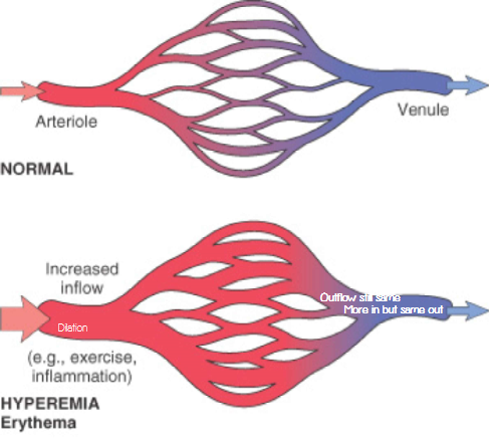
- AIncreased blood in vascular bed
- BDilation of arterioles
- Cincreased erythrocytes = more redness
- DWell oxygenated blood
- EACTIVE process
- Fe.g. blushing
2Congestion
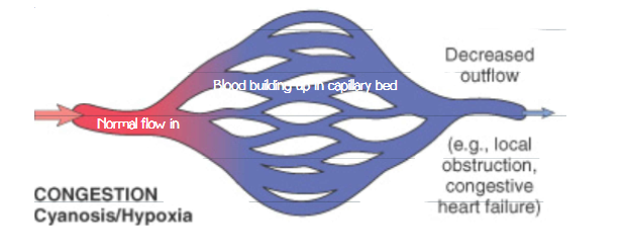
- AIncreased blood in terminal vascular bed
- Bimpeded outflow
- CType 1 = localised
- DType 2 = Generalised
- EType 3 = Hypostatic
3Ishaemia
Define: [blank_start]Inadequare blood supply of tissue[blank_end] [blank_start]relative to its needs[blank_end]
Consequences: [blank_start]Hypoxia[blank_end], [blank_start]Malunutrition[blank_end], [blank_start]Build up of waste products[blank_end]
Causes: [blank_start]Cardiac arrest[blank_end], [blank_start]Arterial obstruction[blank_end], [blank_start]Venous obstruction[blank_end], C[blank_start]apillary damage[blank_end], [blank_start]Shock[blank_end]
E.g.: [blank_start]Heart attack[blank_end], [blank_start]Arteritis[blank_end], [blank_start]Bed sores[blank_end]- AInadequare blood supply of tissue
- Brelative to its needs
- CHypoxia
- DMalunutrition
- EBuild up of waste products
- FCardiac arrest
- GArterial obstruction
- HVenous obstruction
- Iapillary damage
- JShock
- KHeart attack
- LArteritis
- MBed sores
4Effects of Congestion
Gradual onset - [blank_start]collateral circulation can develop so[blank_end] [blank_start]effects are minimised[blank_end]
Chronic congestion - [blank_start]continues for long time[blank_end] = [blank_start]serious effects[blank_end]
e.g [blank_start]Odema[blank_end], [blank_start]Hypoxia[blank_end], [blank_start]Haemorrhage[blank_end]- Acollateral circulation can develop so
- Beffects are minimised
- Ccontinues for long time
- Dserious effects
- EOdema
- FHypoxia
- GHaemorrhage
5Ischaemia - [blank_start]Inadequate blood supply of a tissue[blank_end] [blank_start]relative to its needs[blank_end]
Infarction - [blank_start]Localised area of necrosis[blank_end] [blank_start]caused by ischemia[blank_end]
Hypoxia - [blank_start]Deficiency in the amount of oxygen[blank_end] [blank_start]reaching the tissue[blank_end]- AInadequate blood supply of a tissue
- Brelative to its needs
- CLocalised area of necrosis
- Dcaused by ischemia
- EDeficiency in the amount of oxygen
- Freaching the tissue
6Acute infarct - [blank_start]Swelling of affected tissue[blank_end]
Colour: [blank_start]Dark red[blank_end]
Shape: [blank_start]Wedge[blank_end]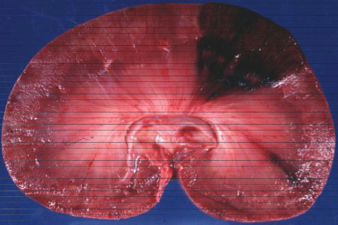
- AWedge
- BDark red
- CSwelling of affected tissue
7Sub-acute infarct - [blank_start]Degeneration and necrosis of ischaemia[blank_end] tissue
What happens:
[blank_start]Fluid forced[blank_end] out of area
[blank_start]Swelling[blank_end] decreases
Area becomes [blank_start]paler[blank_end]
Line of [blank_start]hyperaemia[blank_end]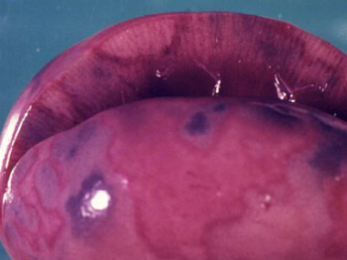
- ADegeneration and necrosis of ischaemia
- BFluid forced
- CSwelling
- Dpaler
- Ehyperaemia
8Chronic infarct - [blank_start]affected tissue is pale and shrunken due[blank_end] to fibrosis
Fibrosis - [blank_start]Healing of the infarct[blank_end]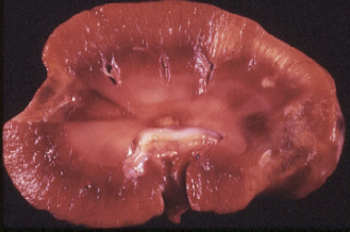
- Aaffected tissue is pale and shrunken due
- BHealing of the infarct
9Thrombus - [blank_start]Blood clot/solid structure that forms[blank_end] within the [blank_start]flowing blood stream from the normal[blank_end] [blank_start]constituents of blood during life[blank_end]
Thrombosis - [blank_start]Process by which a thrombus forms[blank_end]
Embolus - [blank_start]Abnormal mass circulating in the blood[blank_end] stream
Embolism - [blank_start]Arrest of a circulating mass within[blank_end] a vessel- AArrest of a circulating mass within
- BAbnormal mass circulating in the blood
- CProcess by which a thrombus forms
- DBlood clot/solid structure that forms
- Eflowing blood stream from the normal
- Fconstituents of blood during life
10Three Components of Virchow's Triad
1. [blank_start]Endothelial Injury[blank_end]
2. [blank_start]Abnormal Blood Flow[blank_end]
3. [blank_start]Hypercoagulability[blank_end]/[blank_start]Abnormal blood composition[blank_end]- AEndothelial Injury
- BAbnormal Blood Flow
- CHypercoagulability
- DAbnormal blood composition
11Virchow's Triad
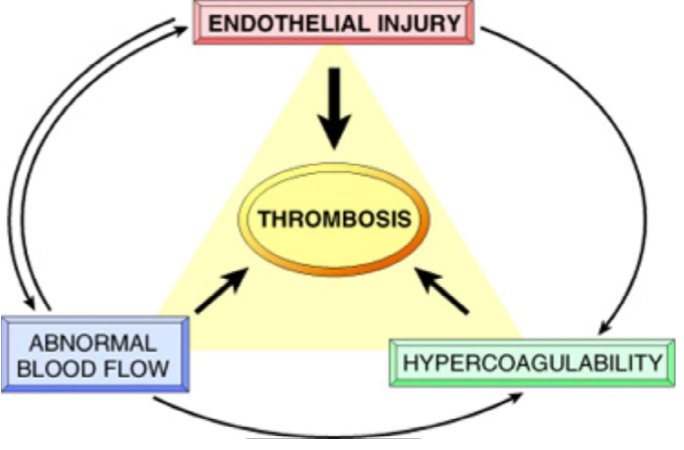
- AMost important
- BInfluences thrombus progression
- CInfluences thrombus progression (3rd)
12Different types of embolus
1. [blank_start]Thromboemboli[blank_end]
2. [blank_start]Gas[blank_end]
3. [blank_start]Fat[blank_end]
4. [blank_start]Neoplasms[blank_end]
5. [blank_start]Foreign bodies[blank_end]
6. [blank_start]Parasites[blank_end]
7. [blank_start]Clumps of bacteria[blank_end]
8. [blank_start]Pus[blank_end]
9. [blank_start]Injected material[blank_end]- AThromboemboli
- BGas
- CFat
- DNeoplasms
- EForeign bodies
- FParasites
- GClumps of bacteria
- HPus
- IInjected material
13Diapedesis - [blank_start]Small momentary spurting losses of blood[blank_end] [blank_start]occur between endothelial cell[blank_end] [blank_start]of otherwise normal capillaries[blank_end]
Haematoma - [blank_start]Local accumulation of blood[blank_end], [blank_start]usually clotted[blank_end]
Petechiae - [blank_start]Very small haemorrhagic spots[blank_end]
Ecchymoses - [blank_start]Slightly larger foci of haemorrhage[blank_end]
Bruising - [blank_start]Subcutaneous haemorrhage[blank_end]- ASubcutaneous haemorrhage
- BSlightly larger foci of haemorrhage
- CVery small haemorrhagic spots
- DLocal accumulation of blood
- Eusually clotted
- FSmall momentary spurting losses of blood
- Goccur between endothelial cell
- Hof otherwise normal capillaries
14Haemorrhage Compensatory Mechanisms
1. [blank_start]Blood redistribution[blank_end]
2. [blank_start]Restoration of blood volume[blank_end]
3. [blank_start]replacement of lost erythrocytes[blank_end]- ABlood redistribution
- BRestoration of blood volume
- Creplacement of lost erythrocytes
15Classifications of Shock
1. [blank_start]Hypovolaemic[blank_end] shock
2. [blank_start]Vasculogenic[blank_end] ([blank_start]septic[blank_end]) shock
3. [blank_start]Cardiogenic[blank_end] shock- AHypovolaemic
- BVasculogenic
- Cseptic
- DCardiogenic
16Oedema - [blank_start]Excessive accumulation of tissue fluid[blank_end]
Anasarca - [blank_start]Generalised subcutaneous oedema[blank_end]
Ascites - [blank_start]Fluid in abdomen[blank_end]
Hydropericardium - [blank_start]Fluid in pericardical sac[blank_end]
Hydrothorax - [blank_start]Fluid in pleural cavity[blank_end]- AFluid in pleural cavity
- BFluid in pericardical sac
- CFluid in abdomen
- DGeneralised subcutaneous oedema
- EExcessive accumulation of tissue fluid
17Starling's Equilibrium
Filtration Pressure = [blank_start]Hydrostatic pressure[blank_end] in plasma and tissues - [blank_start]Colloid osmotic pressure[blank_end] in plasma and tissues
Movement of [blank_start]fluid[blank_end] between [blank_start]vascular[blank_end] and [blank_start]extravascular[blank_end] compartments depends on the balance between [blank_start]hydrostatic pressure[blank_end] and [blank_start]colloid osmotic pressure[blank_end]- AHydrostatic pressure
- BColloid osmotic pressure
- Cvascular
- Dextravascular
- Efluid
- Fhydrostatic pressure
- Gcolloid osmotic pressure
18Increased hydrostatic pressure
Results from:
[blank_start]Increased fluid pressure[blank_end] within vessels which overcomes the [blank_start]attractive osmotic force[blank_end] of [blank_start]circulating protein[blank_end] leading to a net increase in [blank_start]outflow of fluid[blank_end] that is not matched by [blank_start]reabsorption by venules[blank_end] or by [blank_start]increased removal by lymphatics[blank_end]- AIncreased fluid pressure
- Battractive osmotic force
- Ccirculating protein
- Doutflow of fluid
- Ereabsorption by venules
- Fincreased removal by lymphatics
19Decreased plasma oncotic (osmotic) pressure
A reduction in [blank_start]circulating proteins[blank_end]
[blank_start]Albumin[blank_end] is the most [blank_start]abundant[blank_end] protein and most [blank_start]effective osmotic force[blank_end]
Hypoalbuminaemia = [blank_start]most important cause[blank_end] of decreased osmotic pressure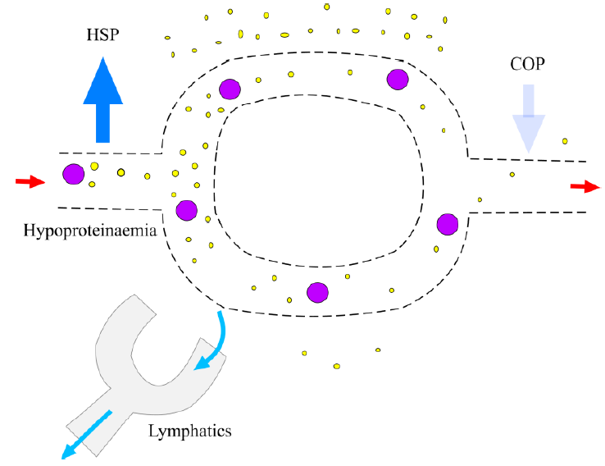
- Acirculating proteins
- BAlbumin
- Cabundant
- Deffective osmotic force
- Emost important cause
20Lymphatic Blockage
Seen if there is an [blank_start]extensive tumour invasion[blank_end] of a regional node OR
if [blank_start]lymph nodes are surgically removed[blank_end]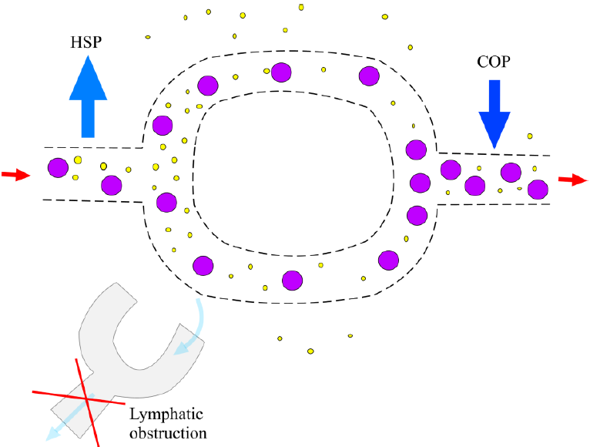
- Aextensive tumour invasion
- Blymph nodes are surgically removed
21Increased vascular permeability
Most commonly results from [blank_start]inflammation[blank_end]
Increase in vascular permeability by [blank_start]increasing the size of the gaps[blank_end] between [blank_start]endothelial cells[blank_end]
Causes an increase in the loss of [blank_start]fluid[blank_end], [blank_start]proteins[blank_end] and [blank_start]inflammatory cells[blank_end]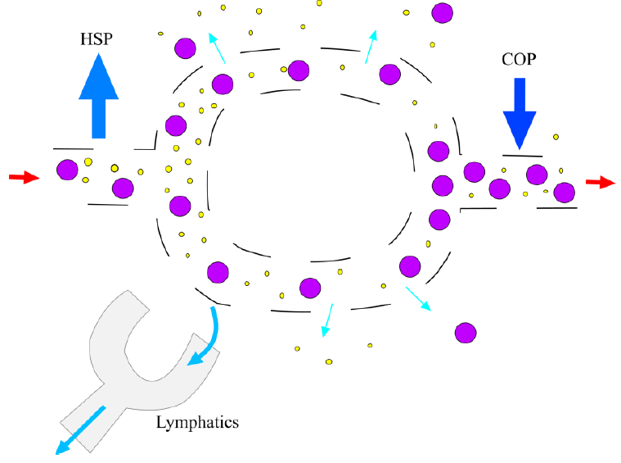
- Ainflammation
- Bincreasing the size of the gaps
- Cendothelial cells
- Dfluid
- Eproteins
- Finflammatory cells
22Examples of Oedema
Pulmonary oedema
rise in [blank_start]pulmonary venous pressure[blank_end] causes [blank_start]leakage of fluid[blank_end] into the [blank_start]alveoli[blank_end] of the lung
Cerebral oedema
Oedema of the [blank_start]brain[blank_end]- Abrain
- Bpulmonary venous pressure
- Cleakage of fluid
- Dalveoli
Informationen
- Beschreibung
- Der Nutzer hat seine Fachbereichs-Information gelöscht. Quiz am Disturbances of Circulation - L3-5, erstellt von Gelöschter Nutzer am 08/02/2020.
- Autor
- Gelöschter Nutzer
- Sprache
- English
- Aufrufe
- 17
- Verlauf
- Erstellt am 8 Feb 2020 · aktualisiert am 16 Feb 2020
- Schlagwörter
- Bewertung
- Noch keine Bewertungen Bewerte dieses Quiz