
GCSE Physics: Electrical Energy
Folien in diesem Satz (4)
-
- Many electrical appliances used at home are lamps or heaters. In a lamp, electrical energy is transferred as light and heat.
- There are different types of lamps, including:
- tungsten filament lamps
- discharge tube lamps
- Filament lamps
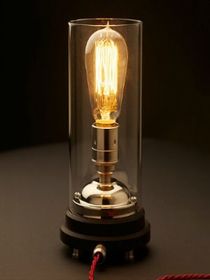
- In a tungsten filament lamp the energy is transferred in the resistance wire which makes up the filament. If you look at it closely, you will see the filament glowing but it also gives off a lot of heat. Of the electrical energy that goes into the lamp as little as 10% is transferred as light and up to 90% as heat.
- An electric heater operates in the same way as a filament lamp in that the energy is transferred (from electrical to heat in this case) in a resistance wire, often called the element.
- https://www.youtube.com/watch?v=7mXgXHIid9k (Einbetten)
- Bildunterschrift: Tungsten Filament Lamp
-
- In a discharge tube the energy is transferred in the gas inside the tube.
- A discharge tube lamp is more efficient than a filament lamp because:
- more of the electrical energy is transferred as light
- less of the electrical energy is transferred as heat
-
- For a given amount of electrical charge that moves, the amount of energy transferred increases as the potential difference increases.
- Calculating energy transferred
- Work out the energy transferred using this equation:
- Energy = current × voltage × time
- E = I × V × t
- where:
- E is the energy transferred in joules, J
- I is the current in amperes, A
- V is the potential differences in volts, V
- t is the time in seconds, s
- Physics: Electricity and Energy
- Electrical energy
- ENERGY
- Electricity
-
- Electricity meters measure the number of units of electricity used in a home or other building. The more units used, the greater the cost. The cost of the electricity used is calculated using this equation:
- Total Cost = number of units × cost per unit
- For example, if 5 units of electricity are used at a cost of 8p per unit, the total cost will be 5 × 8 = 40p.
- Remember that the number of units used can be calculated using this equation:
- Units (kWh) = power (kW) × time (h)
- Total cost = power (kW) × time (h) × cost per unit
- Physics: Electricity and Energy: Equations
- Work, Energy & Power: Quiz
- Energy and Electricity Quiz (Section 1 on Revision Checklist)
Informationen
- Beschreibung
- GCSE Physics: Electrical Energy
- Erstellt von
- Landon Valencia · Jul 2015
- Aktualisiert
- 24 Dez 2016
- Aufrufe
- 323
- Tags
- Bewertung