
Quiz
Fall 2021 Exam 3
Dieses Quiz enthält Fragetypen, die sich im gewohnten Player öffnen.
Fragen in diesem Quiz (64)
1Which structure articulates with the trochlea?
- ADistal ulna
- BDistal radius
- CProximal ulna
- DProximal radius
2What type of joint is the elbow joint?
- AHinge
- BCondyloid
- CGliding
- DSaddle
3Name the types of specific movements that occur at the elbow joint.
[blank_start]Flexion[blank_end]
[blank_start]Extension[blank_end]- AFlexion
- BExtension
4Name the type of functional classification of the elbow joint.
[blank_start]Diarthrotic[blank_end]- ADiarthrotic
5With reference to the trochlea, where is the capitulum located?
- ADistal
- BLateral
- CMedial
- DProximal
6Where is the trochlear notch located?
- ADistal ulna
- BProximal ulna
- CDistal radius
- DProximal radius
7Which structure articulates with the capitulum?
- AUlnar head
- BGlenoid fossa
- CRadial head
- DHumeral head
8Which large bony process is easily located by touching on the posterior aspect of the proximal forearm?
- AStyloid process
- BRadial tuberosity
- CCoronoid process
- DOlecranon process
9The radial and ulnar styloid process are located on the _____ ends of each bone.
- AProximal
- BMedial
- CDistal
- DLateral
10Which joint is the most distal articulation of the wrist?
- AIntercarpal
- BRadiocarpal
- CCarpometacarpal
- DMetacarpophalangeal
11Which carpal bone only has one name?
[blank_start]Pisiform[blank_end]- APisiform
12Which bony structures are located on the proximal end of the ulna?
- ARadial notch, styloid process, and ulnar head
- BRadial head, olecranon process, and ulnar head
- CRadial head, styloid process, and coronoid process
- DRadial notch, olecranon process, and coronoid process
13What other name refers to the carpal bone known as the scaphoid?
[blank_start]Navicular[blank_end]- ANavicular
14Which bony structures are located on the proximal radius?
- AHead and tuberosity
- BOlecranon process and tubercle
- COlecranon process and styloid process
- Dcoronoid process and tubercle
15Which bony structure is located on the distal end of the radius?
- AHead
- BTuberosity
- CNeck
- DStyloid process
16What other name refers to the carpal bone known as the trapezium?
[blank_start]Greater multangular[blank_end]- AGreater multangular
17Upon flexion of the elbow, the _____ of the ____ bone, fits into the _____ of the _____ bone.
- AOlecranon process, radial, coronoid fossa, humerus
- BOlecranon process, ulnar, olecranon fossa, humerus
- CCoronoid process, ulnar, coronoid fossa, humerus
- DCoronoid process, radial, olecranon fossa, humerus
18Which two structures articulate to form the proximal radioulnar joint?
- AHead of the ulna and the radial notch of the ulna
- BHead of the ulna and the ulnar notch of the radius
- CHead of the radius and the radial notch of the ulna
- DHead of the radius and the ulnar notch of the radius
19Which articulation do the trochlea and the trochlear notch form?
- AHumeroradial
- BDistal radioulnar
- CHumeroulnar
- DProximal radiulnar
20What is the roughened process of the humerus superior and lateral to the intertubercular grove?
- AAnatomical neck
- BSurgical neck
- CGreater tubercle
- DLesser tubercle
21Which structure articulates with the radius to form the humeroradial joint?
- ATrochlea
- BCapitulum
- CRadial head
- DHumeral head
22Which depression is located on the posterior surface of the distal humerus?
- ARadial notch
- BOlecranon fossa
- CCoronoid fossa
- DTrochlear notch
23Which depression is located between the lesser and greater tubercles of the proximal humerus?
- AIntertubercular groove
- BOlecranon fossa
- CCoronoid fossa
- DTrochlear notch
24Which structure of the proximal humerus is defined as an oblique line that separates the humeral head form the tubercles?
- ASurgical neck
- BIntertubercular groove
- CAnatomical neck
- DTrochlear notch
25Write the proper names of the three articulations that comprise the elbow joint:
1: [blank_start]Humeroulnar[blank_end] joint
2: [blank_start]Humeroradial[blank_end] joint
3: [blank_start]Proximal radioulnar[blank_end] joint- AHumeroulnar
- BHumeroradial
- CProximal radioulnar
26How much should the elbow be flexed for the lateral projection of the elbow?
- A30 degrees
- B45 degrees
- C90 degrees
- D180 degrees
27Which projection of the elbow best demonstrates the radial head free of bony superimposition?
- AAP
- BLateral
- CAP oblique, medial rotation position
- DAP oblique, lateral rotation position
28For the axiolateral projection (Coyle method) of the elbow to demonstrate the coronoid process, the elbow is:
- AFlexed 80 degrees
- BFlexed 90 degrees
- CIn hyperflexion
- DIn hyperextension
29With reference to the plane of the IR, how should the humeral epicondylar plane be positioned for the AP projection of the elbow?
- AParallel
- B45 degrees, lateral rotation
- CPerpendicular
- D45 degrees, medial rotation
30List the two primary projections of the humerus:
1: [blank_start]AP[blank_end]
2: [blank_start]Lateral[blank_end]- AAP
- BLateral
31What is the direction and amount of central ray angulation for the axiolateral projection (Coyle method) to demonstrate the radial head and capitulum?
- A0 degrees, perpendicular to IR
- B10 degrees, toward the shoulder
- C45 degrees, toward the wrist
- D45 degrees, toward the shoulder
32Which projection and position of the upper limb best demonstrates the coronoid process in profile, free of superimposition?
- AAP oblique wrist in the lateral rotation position
- BPA oblique wrist with the lateral side elevated
- CAP oblique elbow in the lateral rotation position
- DAP oblique elbow in the medial rotation position
33Which projection of the elbow best demonstrates the olecranon process in profile?
- AAP projection
- BLateral projection
- CAP oblique projection, medial rotation
- DAP oblique projection, lateral rotation
34What positioning characteristic best indicates that the humerus is properly positioned for the lateral projection of the humerus?
- AThe hand is pronated on the table
- BThe hand is true lateral on the table
- CThe humeral epicondylar coronal plane is parallel with the IR
- DThe humeral epicondylar coronal plane is perpendicular with the IR
35Which evaluation criteria indicates that the humerus was properly positioned for the AP projection?
- AThe epicondyles are superimposed
- BThe lesser tubercle is seen in profile
- CThe greater tubercle is superimposed over the humeral head
- DThe humeral head and grater tubercle are both seen in profile
36From the prone position, how many degrees should a finger be rotated for the lateral projection of that finger?
- A15 degrees
- B30 degrees
- C45 degrees
- D90 degrees
37Which projection of the shoulder requires that a horizontal central ray be directed 15 to 30 degrees medially and enter the axilla of the affected arm?
- AAP projection
- BPA oblique (scapular Y)
- CInferosuperior axial projection
- DTransthoracic lateral projection
38How should the central ray be directed for the PA oblique (scapular Y) projection of the shoulder?
- A10-15 degrees cephalad
- B10-15 degrees caudad
- C45-60 degrees cephalad
- DPerpendicular to the IR
39In which body position should the patient be placed to demonstrate the left shoulder in the PA oblique (scapular Y) projection?
- ALeft anterior oblique
- BRight anterior oblique
- CRight posterior oblique
- DLeft posterior oblique
40List the two standard/essential projections of the scapula:
1: [blank_start]AP[blank_end]
2: [blank_start]Lateral[blank_end]- AAP
- BLateral
41Where is the humeral head usually seen on a PA oblique (scapular Y) image if the shoulder is anteriorly dislocated?
- ASuperimposed on the junction of the acromion and coracoid process
- BBeneath the acromion
- CBeneath the coracoid process
- DCompletely separated from the glenoid fossa
42How many degrees and in which direction should the central ray be directed for the PA axial projection of the clavicle?
- A15-30 degrees caudad
- B15-30 degrees cephalad
- C25-40 degrees caudad
- D25-40 degrees cephalad
43What is the proper name for the projection used to demonstrate the humerus in a lateral position utilizing breathing technique?
- APearson method
- BFisk method
- CLawrence method
- DStecher method
44When performing the AP projection of the scapula, the central ray should be directed toward a point 2 inches (5cm) ______ to the coracoid process.
- ALateral
- BInferior
- CMedial
- DSuperior
45When performing a lateral projection of the scapula with the patient positioned either RAO or LAO, approximately how much body rotation is necessary for the average patient?
- A15-20 degrees
- B25-30 degrees
- C35-40 degrees
- D45-60 degrees
46In the lateral projection of the scapula, the patient rotation is necessary in order to superimpose which boarders of the scapula?
[blank_start]Medial[blank_end] and [blank_start]Lateral[blank_end]- AMedial
- BLateral
47The lateral scapula projection is similar in positioning to which projection of the shoulder?
[blank_start]PA Oblique scapular Y[blank_end]- APA Oblique scapular Y
48Which projection of the shoulder demonstrates the scapulohumeral joint space open and the glenoid cavity in profile?
- APA oblique (scapular Y) projection
- BAP projection with neutral rotation
- CAP oblique projection (Grashey method)
- DIneriosuperior axial projection (Lawrence method)
49What structures form the shoulder joint?
1: [blank_start]Humeral head[blank_end]
2: [blank_start]Glenoid cavity[blank_end] of the scapula- AHumeral head
- BGlenoid cavity
50What structures form the shoulder girdle?
1: [blank_start]Humerus[blank_end]
2: [blank_start]Scapula[blank_end]- AHumerus
- BScapula
51Write out the entire name of the joint found at the lateral end of the clavicle:
[blank_start]Acromioclavicular[blank_end] joint- AAcromioclavicular
52Which projection of the shoulder best demonstrates the lesser tubercle of the humerus in profile and pointing toward the glenoid cavity?
- ATransthoracic lateral
- BAP projection with neutral rotation
- CAP projection with external rotation
- DAP projection with internal rotation
53What would be the required patient position to demonstrate the left shoulder using the AP oblique projection/ Grashey method?
- A10 -15 degrees RPO
- B10 -15 degrees LPO
- C35 -45 degrees RPO
- D35 -45 degrees LPO
54The name for the projection that causes the clavicle to be projected above the region of the chest and ribs is:
- AGrashey method
- BFisk method
- CTransthoracic lateral
- DApical lordotic projection
55When obtaining an AP projection of the scapula, how does the patient move the scapula away from the overlying ribs and lungs?
- ARoll the shoulders forward
- BAdduct the affected arm
- CAbduct the affected arm and flex the elbow
- DPlace the hands on the hips
56When employing breathing technique for a transthoracic lateral of the shoulder/humerus, write the kVp range and if 100 mAs is required with a 25 mA station, what would the exposure time be?
[blank_start]70-80[blank_end] kVp [blank_start]4[blank_end] s exposure time- A70-80
- B4
57Label each structure:
A: [blank_start]Superior angle[blank_end]
B: [blank_start]Crest of the scapular spine[blank_end]
C: [blank_start]Medial border[blank_end]
D: [blank_start]Inferior angle[blank_end]
E: [blank_start]Infraspinous fossa[blank_end]
F: [blank_start]supraspinous fossa[blank_end]
G: [blank_start]superior angle[blank_end]
H: [blank_start]scapular notch[blank_end]
I: [blank_start]Coracoid process[blank_end]
J: [blank_start]acromion process[blank_end]
K: [blank_start]Scapular spine[blank_end]
L: [blank_start]Glenoid cavity[blank_end]
M: [blank_start]Lateral boarder[blank_end]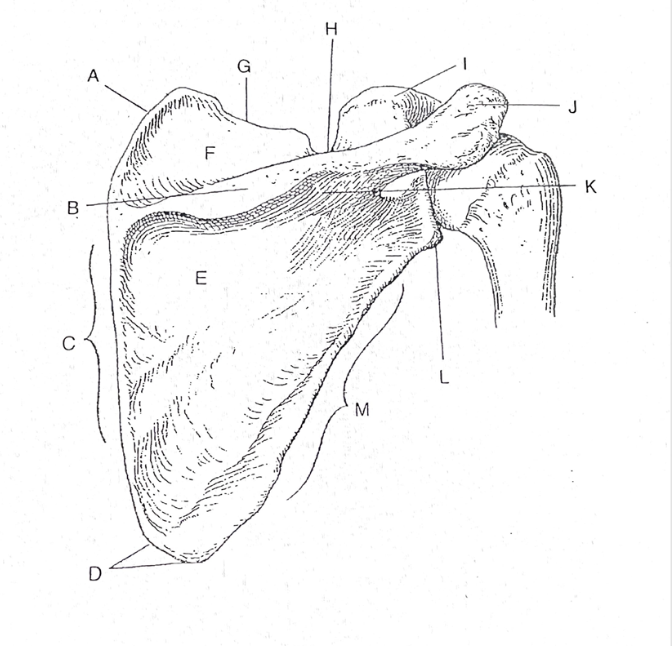
- ASuperior angle
- BCrest of the scapular spine
- CMedial border
- DInferior angle
- EInfraspinous fossa
- Fsupraspinous fossa
- Gsuperior angle
- Hscapular notch
- ICoracoid process
- Jacromion process
- KScapular spine
- LGlenoid cavity
- MLateral boarder
58Label each structure:
A: [blank_start]Lesser tubercle[blank_end]
B: [blank_start]Anatomic neck[blank_end]
C: [blank_start]Humeral head[blank_end]
D: [blank_start]Greater tubercle[blank_end]
E: [blank_start]Intertubercular groove[blank_end]
F: [blank_start]Surgical neck[blank_end]
G: [blank_start]Humeral body[blank_end]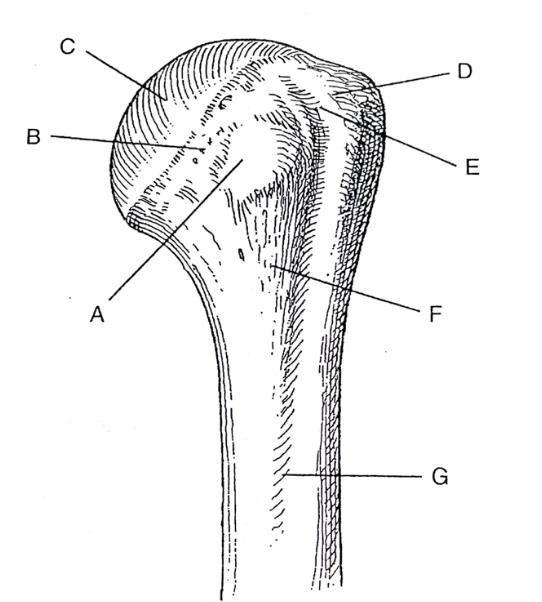
- ALesser tubercle
- BAnatomic neck
- CHumeral head
- DGreater tubercle
- EIntertubercular groove
- FSurgical neck
- GHumeral body
59The image is a ______ projection of what body region and best demonstrates what two structures?
Projection: [blank_start]AP oblique[blank_end], [blank_start]medial[blank_end] rotation
Body region: [blank_start]Elbow[blank_end]
Structure 1: [blank_start]Coronoid process[blank_end]
Structure 2: [blank_start]Medial epicondyle[blank_end]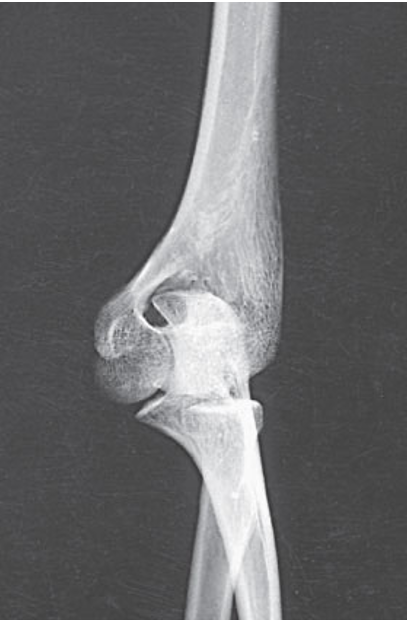
- AAP oblique
- Bmedial
- CElbow
- DCoronoid process
- EMedial epicondyle
60Projection: [blank_start]Lateral[blank_end]
Body area: [blank_start]Humerus[blank_end]
Is there pathology? Yes/no: [blank_start]Yes[blank_end]
You can tell what kind of projection this is because the [blank_start]epicondyles[blank_end] are [blank_start]superimposed[blank_end].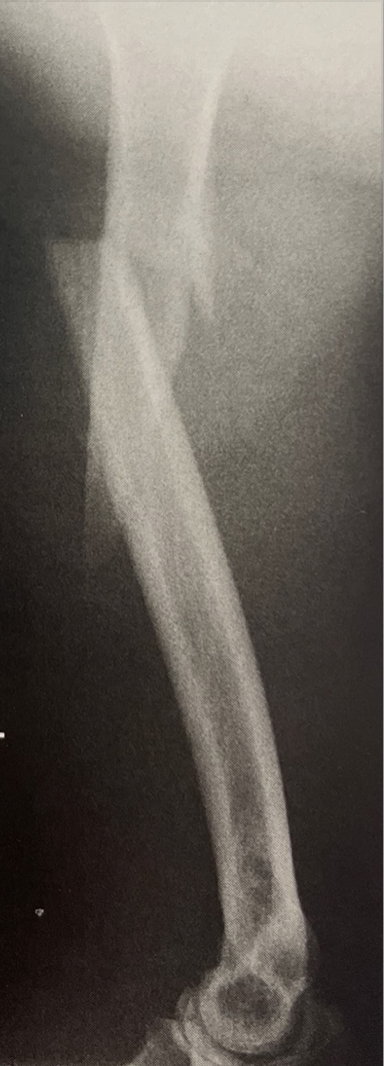
- ALateral
- BHumerus
- CYes
- Depicondyles
- Esuperimposed
61Projection: [blank_start]AP[blank_end] [blank_start]Internal[blank_end] rotation
Body region: [blank_start]Shoulder[blank_end]
Primary structure shown: [blank_start]Lesser tubercle[blank_end]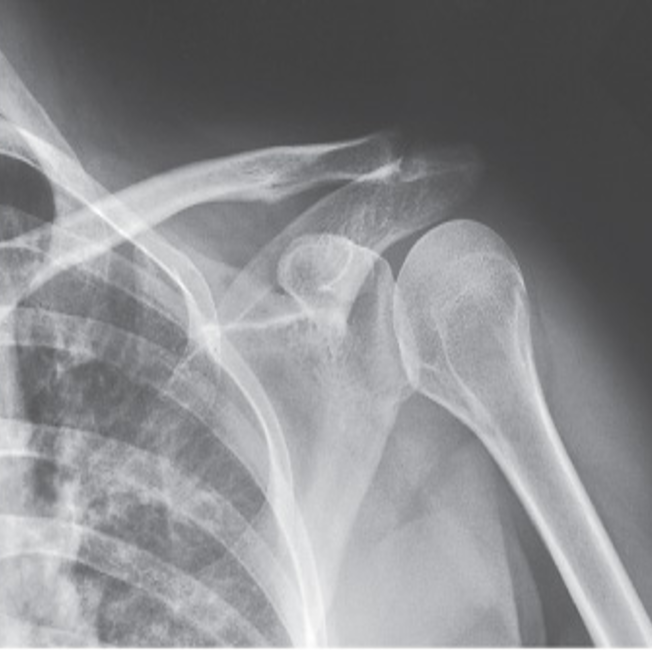
- AAP
- BInternal
- CShoulder
- DLesser tubercle
62Label the image:
- ACoracoid process
- BClavicle
- C5th rib
- DScapula
- Elesser tubercle
63Projection: [blank_start]Transthoracic lateral[blank_end]
Joint: [blank_start]Shoulder[blank_end]
Trauma or non-trauma exam? [blank_start]Trauma[blank_end]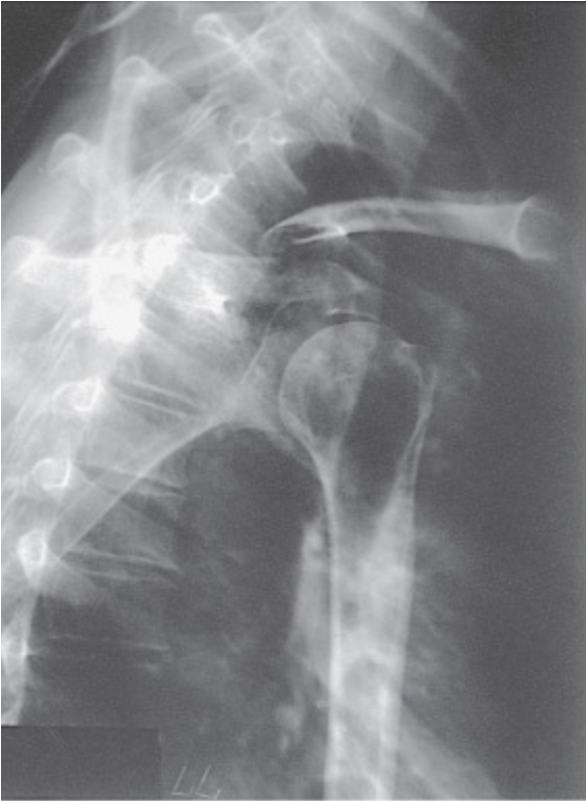
- ATransthoracic lateral
- BShoulder
- CTrauma
64Projection: [blank_start]PA Oblique[blank_end] ([blank_start]scapular y[blank_end])
Body region: [blank_start]Shoulder[blank_end]
What pathologic condition is this used to determine? [blank_start]Dislocation[blank_end]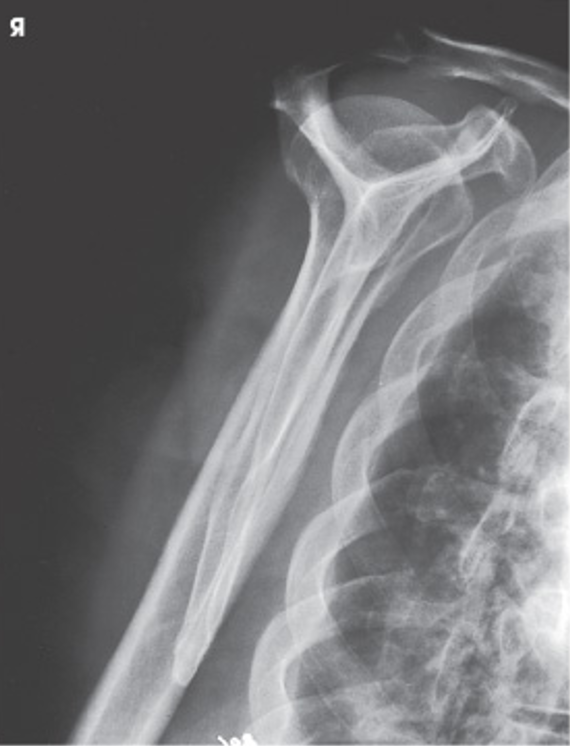
- APA Oblique
- Bscapular y
- CShoulder
- DDislocation
Informationen
- Beschreibung
- Der Nutzer hat seine Fachbereichs-Information gelöscht. Quiz am Fall 2021 Exam 3, erstellt von Gelöschter Nutzer am 31/01/2022.
- Autor
- Gelöschter Nutzer
- Sprache
- English
- Aufrufe
- 13
- Verlauf
- Erstellt am 31 Jan 2022 · aktualisiert am 1 Feb 2022
- Schlagwörter
- Bewertung
- Noch keine Bewertungen Bewerte dieses Quiz