
The global distribution of cold environments
Folien in diesem Satz (13)
-
- They begin as a result of global climate changes.
- Every 200-250 million years there appear to have been major periods of glacial activity.
- During the Quaternary period, the ice began to spread from the polar ice caps. There were up to 20 glacials (cold periods) and interglacials (warmer periods).
- The fluctuation in global temperatures was no more that 6 degrees c.
- At its greatest extent the ice covered nearly a third of the Earth's surface.
-
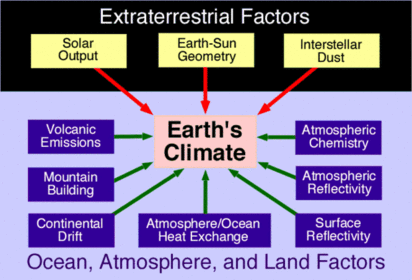
- Reasons for the climatic fluctuations are thought to include:
- Changes in the Earth's position in space (orbit and tilt)
- Variation in sunspot activity
- Changes in the amount of volcanic dust affecting the amount of radiation trapped in the atmosphere
- Trapping of carbon dioxide by the oceans reducing the total amount in the atmosphere and thus cooling the planet
- Variation in ocean currents
- Amount of surface reflection by ice (the albedo effect)
- Orogenesis (process of mountain building)
-
- Glaciers are masses of ice and debris which are continually changing and may be seen as an open system.
- Inputs are precipitation and avalanches (things that increase the mass).
- Outputs are evaporation and melt-water (things that decrease the mass).
- Near the source where inputs are bigger than outputs it's called the zone of accumulation this is because there is more precipitation (the orographic effect). Temperature is lower here because of strong winds at a high altitude and and the reflective properties of snow. As temperatures are low, sublimation (solid into vapor) and other losses are low and melt-water is likely to refreeze
- The zone of ablation is at a lower altitude towars the snout of the glacier. Outputs exceed inputs here. There is less snowfall and temperatures are higher, resulting in melting, sublimation, evaporation and calving.
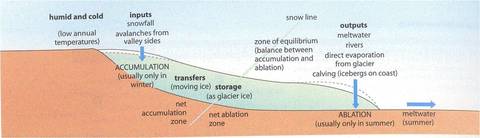
- Bildunterschrift: The dividing line between the two zones is called the firn line or equilibrium line. Gravity moves ice continually down to the equilibrium line, replacing that lost at the snout. The difference between the two zones is called the glacial budget or net balance.. It is positive in the winter and negative in the summer. When they are equal the glacier is said to be in a steady state.
-
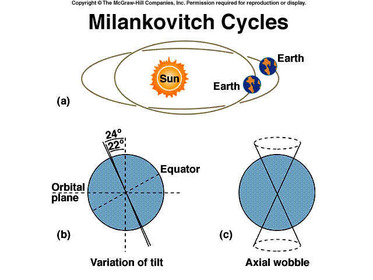
- (a) Eccentricity- Earth encounters more variation in the energy that it receives from the sun when Earth's orbit is elongated than it does when it is more circular.
- (b) Variation of tilt- The tilt of the Earth axis varied between 22.5 and 24.5 degrees c. The greater the tilt angle is, the more solar energy the poles receive.
- (c) Precession/ axial wobble- a gradual change in the orientation of the Earth's axis affects the relationship between Earths's tilt and eccentricity.
-
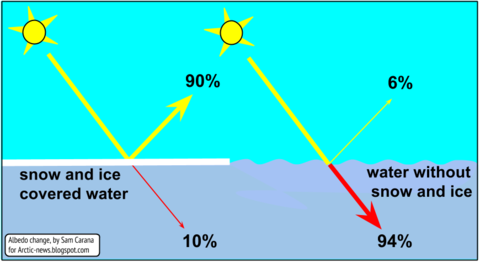
- Albedo is the percentage of incoming radiation reflected off a surface.
- An albedo of 1 means 100% of incoming radiation is reflected.
- An albedo of 0 means 0% of incoming radiation is reflected. all is absorbed.
- The more radiation reflected the less global warming occurs.
- Fresh show has an albedo of approximately 0.9.
-
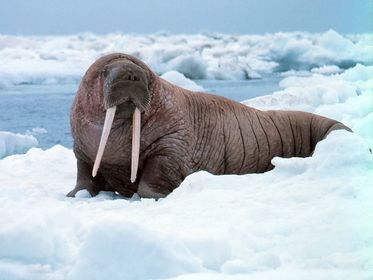
- Receive less intense solar radiation than the other parts of the earth because the sun's energy arrives at an oblique angle, spreading over a larger area, and also travels a longer distance through the Earth's atmosphere in which it may be absorbed, scattered or reflected.
- North and South poles -> polar ice caps in Arctic ocean and Antarctica.
-
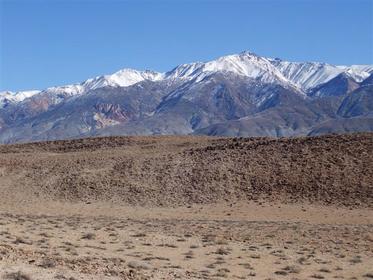
- Average climate for the regions above the tree line AKA mountain climate or highland climate. Cold due to high altitudes. Summer temperature between -12 and 10 degrees c. The average annual precipitation is 30cm
- White mountain, California 4300 metres above sea level
-
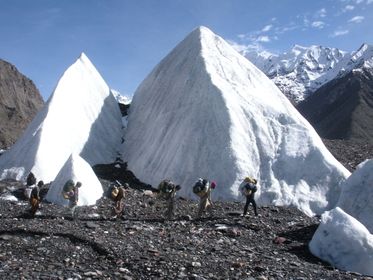
- Environment in which ice is a major transport process. They are located in the polar regions or at high altitudes. Liquid water and wind can also transport sediment. Wind transport is common when there is little vegetation. Liquid water transport occurs when the ice melts
- Baltoro Glacier, Pakistan 62764.4 metres
-
- Cold climate, frequently marginal to the glacial environment, and is characteristically subject to intense cycles of freezing and thawing of superficial sediments. Permafrost commonly occurs (permanently frozen ground condition). Approximately 25% of the worlds total land area is perglacial.
- It is the area at or around the fringes of glaciers.
- Frost action happens here e.g. freeze thaw
- No fixed location due to glacial retreats and advances
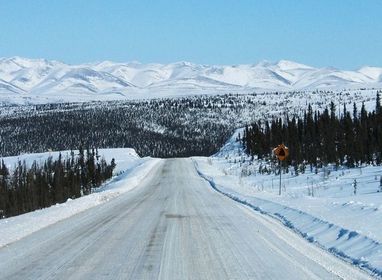
- Tuktoyaktuk, Canada
-
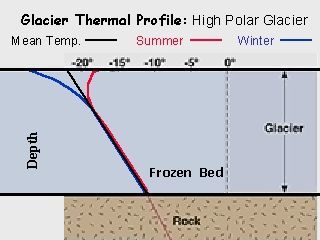
- Occur in polar latitudes where the temperature of the snowfall is below freezing.
- Ice remains frozen to the bedrock and as a result there is very little little ice movement and thus erosion.
- Little/no melt-water beneath the glacier prevents it from moving freely.
- Temperature at the base is well below the pressure melting point.
- Constant annual temperature -50 to -10 degrees c.
-
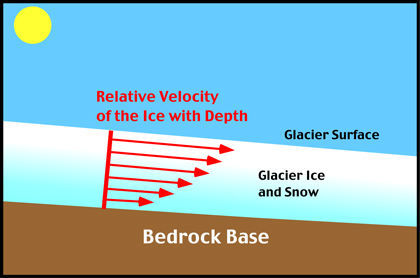
- Movement (bending) within the ice due to the stresses applied by gravity.
- Ice crystals orientate themselves in the direction glacial movement and slip past each other.
- Occurs in in warm as well but not as often.
-
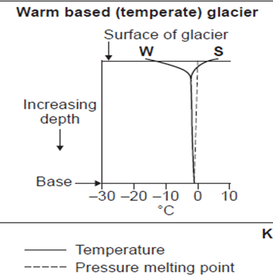
- Water is present throughout the ice mass and acts as a lubricant.
- Movement of between 20 and 200 metres per year, which greatly increases the capacity of the glacier to erode the bedrock.
- Temperature at base is the same as the pressure melting point (around degrees c)
- Cold in the winter, hotter in the summer -30 to 15 degrees c.
- Pressure melting point: the temperature at which ice under pressure will melt. It decreases as the pressure increases.
Informationen
- Beschreibung
- Folienset am The global distribution of cold environments, erstellt von Katy Thompson am 19/03/2016.
- Erstellt von
- Katy Thompson · Mär 2016
- Aktualisiert
- 21 Mär 2016
- Aufrufe
- 20
- Tags
- Bewertung