
psychology- 7 different Studys
Folien in diesem Satz (7)
-
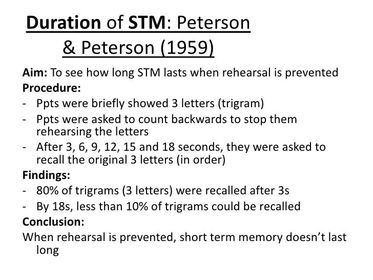
- Aim: To see is STM could work with out rehearsal.
- Method: 24 participants had to recall letters/words. To prevent rehearsal participants had to count backwards in 3's.
- Results: By secs only short amount of letters were recalled.
- Conclusion: If rehearsal is prevented the STM doesn't last long enough.
-
- Aim:To give evidence for the MSM(multi-store memory).
- Method:Participants learnt a list of words presented for 2 secs each. They were then asked to recall the words.
- Results: Words towards the end were recalled first (recency effect), and words at the start were recalled quite well.
- Conclusion: The recency effect shows the last words were in the STM and the first words were in the LTM
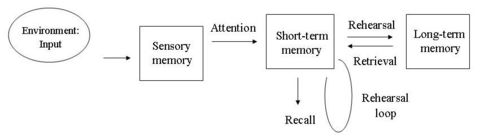
- Bildunterschrift: MSM cycle
-
3.Reconstructive Memory - Barlett
- Aim: To see if people change unfamiliar info.
- Method: Participants had to read a book on war of ghosts, then asked to recall weeks later.
- Results:The story changed every time they had to recall it.
- Conclusion: Our memory is influenced by our belief's.

-
- Aim: To see if the recall of familiar stories changed.
- Method: Uni students to recall details of their first week at uni.
- Results: There accuracy remained the same throughout the study.
- Conclusion: Memories for familiar events will not change over time.

-
- Aim: To see if the question asked about words would change on the number of words recalled.
- Method: Participants had a list of words and could only answer yes or no. Some questions required structural processing.
- Results: 70% of words required semantic processing, 35% phonetic and 15% structural.
- Conclusion: The more deeply info is processed, the more likely to be remembered.
-
- Aim: If new learning interferes with old learning.
- Method: Group A learnt a list of word pairs, Group B only had one list of words to remember.
- Results: Group B could recall their list more accurately.
- Conclusion: New learning will cause people to stop recalling accurately.

-
- Aim: To see if context helps to recall better.
- Method:18 divers had to learn words on land, then recall on land, as well as learning underwater and recall underwater.
- Results:50% could recall better where they learnt the info.
- Conclusion: Context does improve recall.

- Bildunterschrift: Context
Informationen
- Beschreibung
- This is GCSE Psychology unit 1 about all the different study's.
- Erstellt von
- Lauren Anderton · Okt 2016
- Aktualisiert
- 13 Okt 2016
- Aufrufe
- 8
- Bewertung