
Notizen
Intro, Neutralization, Salts
Inhalt der Notizen (1)
Seite 1
Properties of Acids:
- turns litmus paper red
- destroys the chemical properties of bases = neutralizes bases
- conducts electricity
Properties of Bases
- turns litmus paper blue
- destroys the chemical properties of acids = neutralizes acids
- conducts electricity
Bases neutralize acids
- usually metal oxides, hydroxides, or carbonates
- not all are soluble in water
- soluble base = alkali
hydroxide = OH
carbonate = CO3
nitrate = NO3
oxide = O
Indicators
Indicators are used to find out if a liquid is acidic
they change colour when added to acids or alkalis
Litmus is a dye that turns red when added to acid and blue when added to alkali
Universal indicator (mix of several indicators)
pH scale
- devised to let chemists measure the strength of an acidic or alkaline solution
- measures on a 14 point scale
- can change into several colours depending on the pH of the solution
- each units represents 10x in acidity
- can also be found using a pH meter
Salts can be formed when a base neutralises an acid
when sodium hydroxide neutralizes hydrochloric acid = solution of the salt sodium chloride is formed (and water)
Acid + reactive metal --> Salt + Hydrogen
Acid + Metal Oxide --> Salt + water
Acid + metal hydroxide --> salt + water
acid + metal carbonate --> salt + water + carbon dioxide
acid + excess metal --> salt + water + unreactive metal
Acid + Ammonia --> Ammonium salt
zinc did not react with any of the acid solutions
magnesium reacted most strongly
product of:
salt + water
salt + hydrogen
salt + water + carbon dioxide
means that it was acidic
Normal Salts:
compound that has been formed when all the hydrogen ions have been replaced by metal ions or by the ammonium ion (NH4)
Soluble Salts:
- all nitrates
- all common sodium, potassium and ammonium salts
- all chlorides except lead, silver and mercury
- all sulphates but lead, barium and calcium
Excess metal or base is added to an acid until all of the acid has reacted -- no more solid will dissolve
excess solid is removed by filtration
^suitable for making soluble salts when the solid reactants are insoluble
filtering is only suitable for making soluble salts -- if it was insoluble it would get stuck in the filter paper
1. Metal with a dilute acid
METAL + ACID --> SALT + HYDROGEN GAS
do not use this is the metal is very reactive eg sodium or very unreactive eg copper
2. Insoluble base (metal oxide) with an acid
Do not use this if the base is soluble (an alkali) -- when filtering the excess base it will not get stuck in the filter paper and will not separate from the salt
ACID + METAL OXIDE --> SALT + WATER
3. Insoluble base (metal carbonate) with an acid
Do not use if the carbonate is soluble
CARBONATE + ACID --> SALT + CARBON DIOXIDE + WATER
Soluble Salts:
React an excess of the solid with an acid to make sure that all the acid has been neutralized.
Acid + Metal
Method:
Measure out some acid into a beaker
Add the solid metal in excess into the beaker
Filter the mixture to remove the excess metal
Heat the filtrate to evaporate some water
Leave to cool and crystallize
Wash with a little distilled water & pat dry with filter paper
Only suitable for making soluble salts because if insoluble it wouldn't separate from the excess metal and would get stuck in the filter paper
Titration
in other method soluble bases cannot be filtered out
Sodium, potassium, calcium react with cold water = alkalis
ALKALI + ACID --> SALT + WATER
Use: To find the amount of acid needed to neutralize a certain amount of alkali or vice versa.
Equipment:
Set limit of acid/alkali in a CONICAL FLASK
Burette to find the amount to neutralize the acid/alkali
Indicator
Pipette
Method:
Fill the burette with acid/alkali and take note of the reading. Read it to the nearest 0.05 cm3
Pipette 25cm3 of the alkali/acid into a conical flask
Add a few drops of indicator
Add the acid to the alkali swirling the mixture constantly
The end point is determined by the colour the indicator reaches. If phenolphthalein than the end point colour will be a light pink. If univeral indicator than the solution colour will be green. If methyl-orange is used than the colour will be salmon pink.
Record the reading of the end point on the burette.
Repeat without adding the indicator
Pour the neutral solution into an evaporating basin and evaporate about half the water
Pour the concentrated solution into a petri dish set aside to cool and crystallize
crystals form because salts are less soluble in colder liquids
Precipitation
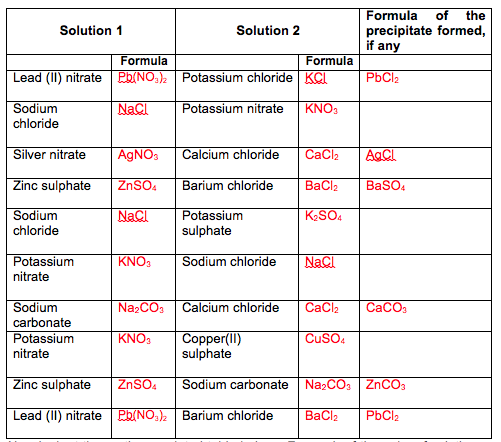
precipitate = insoluble solid that forms out of a mixture of solutions
when solutions of two soluble salts are mixed -- two new combinations of ions are possible
if either of these new combinations produce an insoluble salt then a precipitate will form
spectator ions are left
Method:
Prepared by using a precipitation reaction
Two soluble solutions of the insoluble salt are mixed together. One with the cation, one with the anion
Stir the mixture until a precipitate forms
Filter the mixture to obtain the insoluble salt
Rinse with a little bit of distilled water and pat dry with filter paper
Precipitate: insoluble product in a reaction
Spectator Ion: ions that don't change their state in a reaction ie. ions that don't react
Ionic Equation: equation without spectator ions ie. showing the real reaction
Neutralisation
acids and bases = chemical opposites
when they react together they destroy each other’s characteristics = neutralisation
heat is produced (Exothermic reaction)
HCl + NaOH --> NaCl + H2O
remove spectator ions = H+OH --> H2O
Phenolphthalein Indicator
acid: colorless
base: pink
sodium c
All soluble:
sodium compounds
nitrates
ammonium salts
potassium compounds
Properties and Indicators
Salts and Neutralisation
Making a Soluble Salt
Making a Soluble Salt II (soluble reactants)
Making Insoluble Salts
Informationen
- Beschreibung
- IGCSE Chemistry (C4 Acids and Bases) Notiz am Intro, Neutralization, Salts, erstellt von ShreyaDas am 27/03/2014.
- Erstellt von
- ShreyaDas · Mär 2014
- Aktualisiert
- 18 Apr 2018
- Aufrufe
- 1.085
- Tags
- Bewertung