
Chemistry: Chemical Energetics: Heat energy and enthalpy; Bond enthalpy
Folien in diesem Satz (14)
-
-
- The first law of thermodynamics states that, during a chemical reaction, energy cannot be created or destroyed. However, one form of energy can be converted into another. Various forms of energy are interesting to a chemist. Two of the most important ones are:
- 1. Chemical energy
- 2. Heat energy
- Chemical Energy
- Chemical energy is made up of two components:
- 1. Kinetic energy, which is a measure of the motion of the particles (atoms, molecules or ions) in a substance.
- 2. Potential energy, which is a measure of how strongly these particles interact with one another (i.e. both attract and repel one another).
- Heat Energy
- Heat energy is the portion of the potential energy and the kinetic energy of a substance that is responsible for the temperature of the substance. The heat energy of a substance is directly proportional to its absolute temperature (i.e. the temperature measured in Kelvin).
-
- Enthalpy is a measure of the total energy of a system.
- You cannot directly determine the enthalpy of a system, but you can measure the enthalpy change (delta H) that takes place during a physical or a chemical change.
- The enthalpy change of a process is the heat energy that is transferred between the system and the surroundings at constant pressure.
- Two types of process can take place. These are:
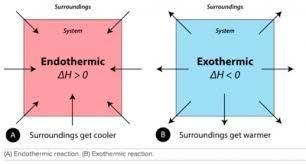
- 1. Exothermic - where heat energy is transferred from the system to the surroundings.
- 2. Endothermic - where heat energy is transferred from the surroundings to the system.
- Making bonds is exothermic, breaking bonds is endothermic.
- If the energy released making bonds is greater than the energy required to break bonds, a reaction is exothermic: delta H < 0.
- If the energy required to break bonds is greater than the energy released making bonds, a reaction is endothermic: delta H > 0.
- This can be remembered using the phrase "MEXOBENDO".
-
Exothermic & Endothermic Reactions
- Some examples of exothermic reactions are:
- 1. Freezing water
- 2. Condensing water vapour
- 3. Dissolving sodium hydroxide in water
- 4. Reaction between dilute hydrochloric acid and aqueous sodium hydroxide
- Combustion of petrol
- Some examples of endothermic reactions are:
- 1. Melting ice
- 2. Evaporating water
- 3. Dissolving ammonium nitrate in water
- 4. Reaction between dilute ethanoic acid and solid sodium hydrogencarbonate
- 5. Photosynthesis
- When considering a chemical reaction, the "system" refers to the reaction mixture. Everything outside of the system is called the "surroundings", which in practice is the air in the room in which the reaction is taking place.
- Exothermic reactions can usually be recognised because they result in an immediate increase in temperature. For example, when hydrochloric acid is added to aqueous sodium hydroxide, the temperature of the reaction mixture increases. Similarly, when natural gas burns in oxygen, the flame produced is hot.
- Conversely, endothermic reactions often produce a decrease in temperature of the reaction mixture, for example when solid sodium hydrogencarbonate is added to aqueous citric acid.
- Any reaction that has to be continually heated in order for it to take place is endothermic. For instance, the thermal decomposition of calcium carbonate into calcium oxide and carbon dioxide is an endothermic reaction.
-
- In 1982, the International Union of Pure and Applied Chemistry (IUPAC) recommended that all enthalpy changes should be quoted using standard conditions of 100kPa pressure and a stated temperature. The temperature most commonly used is 298K. For aqueous solutions, standard concentrations are 1moldm-3.
- Under these conditions, the enthalpy change measured is called the "standard enthalpy change".
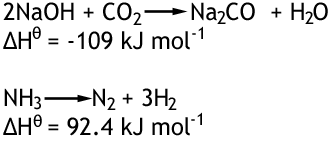
- When looking at standard enthalpy change of reaction, it is important to recognise that the enthalpy change is for the reaction as written.
- For the reaction:
- N2(g) + 3H2(g) -> 2NH3(g) deltaH = -92kJmol-1
- But for the reaction when written as:
- 1/2N2(g) + 3/2H2(g) -> NH3(g) deltaH = -46kJmol-1
- In each case the "per mole" refers to one mole of equation, and not to one mole of any reactant or product.
-
Standard Enthalpy Change of Combustion
- What is meant by standard enthalpy change of combustion?
- The standard enthalpy change of combustion is the enthalpy change measured at 100kPa and a specified temperature, usually 298K, when one moles of a substance is completely burned in oxygen. When writing an equation to represent the standard enthalpy change of combustion, it is important to specify one mole of the substance that is being burned. Two common ways of writing the combustion of hydrogen are:
- 1. H2(g) + 1/2O2(g) -> H2O(l)
- 2. 2H2(g) + O2(g) -> 2H2O(l)
- The first equation, in which one mole of hydrogen undergoes combustion, represents the standard enthalpy change of combustion. The enthalpy change for the second equation is 2 x standard enthalpy change of combustion of hydrogen.
- Experimental determination of enthalpy change of combustion of a liquid
- To find the enthalpy change of combustion of a liquid, a known mass of the liquid is burned and the heat energy produced is used to heat a known volume of water.
- The following procedure is used:
- 1. A spirit burner containing the liquid under test is weighed.
- 2. A known volume of water is added to a copper can.
- 3. The temperature of the water is measured.
- 4. The burner is lit.
- 5. The mixture is constantly stirred with the thermometer.
- 6. When the temperature of the water has reached approx. 20C above its initial temperature, the flame is extinguished and the burner is immediately weighed.
- 7. The final temperature is measured.
- The appropriate laboratory apparatus comprises a thermometer, lid, copper can, water, draught shield, spirit burner, and liquid.
-
Calculating enthalpy change of combustion
- The enthalpy change of combustion is now calculated in three stages.
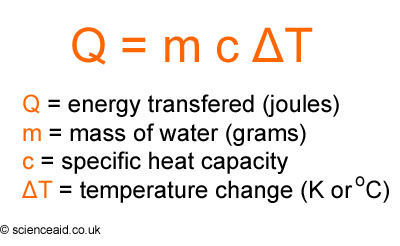
- Stage 1: Calculate the heat energy, Q, transferred to the water using the equation:
- Q = mcdel.T, where m is mass of water, c is specific heat capacity of water (4.18Jg-1K-1) and T is temperature change.
- Stage 2: Calculate the amount, n, of liquid burned.
- Number of moles = Mass of substance used/Relative molecular mass
- Stage 3: Calculate the standard enthalpy change of combustion using the equation:
- standard enthalpy change = -Q/n
-
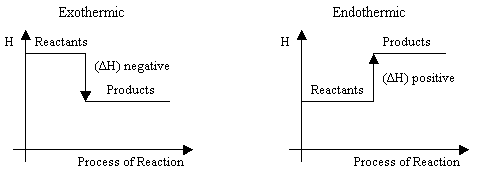
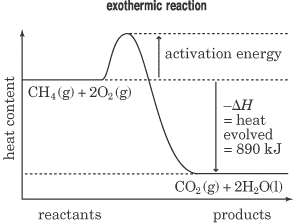
- In an exothermic reaction, the final enthalpy of the system is less that its initial enthalpy. The reverse is true for an endothermic process. This can be shown using enthalpy level diagrams.
- The change in enthalpy, deltaH, is given by:
- deltaH = H(products) - H(reactants)
- Points to remember:
- 1. You only need to label the vertical axis. It is not necessary to label the horizontal axis in an enthalpy level diagram. It is, however, essential to label the axis in an enthalpy profile diagram.
- 2. The formulae for both reactants and products should be given, including their state symbols.
- 3. The values for deltaH should be given, including the correct sign.
- 4. It is not essential to show the activation energy in an enthalpy level diagram, but is should be shown in an enthalpy profile diagram.
-
Standard Enthalpy Change of Neutral.
- The standard enthalpy change of neutralisation is the enthalpy change measured at 100kPa and a specified temperature, usually 298K, when one mole of water is produced by the neutralisation of an acid with an alkali.
- For certain combinations of acid and alkali, the standard enthalpy change of neutralisation is remarkably constant.
- If we make the assumption that strong acids and alkalis are fully ionised in aqueous solution, then the reaction between them is simplified to: H+(aq) + OH-(aq) -> H2O(l). Since the reaction is essentially the same in each case, it is hardly surprising that the enthalpy changes are so similar.
- Experimental determination of enthalpy change of neutralisation
- Here is how to find the enthalpy change of neutralisation:
- 1. Wear safety glasses and a lab coat.
- 2. Using a pipette filled with a safety filter, place 25.0cm3 of 1.00moldm-3 acid into an expanded polystyrene cup.
- 3. Measure the temperature of the acid.
- 4. Using a pipette filled with a safety filter, place 25.0cm3 of the alkali (usually dilute sodium hydroxide of a concentration slightly greater than 1.00moldm-3 to make sure all the acid is neutralised) into a beaker.
- 5. Measure the temperature of the alkali.
- 6. Add the alkali to the acid, stir with the thermometer and measure the maximum temperature reached.
-
Standard Enthalpy Change of Formation
- The standard enthalpy change of formation is the enthalpy change measured at 100kPa and a specified temperature, usually 298K, when one mole of a substance is formed from its elements in their standard states.
- For the purposes of the definition, the standard state of an element is the form in which it exists at the specified temperature, usually 298K, and a pressure of 100kPa.
- The standard enthalpy changes of formation of gaseous carbon dioxide is the enthalpy change for the reaction:
- C(s) + O2(g) -> CO2(g) deltafH = -394kJmol-1
- The standard enthalpy change of formation of liquid ethanol is the enthalpy change for the reaction:
- 2C(s) + 3H2(g) + 1/2O2(g) -> C2H5OH(l) deltafH = -278kJmol-1
- Enthalpy changes of formation emphasise the necessity of including state symbols in thermochemical equations. The value for the enthalpy change of formation of gaseous ethanol is different from that for liquid ethanol:
- deltafH [C2H5OH(l)] = -278kJmol-1
- deltafH [C2H5OH(g)] = -235kJmol-1
-
- Most standard enthalpy changes of formation cannot be determined experimentally. For example, it is impossible to burn carbon in oxygen and form solely carbon monoxide. So, the enthalpy change for the reaction:
- C(s) + 1/2O2(g) -> CO(g) is impossible to determine directly.
- Fortunately, we can make use of Hess's Law, which is an application of the first law of thermodynamics (conservation of energy). Hess's Law states that the enthalpy change of a reaction is independent of the path taken in converting reactants into products, providing the initial and final conditions are the same in each case. Hess's Law allows us to calculate the standard enthalpy change of formation of carbon dioxide.
- C(s) + O2(g) -> C)2(g) deltacH = -394kJmol-1
- CO(g) + 1/2O2(g) -> CO2(g) deltacH = -283kJmol-1
- Method 1: Reverse the second equation above and then add to the first: +283+ -394 = -111kJmol-1
- Method 2: Construct an enthalpy cycle using Hess's Law
- C(s) + 1/2O2(g) ------------------> CO(g)
- \ -394 / -283
- ---> CO2(g) <---
- deltafH = -394 - -283 = -111kJmol-1
-
Using Hess's Law for other Reactions
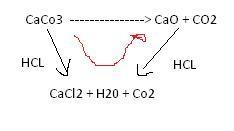
- Hess's Law can be used to calculate the enthalpy change for many different types of reaction.
- Example: Calculate deltafH for the thermal decomposition of calcium carbonate into calcium oxide and carbon dioxide, given the following data:
- CaCO3(s) + 2HCl(aq) -> CaCl2(aq) + H2O(l) + CO2(g) deltaH = -17
- CaO(s) + 2HCl(aq) -> CaCl2(aq) H2O(l) + CO2(g) deltaH = -195
- deltarH = -17 - -195 = +178kJmol-1
-
Bond enthalpy & Mean Bond Enthalpy
- Bond enthalpy is the enthalpy change when one mole of a bond in the gaseous state is broken.
- For a diatomic molecule, XY, the bond enthalpy is the enthalpy change for the following reaction:
- XY(g) -> X(g) + Y(g) e.g. Cl2(g) -> 2Cl(g) deltaH = +243 kJmol-1
- For polyatomic molecules, each bond has to be considered separately. For example, with methane there are four separate bond enthalpies:
- CH4(g) -> CH3(g) + H(g) deltaH = +423kJmol-1
- CH3(g) -> CH2(g) + H(g) deltaH = +480kJmol-1
- CH2(g) -> CH(g) + H(g) deltaH = +425kJmol-1
- CH(g) -> C(g) + H(g) deltaH = +335kJmol-1
- Bond enthalpy of the C-H bond varies with its environment. For this reason it is often useful to quote the mean bond enthalpy. The mean bond enthalpy for the C-H bond in methane is approx. +416kJmol-1. The mean bond enthalpy for the C-H bond in a large number of organic compounds is +413kJmol-1. If the bond enthalpy is calculated for a particular compound, it is likely to be slightly different from the mean value. For example, the mean bond enthalpy for the C-H bond in ethane is +420kJmol-1.
- A shorthand representation for mean bond enthalpy is to use the letter E followed by the bond in brackets. So the mean bond enthalpy of the C-C bond is written as E(C-C) = +347kJmol-1.
- Mean bond enthalpy is the enthalpy change when one mole of a bond, averaged out over many different molecules, is broken.
-
- Here is the process for calculating an enthalpy change of reaction using mean bond enthalpies:
- 1. Calculate the sum of the mean bond enthalpies of the bonds broken
- 2. Calculate the sum of the mean bond enthalpies of the bonds made
- 3. Calculate the enthalpy change of reaction using the equation:
- deltarH = sum of bonds broken - sum of bonds made
- The measured value for the enthalpy change of this reaction is -98kJmol-1. The reason for the difference is that bond enthalpies and measured in the gaseous state, and both hydrogen peroxide and water are liquids in the reaction.
- Calculating mean bond enthalpies from enthalpy changes of reaction
- For this type of calculation you are supplied with a value for the enthalpy change of a reaction, together with all the relevant mean bond enthalpies except one; the one you are asked to calculate.
- To solve the problem, simply substitute the known mean bond enthalpies and the unknown bond enthalpy into the expression:
- deltarH = sum of the bonds broken - sum of the bonds made
- Rearrange the expression to make the unknown bond enthalpy the subject, and solve the problem.
Informationen
- Beschreibung
- A level Chemistry (Year 1 Organic) Folienset am Chemistry: Chemical Energetics: Heat energy and enthalpy; Bond enthalpy, erstellt von Phoebe Johnson am 05/01/2017.
- Erstellt von
- Phoebe Johnson · Jan 2017
- Aktualisiert
- 6 Apr 2018
- Aufrufe
- 116
- Bewertung