
Notizen
DNA
Inhalt der Notizen (5)
Seite 1
DNA is a polymer of nucleotides
DNA (deoxyribonucleic acid) contains all the genetic information of an organism.
DNA is made up from lots of monomers called nucleotides.
Nucleotides are made up of :
A phosphate group
A pentose sugar - 5 carbon sugar. In DNA this is 2-deoxyribose.
A base. One of 4 different bases: Adenine (A), Guanine (G), Cytosine (C) and Thymine (T).
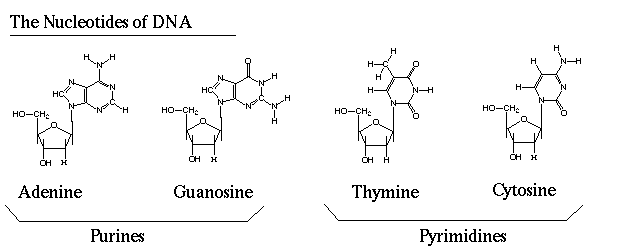
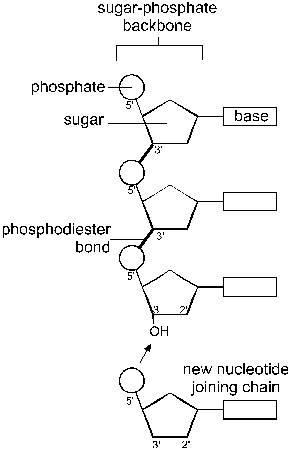
The nucleotides join together to form a polynucleotide chain. Covalent bonds form between the phosphate group of one nucleotide and the sugar of another - this makes what's called the sugar-phosphate backbone of the chain.
Seite 2
DNA forms by condensation polymerisation
A molecule of water is lost and a covalent phosphodiester bond is formed.
There are still OH groups at the top and bottom of each chain, so further links can be made. This allows the nucleotides to form a polymer made up of an alternating sugar-phosphate-sugar-phosphate chain.
Seite 3
DNA forms a double helix
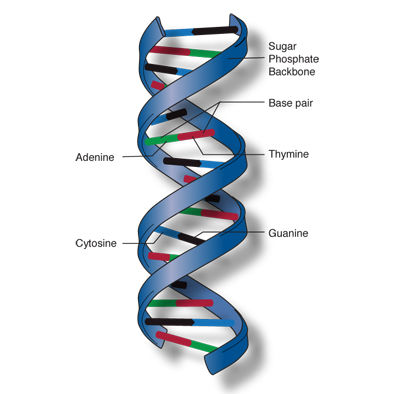
DNA is made of two polynucleotide strands.
The two strands spiral together to form a double helix structure, which is held together by hydrogen bonds between the bases.
Each base can only join with on particular partner - adenine always pars with thymine and guanine always pairs with cytosine.
This causes the two strands of DNA to be complementary - this means that they match up so that whenever there is an adenine base on one strand, there will by a thymine base on the other, and whenever there is a guanine base on one strand, there will be a cytosine base on the other and vice versa.
Seite 4
Hydrogen Bonding causes the bases to form specific pairs
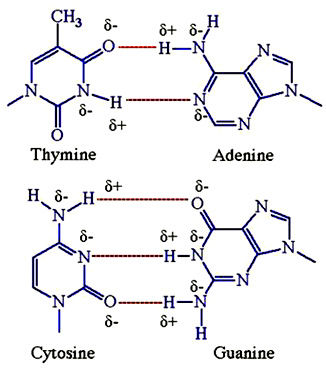
Base pairing exists in the DNA helix, where adenine (A) bonds with thymine (T) and cytosine (C) binds with guanine (G). It happens because of the arrangement and number of atoms in the base molecules that are capable of hydrogen bonding.
A hydrogen bond forms between a polar positive H atom (an H attached to anything highly electronegative like N) and a lone pair of electrons on a nearby O or N atom. To bond, the two atoms have to be the right distance apart.
A and T have the right atoms in the right places to form 2 hydrogen bonds, so they can pair up. G and C each form 3 hydrogen bonds, so they can pair up too.
These are the only posible bas combinations. Other base pairings would put the partially charged atoms too close together (they'd repel each other), or too far apart, or the bonding wouldn't line up properly.
The DNA helix has to twist so that the bases are in the right alignment and at the right distance apart for the complementary base pairs to form.
Seite 5
Cisplatin can bind to DNA in cancer cells
Cisplatin is a complex of Platinum (II) with two chloride ion ligands and two ammonia ligands in a square planar shape. It is used as an anticancer drug.
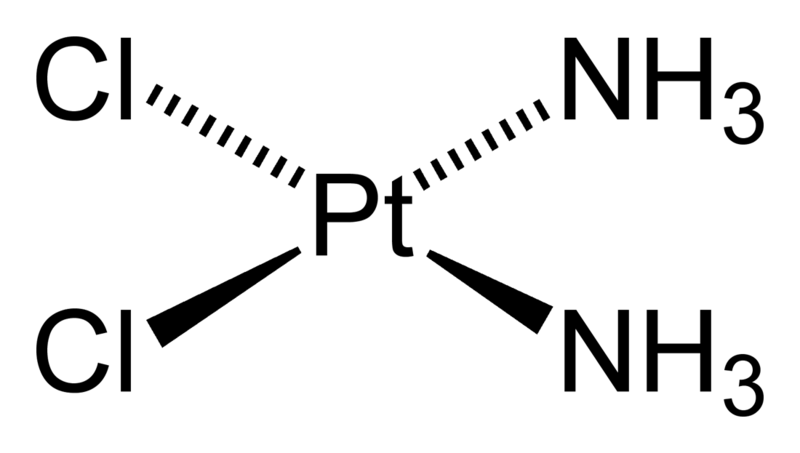
Cancer is caused by cells in the body dividing uncontrollably and forming tumours.
In order for a cell to divide it has to replicate it's DNA.
Cisplatin binds to DNA, causing kinks in the DNA helix which stop the proteins that replicate the DNA from copying it properly. This stops tumour cells reproducing by:
A nitrogen atom on a GUANINE base in DNA forms a co-ordinate bond with cisplatin's platinum ion, replacing one of the chloride ion ligands. (This is a ligand substitution reaction).
A second nitrogen from from a nearby GUANINE (either on the same strand of the DNA or on the opposite strand) can bon to the platinum and replace the second chloride ion.
The presence of the cisplatin complex bound to the DNA strands causes the strands to kink. This means that the DNA strands can't unwind and be copied properly - so the cell can't replicate.
Unfortunately, cisplatin can bind to DNA in normal cells as well as cancer cells. This is a particular problem for any healthy cells that replicate frequently, such as hair cells and blood cells, because cisplatin stops them from replicating in the same way as it does cancer cells. This means that the cisplatin can cause hair loss and supress the immune system (which is controlled by the white blood cells). It can also cause kidney damage.
These side effects can be lessened by giving patients low dosages of cisplatin.
Another way to reduce the side effects of cisplatin is to target it to the tumour - this means using a method that delivers the drug only to the cancer cells, so it doesn't get the chance to attack healthy cells.
Despite the side effects of cisplatin, it is still used as a chemotherapy drug. This is because the balance of the long term effects (curing cancer) outweigh the negative short term
Informationen
- Beschreibung
- A2 Chemistry (Amino Acids, Proteins and DNA) Notiz am DNA, erstellt von Lucy Nove am 28/02/2017.
- Erstellt von
- Lucy Nove · Feb 2017
- Aktualisiert
- 1 Mär 2017
- Aufrufe
- 9
- Bewertung