
Quiz
Study Guide: Axial Muscles
Dieses Quiz enthält Fragetypen, die sich im gewohnten Player öffnen.
Fragen in diesem Quiz (33)
1An entire skeletal muscle is covered by a coarse sheath called
- Aendomysium
- Bperimysium
- Cepimysium
- Daponeurosis
2Muscles that are arranged like the feathers in a plume are described as
- Aparallel
- Bconvergent
- Csphincter
- Dpennate
3An aponeurosis is
- Abroad and flat
- Btube shaped
- Cfeatherlike
- Dnone of the above
4Antagonists are muscles that
- Aoppose prime movers
- Bfacilitate prime movers
- Cstabilize muscles
- Ddirectly perform movements
5A fixed point about which a rod moves is called a
- Alever
- Bbone
- Cbelly
- Dfulcrum
6In first-class levers, the
- Afulcrum is between the pull and the load
- Bload is between the fulcrum and the force
- Cforce is between the fulcrum and the load
- Dload and force are equal
7The origin of a muscle is the point of attachment that moves when the muscle contracts.
- ARichtig
- BFalsch
8Skeletal muscles usually act in groups rather than individually.
- ARichtig
- BFalsch
9Prime mover and agonist are synonymous.
- ARichtig
- BFalsch
10The optimum angle of pull of a muscle is generally parallel to the long axis of the bone.
- ARichtig
- BFalsch
11Tipping the head back, as in looking up at the sky, is an example of the function of a first-class lever.
- ARichtig
- BFalsch
12Shape: [blank_start]deltoid[blank_end]
Location: [blank_start]brachialis[blank_end]
Points of attachment: [blank_start]sternocleidomastoid[blank_end]
Number of heads: [blank_start]quadriceps[blank_end]
Size of muscle: [blank_start]gluteus maximus[blank_end]
Function: [blank_start]adductor[blank_end]
Direction of fibers: [blank_start]rectus[blank_end]- Adeltoid
- Bbrachialis
- Csternocleidomastoid
- Dquadriceps
- Egluteus maximus
- Fadductor
- Grectus
13[blank_start]Corrugator supercilii[blank_end]: wrinkling the forehead vertically
[blank_start]Pterygoids[blank_end]: grating the teeth during mastication
[blank_start]Buccinator[blank_end]: kissing
[blank_start]Epicranius[blank_end]: raising the eyebrows
[blank_start]Sternocleidomastoid[blank_end]: flexing the head
[blank_start]Orbicularis oculi[blank_end]: closing the eyes- ACorrugator supercilii
- BPterygoids
- CBuccinator
- DEpicranius
- ESternocleidomastoid
- FOrbicularis oculi
14Label the following diagram
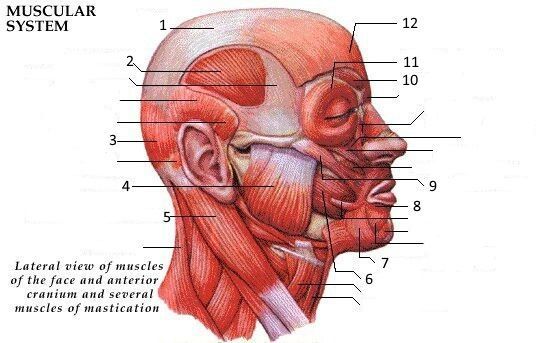
- AGalea aponeurotica
- BTemporalis
- COccipitalis
- DMasseter
- ESternocleidomastoideus
- FBuccinator
- GDepressor angulioris
- HOrbicularis oris
- IZygomaticus major
- JCorrugator
- KOrbicularis oculi
- LFrontalis
15The external oblique compresses the abdomen.
- ARichtig
- BFalsch
16The rectus abdominis flexes the trunk.
- ARichtig
- BFalsch
17The levator ani closes the anal canal.
- ARichtig
- BFalsch
18The external intercostals elevate the ribs.
- ARichtig
- BFalsch
19The coccygeus muscles and levator ani form most of the pelvic floor.
- ARichtig
- BFalsch
20The muscles of the anterior and lateral abdominal wall are arranged in 3 layers.
- ARichtig
- BFalsch
21Label the following diagram: Muscles of the Thorax
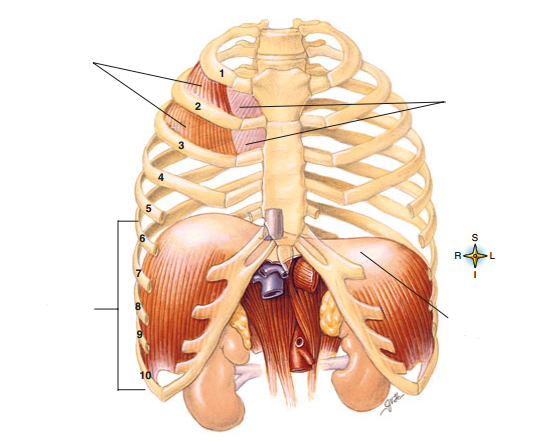
- AExternal intercostals
- BDiaphragm
- CInternal intercostals
- DCentral tendon of diaphragm
22Label the following diagram: Muscles of the trunk and abdominal
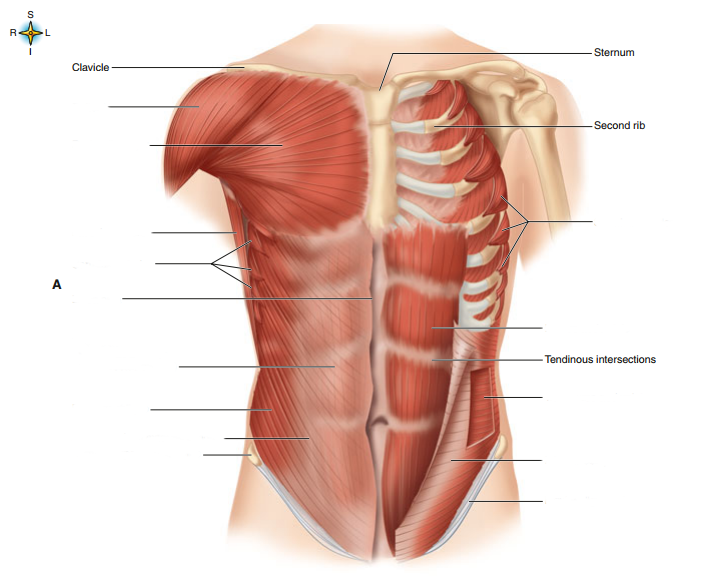
- ADeltoid
- BPectoralis major
- CLatissimus dorsi
- DSerratus anterior (anatomical right)
- ELinea alba
- FRectus abdominus
- GExternal oblique
- HInguinal ligament
- IInternal oblique
- JTransverse abdominis
- KSerratus anterior (anatomical left)
- LRectus abdominis covered by rectus sheat
- MAponeurosis of external oblique
- NAnterior superior iliac spine
23[blank_start]Semispinalis capitis[blank_end]: bends head and neck laterally
[blank_start]External intercostals[blank_end]: elevates ribs
[blank_start]Diaphragm[blank_end]: enlarges thorax
[blank_start]Sternocleidomastoid[blank_end]: "prayer" muscle
[blank_start]Internal oblique[blank_end]: provides important postural function
[blank_start]Rectus abdominis[blank_end]: flexes trunk
[blank_start]Quadratus lumborum[blank_end]: depresses last rib
[blank_start]Erector spinal group[blank_end]: extends vertebral column
[blank_start]Levator ani[blank_end]: helps from the floor of the pelvic cavity
[blank_start]Zygomaticus major[blank_end]: assists in laughing- ASemispinalis capitis
- BExternal intercostals
- CDiaphragm
- DSternocleidomastoid
- EInternal oblique
- FRectus abdominis
- GQuadratus lumborum
- HErector spinal group
- ILevator ani
- JZygomaticus major
24Fascicles are bound together into bundles by a tough connective tissue envelope called the [blank_start]perimysium[blank_end].
- Aperimysium
25[blank_start]Convergent[blank_end] muscles have fascicles that radiate out from a small to a wider point of attachment, much like the blades in a fan.
- AConvergent
26The prime mover is also known as the [blank_start]agonist[blank_end].
- Aagonist
27When a muscle shortens, the central body portion called the [blank_start]belly[blank_end] contracts.
- Abelly
28Lever systems have four component parts: a lever, a fulcrum, a load and a [blank_start]force[blank_end] / [blank_start]pull[blank_end].
- Aforce
- Bpull
29During [blank_start]inspiration[blank_end] the diaphragm flattens.
- Ainspiration
30The muscular pelvic floor filling the diamond-shaped outlet is called the [blank_start]perineum[blank_end].
- Aperineum
31A [blank_start]lever[blank_end] is any rigid bar free to turn about a fixed point called its fulcrum.
- Alever
32The deltoid is so-named because of its descriptive [blank_start]shape[blank_end].
- Ashape
33The powerful muscles that either elevate or retract the mandible are the [blank_start]masseter[blank_end] and the [blank_start]temporalis[blank_end].
- Amasseter
- Btemporalis
Informationen
- Beschreibung
- Study Guide: Axial Muscles
- Autor
- Alexandra Bozan
- Sprache
- English
- Aufrufe
- 2.033
- Verlauf
- Erstellt am 28 Apr 2017 · aktualisiert am 1 Mai 2017
- Schlagwörter
- Bewertung
- Noch keine Bewertungen Bewerte dieses Quiz