
Notizen
MCAT Chemistry Review: Organic Chemistry
Inhalt der Notizen (1)
Seite 1
Organic Chemistry
Substitution & Elimination
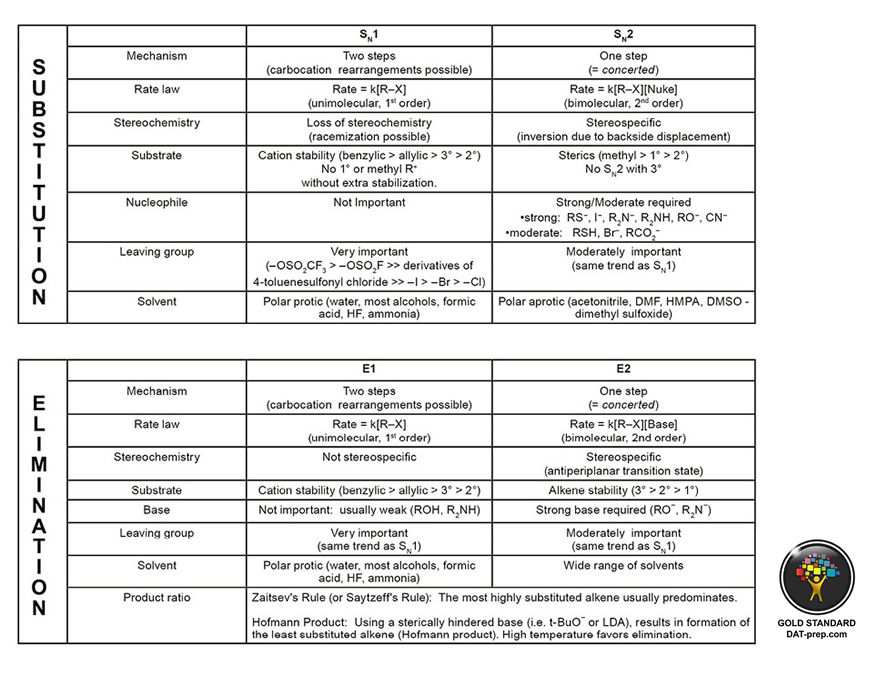
Substitution and elimination reactions are among the most common in organic chemistry. It is key to understand how and when these reactions happen. This section focuses on three concepts necessary for an understanding of substitution and elimination: the rate law, the leaving group, and the nucleophile.
Rate Law
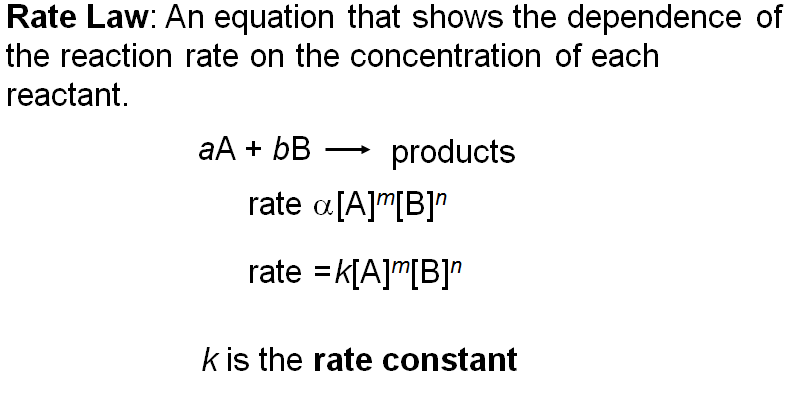
The rate law is a mathematical equation that relates the speed of a reaction and the concentration(s) of its reactants. For example, take this hypothetical reaction:
X + Y → Z
The rate law of the above reaction is:
rate = k [X]a [Y]b
k is a constant determined by the reactions conditions. For the purposes of this SparkNote, a and b will be zero or one. The rate law is useful because it describes what reactants are present in the transition state of the rate-limiting step.
The Leaving Group
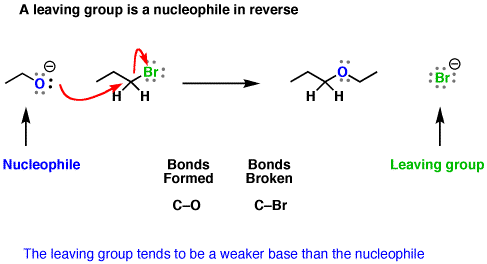
The leaving group is a common feature to all substitution and elimination reactions. It is the part of a reactant molecule that leaves during the course of the reaction. In the process of leaving, it generally picks up an extra electron from its bond to the main molecule. The leaving group's stability after it has left the main molecule determines its efficacy.
Th
The Nucleophile
All of the substitution reactions discussed in the SparkNote involve a nucleophile. In these reactions, the nucleophile substitutes for the leaving group. As the name suggests, nucleophiles generally like to pick up protons and other bare nuclei just like bases. However, nucleophilicity and basicity are fundamentally different concepts. A clear relationship does not always exist between the two. Nucleophilicity jumps dramatically in polar, aprotic solvents.
RATE LAW
The Rate Limiting Step
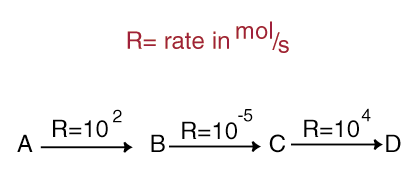
Almost all reactions consist of discrete steps. Consider the reaction of A to B. The reaction must go through intermediates B and C in order to get to D. Notice that the rate of steps A to B and C to D are much greater than that of B to C. The reaction will bottleneck at B to C, and thus the overall rate of the reaction can never be greater than the rate of B to C. Thus B to C is the rate-limiting step. When you measure the rate of a reaction, you are in fact measuring the rate-limiting step.
The rate law is a mathematical equation that describes the rate of the overall reaction and, by correspondence, the rate-limiting step. The rate law has great power because it describes what molecules are present in the rate-limiting step.
The Rate Equation
X + Y → Z
The rate law of the above reaction is:
rate = k [X]a [Y]b
k is a constant determined by the reaction and conditions. The values of a and b are determined by varying the concentrations of X and Y. For example, if the concentration of X is doubled while the concentration of Y is constant, and the rate quadrupl es, then a must equal two. Likewise, if in a separate experiment the concentration of Y doubles and the concentration of X stays the same, and the rate does not change, than b must equal zero. Thus it appears that two molecules of X and no molecules of Y are involved in the rate-limiting step.
For substitution and elimination reactions, the values of a and b are zero or one. The sum of a and b is the reaction order. Substitution and elimination reactions have orders of one and two.
An Energetic Approach
Let's take the formation of C from A through the intermediate B:
A → B → C
Here's a hypothetical plot of reaction coordinate vs. energy of the reaction:
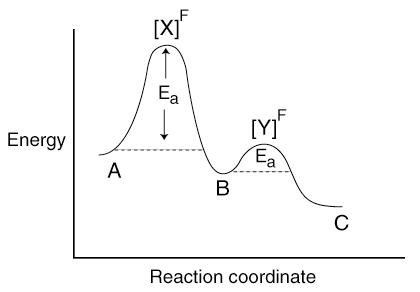
The activation energy ( Ea ) of A to B is much greater than the activation energy of B to C. Fewer molecules of A will gain enough energy to surmount the hump to B than molecules of B to C per unit time. This indicates that under most circumstan ces the rate of A to B is less than the rate of B to C.
[X]âá and [Y]âá are transition states between A, B, and C. Transition states are high-energy molecules that exist at the peaks of an energy diagram. They are so called because they are the transitions between the reacta nts and intermediates of the reaction. They are denoted with brackets and the âásymbol. Since a transition state exists at an energy peak, it is highly unstable and cannot be isolated. In contrast, reaction intermediates like B are local e nergy minima and can be isolated (albeit not easily).
The structure of the transition state determines the activation energy. The activation energy of the rate-limiting step in turn determines the rate. Thus the rate law connects the structure of the transition state to the order of the rate law. In other words, the order of the rate law tells us what reactant molecules are present in the transition state of the rate-limiting step.
Overview
Rate LAW
Informationen
- Beschreibung
- Third Year MCAT Notiz am MCAT Chemistry Review: Organic Chemistry, erstellt von HappyOwl am 20/05/2014.
- Erstellt von
- HappyOwl · Mai 2014
- Aktualisiert
- 9 Okt 2016
- Aufrufe
- 238
- Tags
- Bewertung