
Quiz
Chapter 6
Erstelle ein kostenloses Konto, um dieses Quiz zu beenden
Speichere deinen Fortschritt und sieh dir dein Endergebnis an.
oder mit deiner E-Mail registrieren
Schon ein Konto? Anmelden
Fragen in diesem Quiz (15)
1What is the spectral sequence in order of increasing temperature?
- AMKFAGBO
- BBAFGKMO
- CMKGFABO
- DABFMKGO
2Which of the following can we use to determine the surface temperature of a star?
- Adetermining if the star has a companion star
- Bstudying its line absorption spectrum
- Cmeasuring the star’s distance
- Dmeasuring the star’s parallax
3The table lists the spectral types for each of four stars. Which star in this table would have the lowest surface temperature?
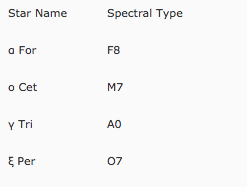
- Aα For
- Bο Cet
- Cγ Tri
- Dξ Per
4The table lists the spectral types for each of four stars. Which star in this table would have the highest surface temperature?
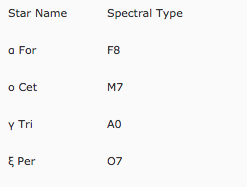
- Aα For
- Ba
- Cγ Tri
- Dξ Per
5What properties of a star determine its luminosity?
- Adistance and diameter
- Btemperature and distance
- Ctemperature and diameter
- Dapparent magnitude and temperature
6How do we know that giant stars are larger in diameter than the Sun?
- AThey are more luminous but have about the same temperature
- BThey are less luminous but have about the same temperature
- CThey are hotter but have about the same luminosity
- DThey are cooler but have about the same luminosity
7Sirius A and B are two stars at the same distance from the Earth. In this binary system, Sirius A is much brighter but Sirius B is much hotter. From this information, what can you conclude about the two stars?
- ASirius B must be much smaller than Sirius A
- BSirius B must be much larger than Sirius A
- CSirius B must be much more massive than Sirius A
- DSirius B must be much less massive than Sirius A
8In a Hertzsprung-Russell diagram, where are the stars with the smallest radius found?
- Ain the upper left corner
- Bin the upper right corner
- Cin the lower left corner
- Din the lower right corner
9In a Hertzsprung-Russell diagram, where are 90 percent of all the stars found?
- Ain the giant region
- Bin the supergiant region
- Con the dwarf sequence
- Don the main sequence
10The star named Sheat is of spectral type M2 and luminosity class II. Based on this information, how does Sheat compare to the Sun?
- ASheat is cooler and larger than the Sun
- BSheat is cooler and smaller than the Sun
- CSheat is hotter and more luminous than the Sun
- DSheat is hotter and larger than the Sun
11The star named Circini has the spectral type and luminosity class of O 8.5 V. Based on this information, how does Circini compare to the Sun?
- ACircini is cooler and larger than the Sun
- BCircini is cooler and smaller than the Sun
- CCircini is hotter and more luminous than the Sun
- DCircini is hotter and less luminous than the Sun
12Where are red giant stars found in the Hertzsprung-Russell diagram?
- Aabove the main sequence
- Bbelow the main sequence
- Con the lower main sequence
- Don the upper main sequence
13Which star in the table is the closest to Earth?
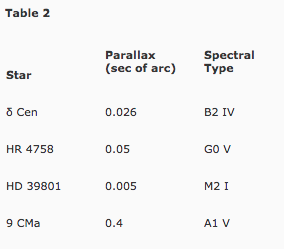
- Aδ Cen
- BHR 4758
- CHD 39801
- D9 CMa
14Which star in the table has the highest surface temperature?
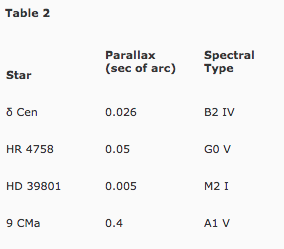
- Aδ Cen
- BHR 4758
- CHD 39801
- D9 CMa
15Which star in the table has the largest diameter?
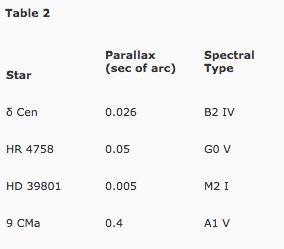
- Aδ Cen
- BHR 4758
- CHD 39801
- D9 CMa
Informationen
- Beschreibung
- Astronomy
- Autor
- Ryan Tram
- Sprache
- English
- Aufrufe
- 576
- Schlagwörter
- Bewertung
- 5,0 von 5 · 2 Bewertungen Bewerte dieses Quiz