
11665697
Beschreibung

Quiz von Kristen Hughlett, aktualisiert more than 1 year ago

|
Erstellt von Kristen Hughlett
vor etwa 8 Jahre
|
|
Frage 1
Frage
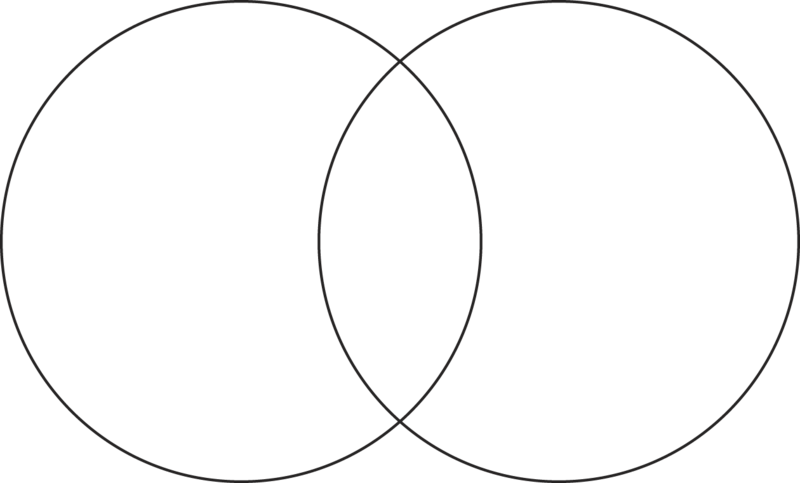
Label the Venn diagram, prokaryotic on left, eukaryotic on right.
Antworten
-
no membrane-bound organelles
-
smallest and simplest type of cell
-
bacteria
-
no nucleus
-
single-celled
-
single circular chromosome
-
oldest cell type
-
have ribosomes
-
have cytoplasm
-
have DNA
-
have plasma membrane
-
membrane bound organelles
-
larger and more complex
-
animals, plants, protists, fungi
-
nucleus holds DNA
-
single-celled or multicellular
-
multiple linear chromosomes
-
evolved from prokaryotes
Frage 2
Frage
Which of these organelles is correctly matched with their function?
Antworten
-
Nucleus- contains DNA
-
Nucleus- communicates with cell
-
Nucleus- photosynthesis
-
Smooth ER- fluid
-
Smooth ER- makes hormones and lipids
-
Rough ER- protein production and export out of cell
-
Rough ER- make the ribosomes smooth
-
Golgi Body- photosynthesis
-
Golgi body- protein modification and export
-
Mitochondria- powerhouse, cellular respiration
Frage 3
Frage
Which organelle is not correctly matched with it's function?
Antworten
-
chloroplasts- make gree fluid
-
vacuole- storage
-
lysosome- cellular digestion
Frage 4
Antworten
-
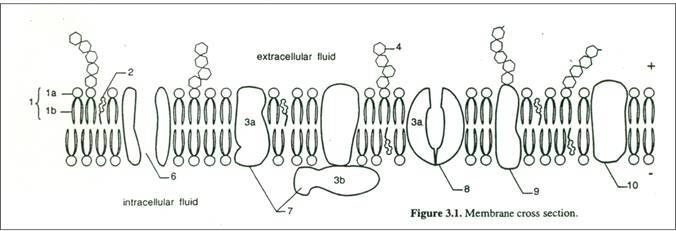
Carrier Protein
-
channel protein
-
hydrophilic head
-
hydrophobic tail
-
cholestrol
-
phospholipid
Frage 5
Frage
Which things happen in prophase?
Antworten
-
Chromatids seperate and begin to move to the poles of the cell.
-
Spindle fibers form
-
chromosomes form from chromatids
-
chromatids attach to spindle fibers
-
two new nuclei form
-
nuclear membrane disappears
Frage 6
Frage
Who was the first to look at living cells?
Antworten
-
Robert Hooke
-
Rudolf Virchow
-
Theodore Schwann
-
Anton Van Leeuwenhoek
Frage 7
Frage
A cell spends most of its life in which phase?
Antworten
-
interphase
-
metaphase
-
prophase
Frage 8
Antworten
-
human blood cell
-
frog blood cell
-
potato cell
-
elodea cell
Frage 9
Frage
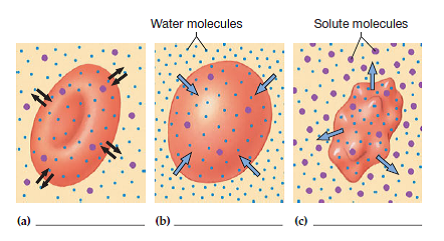
Label the images below as hypertonic, isotonic, or hypotonic
Image:
12498 3 1 Rftei1 (image/gif)
Antworten
-
isotonic
-
hypotonic
-
hypertonic
Möchten Sie mit GoConqr kostenlos Ihre eigenen Quiz erstellen? eigenen Mehr erfahren.