
11730224
Beschreibung

Quiz von Katelynne Tomasek, aktualisiert more than 1 year ago
|
|
Erstellt von Katelynne Tomasek
vor etwa 8 Jahre
|
|
Frage 1
Frage
Which of the following types of molecules are the major structural components of the cell membrane?
Antworten
-
phospholipids and cellulose
-
nucleic acids and proteins
-
phospholipids and proteins
-
proteins and cellulose
-
glycoproteins and cholesterol
Frage 2
Frage
According to the fluid mosaic model of cell membranes, which of the following is a true statement about membrane phospholipids?
Antworten
-
They can move laterally along the plane of the membrane.
-
They frequently flip-flop from one side of the membrane to the other.
-
They occur in an uninterrupted bilayer, with membrane proteins restricted to the surface of the membrane.
-
They are free to depart from the membrane and dissolve in the surrounding solution.
-
They have hydrophilic tails in the interior of the membrane.
Frage 3
Frage
In order for a protein to be an integral membrane protein it would have to be which of the following?
Antworten
-
hydrophilic
-
hydrophobic
-
amphipathic
-
completely covered with phospholipids
-
exposed on only one surface of the membrane
Frage 4
Frage
Which of the following is true of integral membrane proteins?
Antworten
-
They lack tertiary structure.
-
They are loosely bound to the surface of the bilayer.
-
They are usually transmembrane proteins.
-
They are not mobile within the bilayer.
-
They serve only a structural role in membranes.
Frage 5
Frage
Of the following functions, which is most important for the glycoproteins and glycolipids of animal cell membranes?
Antworten
-
facilitated diffusion of molecules down their concentration gradients
-
active transport of molecules against their concentration gradients
-
maintaining the integrity of a fluid mosaic membrane
-
maintaining membrane fluidity at low temperatures
-
a cell's ability to distinguish one type of neighboring cell from another
Frage 6
Frage
Which of these are not embedded in the lipid bilayer at all?
Antworten
-
transmembrane proteins
-
integral proteins
-
peripheral proteins
-
integrins
-
Extracellular matrix fibers
Frage 7
Frage
Which of these often serve as receptors or cell recognition molecules on cell surfaces?
Antworten
-
transmembrane proteins
-
integral proteins
-
peripheral proteins
-
integrins
-
glycoproteins
Frage 8
Frage
Which of the following is true of the evolution of cell membranes?
Antworten
-
Cell membranes have stopped evolving now that they are fluid mosaics.
-
Cell membranes cannot evolve if proteins do not.
-
The evolution of cell membranes is driven by the evolution of glycoproteins and glycolipids.
-
As populations of organisms evolve, different properties of their cell membranes are selected for or against.
-
An individual organism selects its preferred type of cell membrane for particular functions.
Frage 9
Frage
What kinds of molecules pass through a cell membrane most easily?
Antworten
-
large and hydrophobic
-
small and hydrophobic
-
large polar
-
ionic
-
monosaccharides such as glucose
Frage 10
Frage
Which of the following statements is correct about diffusion?
Antworten
-
It is very rapid over long distances.
-
It requires an expenditure of energy by the cell.
-
It is a passive process in which molecules move from a region of higher concentration to a region of lower concentration.
-
It is an active process in which molecules move from a region of lower concentration to one of higher concentration.
-
It requires integral proteins in the cell membrane.
Frage 11
Frage
Water passes quickly through cell membranes because
Antworten
-
the bilayer is hydrophilic.
-
it moves through hydrophobic channels.
-
water movement is tied to ATP hydrolysis.
-
it is a small, polar, charged molecule.
-
it moves through aquaporins in the membrane.
Frage 12
Frage
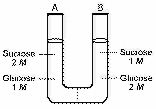
The solutions in the two arms of this U-tube are separated by a membrane that is permeable to water and glucose but not to sucrose. Side A is half filled with a solution of 2 M sucrose and 1 M glucose. Side B is half filled with 1 M sucrose and 2 M glucose. Initially, the liquid levels on both sides are equal.
Initially, in terms of tonicity, the solution in side A with respect to that in side B is
Image:
1 (binary/octet-stream)
Antworten
-
hypotonic
-
plasmolyzed.
-
isotonic.
-
saturated
-
hypertonic.
Frage 13
Frage
The solutions in the two arms of this U-tube are separated by a membrane that is permeable to water and glucose but not to sucrose. Side A is half filled with a solution of 2 M sucrose and 1 M glucose. Side B is half filled with 1 M sucrose and 2 M glucose. Initially, the liquid levels on both sides are equal.
After the system reaches equilibrium, what changes are observed?
Image:
1 (binary/octet-stream)
Antworten
-
The molarity of sucrose is higher in side A than in side B.
-
The molarity of glucose is higher in side A than in side B.
-
The water level is higher in side A than in side B.
-
The water level is unchanged.
-
The water level is higher in side B than in side A.
Frage 14
Frage
The solutions in the two arms of this U-tube are separated by a membrane that is permeable to water and glucose but not to sucrose. Side A is half filled with a solution of 2 M sucrose and 1 M glucose. Side B is half filled with 1 M sucrose and 2 M glucose. Initially, the liquid levels on both sides are equal.
A patient has had a serious accident and lost a lot of blood. In an attempt to replenish body fluids, distilled water, equal to the volume of blood lost, is transferred directly into one of his veins. What will be the most probable result of this transfusion?
Image:
1 (binary/octet-stream)
Antworten
-
It will have no unfavorable effect as long as the water is free of viruses and bacteria.
-
The patient's red blood cells will shrivel up because the blood fluid is hypotonic compared to the cells.
-
The patient's red blood cells will swell because the blood fluid is hypotonic compared to the cells.
-
The patient's red blood cells will shrivel up because the blood fluid is hypertonic compared to the cells.
-
The patient's red blood cells will burst because the blood fluid is hypertonic compared to the cells.
Frage 15
Frage
The solutions in the two arms of this U-tube are separated by a membrane that is permeable to water and glucose but not to sucrose. Side A is half filled with a solution of 2 M sucrose and 1 M glucose. Side B is half filled with 1 M sucrose and 2 M glucose. Initially, the liquid levels on both sides are equal.
Celery stalks that are immersed in fresh water for several hours become stiff and hard. Similar stalks left in a salt solution become limp and soft. From this we can deduce that the cells of the celery stalks are
Image:
1 (binary/octet-stream)
Antworten
-
hypotonic to both fresh water and the salt solution.
-
hypertonic to both fresh water and the salt solution.
-
hypertonic to fresh water but hypotonic to the salt solution.
-
hypotonic to fresh water but hypertonic to the salt solution.
-
isotonic with fresh water but hypotonic to the salt solution.
Frage 16
Frage
The solutions in the arms of a U-tube are separated at the bottom of the tube by a selectively permeable membrane. The membrane is permeable to sodium chloride but not to glucose. Side A is filled with a solution of 0.4 M glucose and 0.5 M sodium chloride (NaCl), and side B is filled with a solution containing 0.8 M glucose and 0.4 M sodium chloride. Initially, the volume in both arms is the same.
At the beginning of the experiment,
Antworten
-
side A is hypertonic to side B.
-
side A is hypotonic to side B.
-
side A is isotonic to side B.
-
side A is hypertonic to side B with respect to glucose.
-
side A is hypotonic to side B with respect to sodium chloride.
Möchten Sie mit GoConqr kostenlos Ihre eigenen Quiz erstellen? eigenen Mehr erfahren.