
Quiz
Protein Structure Pt. 1
Erstelle ein kostenloses Konto, um dieses Quiz zu beenden
Speichere deinen Fortschritt und sieh dir dein Endergebnis an.
oder mit deiner E-Mail registrieren
Schon ein Konto? Anmelden
Fragen in diesem Quiz (39)
1Which type of protein is conjugated?
- AOne that contains only amino acid residues
- BOne that contains prosthetic groups
- COne that is bound to a membrane
2Which of the following means a protein with two identical subunits?
- AHeteromultimer
- BHomomonomer
- CHomomultimer
3Which of the following proteins types tend to have various roles, as opposed to a single, defined one?
- AFibrous
- BGlobular
- CMembrane
4Which of the following tend not to be water soluble?
- AFibrous
- BGlobular
- CMembrane spanning
5What secondary structures tend to make up fibrous proteins?
- ALong strands
- BLong sheets
- CShort strands
6What is specific about the membrane spanning part of membrane proteins?
- AThey are hydrophobic
- BThey are hydrophillic
7Define 'Domain' in reference to protein structure
- AIndependent folding units of the tertiary structure that have independent functions
- BIndependent folding units of tertiary structure that have related functions
- CDependent folding units of secondary structure that have relation functions
- DDependent folding units of tertiary structure that have related functions
8Define subunit
- AIndependent structures in a quaternary structure
- BIndependent structures in a tertiary structure
- CDependent subunits in a quaternary structure
9What can be the result of a single amino acid mutation in collagen?
- AOsteoarthritis
- BOsteogenesis imperfecta
- COsteocalcification
10What is Resonance (as pertaining to protein structure)?
- AWhere bond pairs cannot be described as a single Lewis Diagram
- BWhere two atoms in separate molecules cause each other to vibrate
- CWhere two atoms in separate molecules are more likely to bond to each other than to another atom
11Which is the psi bond?
- ABetween the carbonyl carbon and the alpha carbon
- BBetween the alpha carbon and the amide group
- CBetween the alpha carbon and the R group
12Which is the phi bond?
- ABetween the alpha carbon and the amide group
- BBetween the alpha carbon and the carbonyl carbon
- CBetween the alpha carbon and the R group
13What is Steric clashing?
- AWhere the charge of an atom prevents it from being close to another
- BWhere the electron arrangement of an atom prevents it from being close to another
- CWhere the size of an atom prevents it from being close to another
14Why is a peptide bond planar?
- AIt has a double bond like structure
- BIt's electrons clash with that of the psi bond
- CIt's electrons clash with the phi bond
15How many residues per turn in an alpha helix?
- A3.4
- B3.5
- C3.6
16How much does an alpha helix rise per aa?
- A1.5 angstroms
- B1.6 angstroms
- C1.7 angstroms
17Alpha helices are stabilised by hydrogen bonding with what groups?
- ACarbonyl oxygen 4 amino acids away
- BCarbonyl oxygen 6 amino acids away
- CCarbonyl oxygen 8 amino acids away
18The stabilising effect of the hydrogen bonds makes a loop of how many atoms?
- A12
- B13
- C14
19Which of the following destabilize an alpha helix?
- AGlycine
- BProline
- CLeucine
- DGlutamic acid
20Beta sheets rise by 3.47A per residue in anti-parallel sheets
- ARichtig
- BFalsch
21In parallel sheets, there is a rise of .... per residue
- A3.25A
- B4.25A
- C2.25A
223 residues per turn of the strand are pictured as a helix
- ARichtig
- BFalsch
23Anti-parallel strands are _ stable than parallel ones
- AMore
- BLess
24Side chains all point the same way (in the plane of the sheet)
- ARichtig
- BFalsch
25What is the role of loops?
- AConnecting alpha and beta sheets
- BConnecting alpha helices and alpha helices
- CConnecting beta sheets and beta sheets
26Loops contain mostly hydrophillic residues & are found on the protein surface
- ARichtig
- BFalsch
27What is the role of beta turns?
- ATo allow beta sheets to reverse direction
- BTo connect beta sheets together
- CTo link protein subunits together
28What two amino acids cannot be contained within a beta sheet?
- AProline
- BArgenine
- CGlycine
- DValine
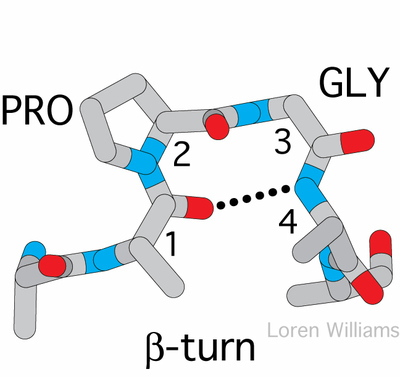
29Beta turns link the oxygen of the carbonyl group and the hydrogen of the nitrile group 4 residues away
- ARichtig
- BFalsch
30Levinthals Paradox- if a protein folded by trying each fold in a sequence, it would take an impossibly long time to fold correctly. Therefore, protein folding cannot be random or sequential
- ARichtig
- BFalsch
31What is this?
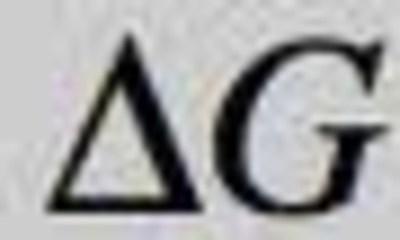
- AThe energy change as proteins fold
- BGibbs free energy
- CEntropy change
32Why are the internal interactions of protein folding unfavorable?
- AIt decreases entropy
- BThey're hydrophobic in a hydrophillic environment
- CThey prevent the protein from folding correctly
33Non-covalent and hydrophobic effects (which effects free water) decrease enthalpy
- ARichtig
- BFalsch
34Change in energy during folding = Internal interactions - (Hydrophobic effect + conformational entropy)
- ARichtig
- BFalsch
35Proteins fold towards configurations with the...
- Alowest energy
- BHighest energy
- CEasiest energy to reach (energy closest to that of unfolded protein)
36What can slow the progress of protein folding?
- AA local low energy minimum
- BA local high energy minimum
37What is nucleation?
- AReversible secondary structure formation
- BReversible tertiary structure formation
- CReversible quaternary structure formation
38Which of the following happens after nucleation?
- AThe secondary structure aggregation forms a molten globular intermediate
- BDomains adjust to the lowest energy form
39The protein is capable of conformational change after forming
- ARichtig
- BFalsch
Informationen
- Beschreibung
- Structural Basis for Biological Function (Basics) Quiz am Protein Structure Pt. 1, erstellt von gina_evans0312 am 21/09/2013.
- Autor
- gina_evans0312
- Sprache
- English
- Aufrufe
- 1.020
- Schlagwörter
- Bewertung
- Noch keine Bewertungen Bewerte dieses Quiz