
Quiz
C2 Quiz
Dieses Quiz enthält Fragetypen, die sich im gewohnten Player öffnen.
Fragen in diesem Quiz (17)
1Melting Point is....
- A....the temperature at which a solid turns into a liquid.
- B....the force needed to break a material when it is being stretched
- C....the force needed to crush a material when it is squeezed
- D....the force needed to bend a material
2Tensile strength is....
- A....the force needed to break a material when it is being stretched
- B....the force needed to crush a material when it is being squeezed
- C....a comparison of two materials where one can or cannot scratch the other
- D....the mass of a given volume of the material
3Choose 3 examples of natural materials
- Acotton
- Bplastic
- Cpaper
- Dnylon
- Esilk
4What is meant by the word 'polymer'?
- AA large molecule that can be made into rubbers, plastics and fibres.
- BA material which needs very little processing for it to be useful.
5What are hydrocarbons?
- ACompounds containing just carbon and hydrogen atoms
- BCompounds containing water and carbon
- CCompounds containing just oxygen and carbon atoms
6Crude oil is separated by a process called fractional [blank_start]distillation[blank_end]. Crude oil is heated to around 400 degrees celsius to turn all the hydrocarbons to gases. The gas is then passed into a fractional distillation [blank_start]column[blank_end] where the gases rise up cool and [blank_start]condense[blank_end] to liquid at their boiling points. Some have [blank_start]high[blank_end] boiling points so condense lower down, while those with lower boiling points [blank_start]rise[blank_end] up the column. Some stay as [blank_start]gases[blank_end] even at the top of the column. Each substance is a mixture of [blank_start]hydrocarbons[blank_end] with similar boiling points called a fraction.
The hydrocarbons of each fraction have [blank_start]similar[blank_end] boiling points as the molecules in that fraction are all a similar size - they have a similar number of [blank_start]carbon[blank_end] and hydrogen atoms. There are [blank_start]attractive[blank_end] forces between molecules which hold them together. Force is needed to separate these molecules. When heated, the molecules gain [blank_start]energy[blank_end] until they have enough energy to overcome the forces holding them together and the molecules become a [blank_start]gas[blank_end].- Adistillation
- Bcolumn
- Ccondense
- Dhigh
- Erise
- Fgases
- Ghydrocarbons
- Hsimilar
- Icarbon
- Jattractive
- Kenergy
- Lgas
7Polymerisation is the process of making a polymer.
- ARichtig
- BFalsch
8What notation would be used to express a polymer of polyethene?
- A[C₂H₄]ₓ
- B[C₂H₆]ₓ
- CXC₂H₄
9All polymers are chemically synthesised.
- ARichtig
- BFalsch
10An important reason why [blank_start]synthetic[blank_end] polymers have been chosen for a purpose is because they are [blank_start]cheaper[blank_end] and available in larger quantities than the natural material they replace. This is why [blank_start]nylon[blank_end] replaced silk and [blank_start]wool[blank_end] for stockings in the 1940s. Synthetic polymers have many other properties that make them [blank_start]useful[blank_end] and also their properties can be [blank_start]adjusted[blank_end] to make them suit the job they have to do.
- Asynthetic
- Bcheaper
- Cnylon
- Dwool
- Euseful
- Fadjusted
11There is a [blank_start]force[blank_end] between polymer [blank_start]molecules[blank_end] that pulls them together. The [blank_start]closer[blank_end] the molecules are to each other, the stronger the force. Polymers with a [blank_start]larger[blank_end] force between their molecules melt at [blank_start]higher[blank_end] temperatures.
- Aforce
- Bmolecules
- Ccloser
- Dlarger
- Ehigher
12What does it mean to say a material is highly 'crystalline'?
- AThat there are a lot of areas in the material where there is a regular pattern of molecules lined up alongside each other.
- BThat there are branches between the polymer chains, reducing the attractive forces between the chains.
13What effect do plasticisers have on a polymer?
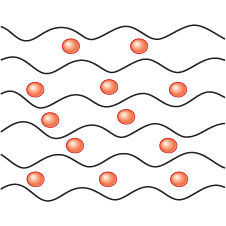
- AThey fit between the polymer molecules, keeping them apart and weakening the forces between them. They also allow the polymer chains to move over each other more easily, making the material flexible.
- BThey connect the polymer chains together into one large molecule, making the material rigid and strong.
14Cross-linked polymers are thermosetting plastics.
- ARichtig
- BFalsch
15What size range does nanotechnology involve?
- A1 - 100 nm
- B1 - 10 nm
- C1 - 1000 nm
16Why do nanoparticles of gold or other materials act as good catalysts?
- AThey have a large surface area on which the reaction can take place.
- BThey are larger.
- CThe reactions can happen faster.
17Nanoparticles have been used in products such as [blank_start]cosmetics[blank_end] and sunscreens, and tests have shown that they are not [blank_start]harmful[blank_end] to the skin. However, the nanoparticles are so small that they can slip through tiny [blank_start]pores[blank_end] in the skin and be [blank_start]absorbed[blank_end] by the blood where they could be carried to the organs in the body. It is not known if these substances may be harmful to tissues.
One fear is that breathing [blank_start]carbon[blank_end] nanotubes into the lungs to cause diseases in the way that the tiny fibres of [blank_start]asbestos[blank_end] do. We need to find out how [blank_start]hazardous[blank_end] nanoparticles are so that we can assess whether they pose too great a risk to health.
Some people think that as nanoparticles occur [blank_start]naturally[blank_end] they are no danger as we have evolved to live with them. Others disagree as scientists are now making [blank_start]synthetic[blank_end] nanoparticles that have new and [blank_start]unexpected[blank_end] properties.- Acosmetics
- Bharmful
- Cabsorbed
- Dcarbon
- Easbestos
- Fhazardous
- Gnaturally
- Hsynthetic
- Iunexpected
- Jpores
Informationen
- Beschreibung
- GCSE Chemistry Quiz am C2 Quiz, erstellt von Leah Firmstone am 30/10/2015.
- Autor
- Leah Firmstone
- Sprache
- English
- Aufrufe
- 24
- Schlagwörter
- Bewertung
- Noch keine Bewertungen Bewerte dieses Quiz