
Quiz
Anatomy lecture exam IV urinary
Dieses Quiz enthält Fragetypen, die sich im gewohnten Player öffnen.
Fragen in diesem Quiz (57)
1The functions of the urinary system are:
1. [blank_start]volume regulation[blank_end]
2. [blank_start]acid/base balance[blank_end]
3. [blank_start]electrolyte balance[blank_end]
4. [blank_start]elimination of waste[blank_end]
5. [blank_start]Endocrine[blank_end]- Avolume regulation
- Bacid/base balance
- Celectrolyte balance
- Delimination of waste
- EEndocrine
2[blank_start]Glomerular filtration[blank_end] is the movement of components of plasma out of the glomereal capillaries into the bowman's capsule.
- AGlomerular filtration
3The functional urine forming unit in the kidney is the [blank_start]nephron[blank_end].
- Anephron
4Trace plasma from an afferent arteriole until it is excreted from the body as urine.
[blank_start]glomerulus[blank_end]--> [blank_start]bowmans capsule[blank_end] --> [blank_start]Proximal Convoluted Duct[blank_end] --> [blank_start]loop of henle[blank_end] --> [blank_start]Distal convoluted duct[blank_end] --> [blank_start]collecting tubule[blank_end] --> [blank_start]papillae[blank_end] --> [blank_start]minor calyces[blank_end] --> [blank_start]major calyces[blank_end] --> [blank_start]pelvis -[blank_end]-> [blank_start]ureter[blank_end] --> [blank_start]bladder[blank_end] --> [blank_start]urethra[blank_end]- Aglomerulus
- Bbowmans capsule
- CProximal Convoluted Duct
- Dloop of henle
- EDistal convoluted duct
- Fcollecting tubule
- Gpapillae
- Hminor calyces
- Imajor calyces
- Jpelvis -
- Kureter
- Lbladder
- Murethra
5The rate at which you form glomelular filtrate is [blank_start]GFR[blank_end].
- AGFR
6GFR in the average adult male is:
- A120ml/min
- B225ml/min
- C90-95ml/min
- D125ml/min
7GFR in the average adult female is:
- A90-95ml/min
- B125ml/min
- C80-85ml/min
- D120ml/min
8The absorption rate of water from glomelular filtrate is [blank_start]99%[blank_end].
- A99%
9How much of your cardiac output goes to the kidneys?
- A30-35%
- B20-25%
- C10-15%
- D5-10%
10If a substance is tubularly reabsorbed, then the amount in the urine is [blank_start]less than[blank_end] the amount in the glomerular filtrate.
- Aless than
- Bgreater than
11label all the structures of the nephron
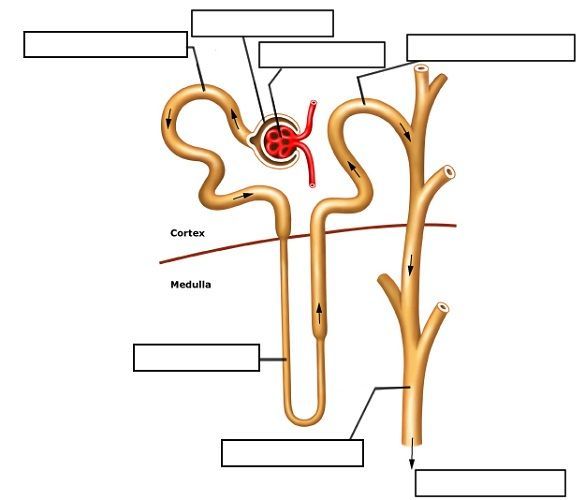
- Acollecting tubule
- Bgoes to paillae
- Cdistal convoluted tubule
- Dloop of henle
- Eproximal convoluted tubule
- Fbowman's capsule
- Gglomerulus
12[blank_start]Tubular re-absorption[blank_end] is when you move something form the nephron tubules to the peritubular capillaries. Another way of saying out of the [blank_start]tubule[blank_end] and into the [blank_start]blood[blank_end].
- ATubular re-absorption
- Btubule
- Cblood
13How is glucose sent across membranes?
- Are-absorption
- Bactive transport
- Cosmosis
- Dglomelular filtration
14Clearing is the ability of the kidney to remove substances from your blood.
- ARichtig
- BFalsch
15What determines the amount of a substance in glomelular filtrate (ex: glucose)?
- Athe filtration rate of the same substance
- Bthe concentration of the same substance found in plasma
- Cpermeability of same substance in PCT
- Dability of kidney to clear the same substance
16The maximum rate at which a substance can be re-absorbed from the nephron tubules is referred to as the [blank_start]transport maximum[blank_end] for that substance.
- Atransport maximum
17This is a process where a carrier molecule uses ATP to move a molecule across a cell membrane against the concentration gradient. It has a high level of specificity.
- Afacilitated diffusion
- Bexocytosis
- Cactive transport
- Ddiffusion
18If glucose is found in your urine is it called [blank_start]glucosuria[blank_end] or [blank_start]glycosuria[blank_end].
- Aglucosuria
- Bglycosuria
19The [blank_start]renal plasma threshold[blank_end] is the plasma level at which something starts to appear in your urine.
- Arenal plasma threshold
20If a patient has glucosuria what do you already know about his plasma glucose level?
- Ahis plasma has exceeded the renal plasma threshold level of 180mg/100ml of blood.
- Bthe patient is diabetic and is not producing proper amounts of insulin.
- Cthere is no way to determine anything about his plasma glucose level at this point.
- Dthe patient is spilling glucose in his urine because his afferent arteriole is blocked and not allowing the glomerulus to filter to the bowman's capsule.
21Amino acids should be present in your urine.
- ARichtig
- BFalsch
22[blank_start]Amino acids[blank_end] are actively transported in the tubules and are needed so that your body can make [blank_start]proteins[blank_end].
- AAmino acids
- BPotassium ions
- CNucleic acids
- Dproteins
- Eelectolytes
- FDNA and RNA
23It is called [blank_start]aminoaciduria[blank_end] when amino acids are found in your urine. The most common type of this is [blank_start]cystine[blank_end].
- Aaminoaciduria
- Bcystine
24When substances "fall out of solution" or become too concentrated they [blank_start]precipitate[blank_end].
- Aprecipitate
25The major nitrogenous waste in humans is [blank_start]urea[blank_end].
- Aurea
26Urea is produced primarily in the [blank_start]deamination of amino acids[blank_end].
- Adeamination of amino acids
27The clinical estimate of urea in blood is called your [blank_start]blood urea nitrogen[blank_end] level or [blank_start]BUN[blank_end].
- Ablood urea nitrogen
- BBUN
28Why would your BUN level increase when you have a disease?
- ABecause the kidneys are not functioning at full capacity and are unable to clear the nitrogen from your system properly
- Bduring a disease there is a significant number of cells that are damaged and dying. They are made up of proteins which is a nitrogenous waste and thus your BUN will rise.
- Cduring the disease process the inflammatory process produces greater amounts of nitrogen therefor increase blood nitrogen levels.
- Dyour BUN will not increase when you have a disease.
29Urine is basically glomelular filtrate minus everything you decided to re-absorb or uptake.
- ARichtig
- BFalsch
30the hormone promoting Na+ retention by the kidney is [blank_start]aldosterone[blank_end].
- Aaldosterone
- BADH
- Cadrenal norepinephrine
31The hormone [blank_start]aldosterone[blank_end] comes from a gland on top of the kidneys called the [blank_start]adrenals[blank_end].
- Aaldosterone
- Badrenals
32Only about 20% of your nephrons are called [blank_start]jextamedullary[blank_end] nephrons.
- Ajuxtamedullary
33The juxtamedullary nephrons have a __________ that projects way down into the tip of the pyramid and the remaining nephrons are called cortica nephrons because they primarily lie within the __________ .
- Acollecting tubule/pyramid
- Bloop of henle/papillae
- Cloop of henle/cortex medulla
- Dmedulla/adrenal cortex
34solute=[blank_start]dissolve e[blank_end] and solvent= [blank_start]dis-solver[blank_end]
- Adissolve e
- Bdis-solver
35This type of solution has a higher solute than the comparative solution.
- Ahypotonic
- Bosmotic
- Chypertonic
- Dhomogeneous
36Cells placed in hypertonic solution would be expected to [blank_start]shrink[blank_end].
- Ashrink
- Bswell
37Molecules going from an area of high solvent to low solvent through a semi-permeable membrane is called [blank_start]osmosis[blank_end].
- Aosmosis
38Freshwater fish live in a hypotonic environment. They generally have a problem with water [blank_start]gain[blank_end].
- Again
- Bloss
39Medullary fluids of the kidney are [blank_start]hypertonic[blank_end] to most body fluids.
- Ahypertonic
- Bhypotonic
40Solutes are concentrated in the medullary fluids of the kidney by the [blank_start]counter current multiplier[blank_end] mechanism.
- Acounter current multiplier
41Water goes from hypotonic solutions to hypertonic solutions because tonicity is determined by the solute.
- ARichtig
- BFalsch
42Sodium retention generally has the effect of [blank_start]raising[blank_end] blood potassium levels.
- Araising
- Blowering
43Does facilitated diffusion utilize ATP?
- Ayes
- Bno
44We control urine concentration by the counter current multiplier mechanism.
- ARichtig
- BFalsch
45What separates the cortex from the medulla?
- Abase of pyramid
- Bcortico medullary line
- Cmedullary cortex
- Dloop of henle
46The cortex of the kidney is what in relationship to the body?
- Ahypotonic
- Bionic
- Cisotonic
- Dhypertonic
47The [blank_start]ascending[blank_end] loop of henle has a [blank_start]thicker[blank_end] membrane that is [blank_start]impermeable[blank_end] to water and therefore osmosis [blank_start]can not[blank_end] occur. Salt is then removed from the tubular fluid by means of [blank_start]active transport[blank_end] and the fluid is now more [blank_start]dilute[blank_end].
- Aascending
- Bdescending
- Cthicker
- Dthinner
- Eimpermeable
- Fpermeable
- Gcan not
- Hdoes
- Iactive transport
- Jfascilitated diffusion
- Kdilute
- Lconcentrated
48When urine reaches the top of ascending loop of hele what level of concentration is it in proportion to your bodily fluids?
- A1/3
- B2/3
- C1/2
- D3/4
49Highest level of dilute you can get urine is [blank_start]1/3[blank_end] that of bodily fluids and the highest level of concentration is [blank_start]4[blank_end] times that of normal bodily fluids.
- A1/3
- B4
50What gives the medullary portion of the kidney it's hypertonicity?
- Athe cortico medullary line because as the fluid passes through solutes are removed
- Bthe collecting tubule where solutes spill over into the medulla
- Cnone of these
- Dthe ascending portion of the loop of henle where salt is actively transported and the osmotic capibility of the descending loop of henle or more simply put it is because of the counter current multiplier mechanism.
51The [blank_start]DCT[blank_end] and collecting tubule have [blank_start]water[blank_end] pores that allow for further control of urine concentration. If the pores are open the urine is more [blank_start]concentrated[blank_end] and if the pores are closed the urine will be [blank_start]diluted[blank_end].
- ADCT
- BPCT
- Cwater
- Dsalt
- Econcentrated
- Fdilute
- Gdiluted
- Hconcentrated
52The hormone that controls your water pores in the DCT and collecting tubule is [blank_start]anti diuretic hormone[blank_end] also known as [blank_start]ADH[blank_end].
- Aanti diuretic hormone
- BADH
53Vasopressin is another word for ADH and it is stored and released by your posterior pituitary.
- ARichtig
- BFalsch
54ADH is [blank_start]against[blank_end] diuresis because it [blank_start]decreases[blank_end] urine volume and [blank_start]increases[blank_end] urine concentration.
- Aagainst
- Bfor
- Cdecreases
- Dincreases
- Eincreases
- Fdecreases
55ADH [blank_start]opens[blank_end] the water pores of the DCT and collecting tubules.
- Aopens
- Bcloses
56At night your production of ADH goes [blank_start]up[blank_end].
- Aup
- Bdown
57[blank_start]Glomerular filtrate[blank_end] is made up of everything that is in plasma except for the [blank_start]plasma proteins[blank_end].
- AGlomerular filtrate
- Bplasma proteins
Informationen
- Beschreibung
- practice exam focusing on urinary system and primarily physiology of the kidney
- Autor
- Rebecca Matthews
- Sprache
- English
- Aufrufe
- 77
- Verlauf
- Erstellt am 29 Nov 2015 · aktualisiert am 30 Jul 2016
- Schlagwörter
- Bewertung
- Noch keine Bewertungen Bewerte dieses Quiz