
5861550
Beschreibung

Quiz von Koh Swee Hong, aktualisiert more than 1 year ago

|
Erstellt von Koh Swee Hong
vor mehr als 10 Jahre
|
|
Frage 1
Frage
Why are elements in group O inert?
They have a [blank_start]fully filled valence electron shell[blank_end] and does not require to [blank_start]gain[blank_end], lose or [blank_start]share[blank_end] [blank_start]electron[blank_end] with any other atom to [blank_start]obtain[blank_end] a [blank_start]fully filled valence electron shell[blank_end]. Hence, they are inert.
Antworten
-
fully filled valence electron shell
-
gain
-
share
-
electron
-
obtain
-
stable electronic structure
Frage 2
Frage
Ionic Bonding is the a reaction between two non-metal elements
Antworten
- True
- False
Frage 3
Frage
Balance the equation
Fe2O3 ([blank_start]s[blank_end]) + [blank_start]3[blank_end]CO ([blank_start]g[blank_end]) → [blank_start]2[blank_end]Fe ([blank_start]l[blank_end]) + [blank_start]3[blank_end]CO2 ([blank_start]g[blank_end])
Antworten
-
g
-
3
-
l
-
2
-
g
-
3
-
s
Frage 4
Frage
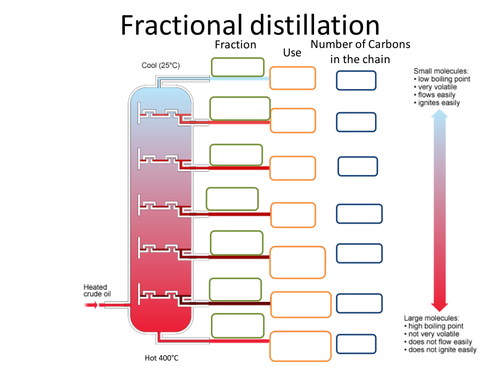
The following diagram shows a fractional distillation of crude oil. Fill in the blanks provided (Use all small caps)
Antworten
-
petroleum gas
-
petrol
-
naphtha
-
kerosene
-
diesel oil
-
lubricating oil
-
bitumen
Frage 5
Frage
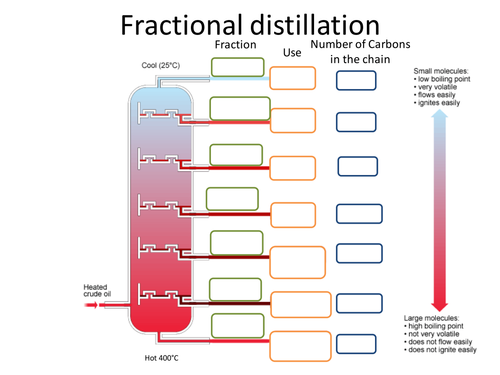
What are the uses of each fraction, drag and drop to the appropriate blanks. Any mistakes my result in 0 marks for this question.
Antworten
-
Fuel for cooking and heating
-
Fuel for car engines
-
Raw material - petrol chemical industry
-
Fuel for aircraft engines: Fuel for heat
-
Fuel for diesel engines. Eg. Lorries
-
For lubricating machines; For making wax
-
For paving road surfaces
Frage 6
Frage
What is the purpose of adding limestone into the blast furnace
[blank_start]To remove acidic impurities[blank_end] such as sand (Silicon dioxide)
Antworten
-
To remove acidic impurities
Frage 7
Frage
Question: Why are alloys harder and stronger than pure metals
Answer: Atoms in an alloy are made up of [blank_start]different sizes[blank_end] thus it [blank_start]disrupts[blank_end] the orderly arrangement of atoms in the pure metal. The layers of atoms [blank_start]cannot[blank_end] slide over each other [blank_start]easily[blank_end]. Thus, alloys are harder and stronger than pure metals
Antworten
-
different sizes
-
same sizes
-
disrupts
-
smoothens
-
cannot
-
can
-
easily
-
in a disorderly manner
Frage 8
Frage
What is the composition of Argon in the air
Antworten
-
78%
-
21%
-
1%
-
0.7%
-
0.03%
Frage 9
Frage
What is the main source of Carbon Monoxide (CO)?
Antworten
-
Complete burning of fossil fuels
-
Incomplete combutsion of fuels
-
Volcanic eruption
-
Acid rain
Frage 10
Frage
The method to obtain for Barium Sulfate is through adding excess insoluble reactant to acid.
Antworten
- True
- False
Frage 11
Frage
What are the examples of Acidic oxide or neutral oxide (Choose more than one answer)
Antworten
-
Carbon dioxide
-
Silicon dioxide
-
Sulfur dioxide
-
Water
-
Aluminium oxide
-
Oxides of nitrogen
-
Lithium oxide
Frage 12
Frage
Describe a test for ammonia gas
Test: Place a [blank_start]moist[blank_end] [blank_start]red[blank_end] litmus paper at the mouth of the test tube
Observation: If ammonia gas is present, [blank_start]red[blank_end] litmus paper turns [blank_start]blue[blank_end]
Antworten
-
moist
-
dry
-
red
-
blue
-
red
-
blue
-
blue
-
red
Frage 13
Frage
Why do ionic compounds conduct electricity in molten and aqueous states but not in solid states?
In [blank_start]molten and aqueous[blank_end] states, there are [blank_start]free-moving[blank_end] ions to serve as charge carriers. In [blank_start]solid[blank_end] states, ions are held in a [blank_start]fixed position[blank_end] in the [blank_start]lattice structure[blank_end], so there are no free-moving ions to serve as [blank_start]charge carriers[blank_end].
Antworten
-
molten and aqueous
-
free-moving
-
solid
-
fixed position
-
lattice structure
-
charge carriers
Frage 14
Antworten
-
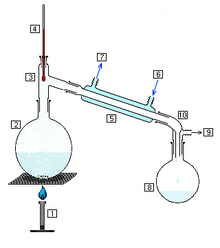
condenser
-
distillate
-
thermometer
-
boiling chips
-
mixture
Frage 15
Frage
Why is recycling metals important?
Antworten
-
They are finite resources
-
We have the rights to save them
-
They are cheaper than extracting of metals
-
Recycling requires less energy than mining
Frage 16
Frage
In what conditions will metals rust?
Antworten
-
Exposed to air
-
Moist
-
Dry
-
Vacuum
Frage 17
Frage
To test whether it is an alkane or alkene, we need to use addition of aqueous bromine.
Antworten
- True
- False
Frage 18
Frage
To test acidity of the soil:
Add a few drops of [blank_start]universal indicator[blank_end]. If the colour turns [blank_start]red[blank_end], yellow or orange, it is [blank_start]acidic[blank_end]. If the colour is [blank_start]green[blank_end], it is neutral. If the colour turns, blue, purple or violet, it is [blank_start]alkaline[blank_end].
Antworten
-
alkaline
-
acidic
-
green
-
red
-
universal indicator
Frage 19
Frage
What is the condition for cracking reaction of alkane
1) [blank_start]600[blank_end] degrees celcius
2) Powered [blank_start]aluminium oxide[blank_end] as catalyst
Antworten
-
600
-
aluminium oxide
Frage 20
Frage
Margarine is an example for addition reaction of hydrogen.
Antworten
- True
- False
Möchten Sie mit GoConqr kostenlos Ihre eigenen Quiz erstellen? eigenen Mehr erfahren.