
Quiz
Chapter 3
Fragen in diesem Quiz (35)
1In 1054 CE, the Chinese recorded a very interesting and powerful cosmic event. What was this event?
- Aa star merger
- Ba supernova
- Ca galactic collapse
- Dsimultaneous solar and lunar eclipses
2What did Eratosthenes measure very accurately?
- Athe size of the Earth
- Bthe length of the year
- Cthe distance to the Moon
- Dthe length of the month
3Who were the two great authorities of Greek astronomy?
- AAristotle and Ptolemy
- BJulius Caesar and Aristotle
- CColumbus and Ptolemy
- DAlexander the Great and Julius Caesar
4Whose writings became so famous that he was known throughout the Middle East simply as “The Philosopher”?
- APtolemy
- BEratosthenes
- CAristotle
- DHipparchus
5Which of the following statements reflects beliefs that were almost universally held in pre-Copernican astronomy?
- AThe planets travelled in elliptical orbits around the Earth
- BThe planets travelled in elliptical orbits around the Sun
- CThe Sun was at the centre of the universe
- DThe Earth was at the centre of the universe
6In what circumstances is retrograde motion observable?
- AIt is observable for planets located between the Earth and the Sun
- BIt is observable for planets more distant from the Sun than the Earth
- CIt is only observable for the Moon
- DIt is observable for all planets
7You are observing the night sky from Mars. In what circumstances is retrograde motion observable?
- AIt is observable for planets more distant from the Sun than Mars
- BIt is observable for planets located between Mars and the Sun
- CIt is only observable for Earth and Venus
- DIt is observable for all planets
8What is the term for the apparent westward motion of a planet in the sky compared to the background stars (as viewed from the Earth) when observed on successive nights?
- Aepicycle
- Bretrograde motion
- Cprograde motion
- Dheliocentric motion
9What is parallax?
- Athe apparent motion of an object due to the motion of the observer
- Bthe distance between two straight lines
- Cthe small circle that the planets slid along in Ptolemy’s geocentric universe
- Dthe distance between two foci of an ellipse
10Why did ancient astronomers believe that the Earth did not move?
- Abecause they could not detect parallax
- Bbecause they believed in circular motion
- Cbecause all observable planets follow retrograde motion
- Dbecause parallax is only detectable during the day
11In Ptolemy’s view of the universe, what is at the centre of a planet’s epicycle?
- Athe Sun
- Bthe Earth
- Cthe deferent
- Dthe equant
12Which of the following astronomers described the universe in a way that matches the diagram?
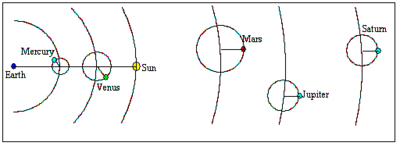
- AKepler
- BPtolemy
- CCopernicus
- DGalileo
13What was the greatest inaccuracy in Copernicus’s model of the solar system?
- Athat the planets travelled in circular orbits with uniform motion
- Bthat the planets travelled on epicycles, the centers of which followed orbits around the Sun
- Cthat the planets travelled in elliptical orbits
- Dthat the planets were allowed to travel backwards in their orbits
14Which of the following objects cannot transit (i.e. pass in front of) the Sun, as seen from Jupiter?
- AMercury
- BVenus
- CMars
- DSaturn
15What was Tycho Brahe’s greatest contribution to astronomy?
- Ahis model of the universe
- Bhis telescopic observations
- Chis discovery of three laws of motion
- Dhis 20 years of careful observations of the planets
16What two numbers tell us the size and shape of an ellipse
- Aradius, eccentricity
- Bradius, deferent
- Csemi-major axis, deferent
- Dsemi-major axis, eccentricity
17The orbit of planet A has an eccentricity of 0.5 and the orbit of planet B has an eccentricity of 0.01. What can be said about the shape of the orbits of these two planets?
- APlanet A has a nearly circular orbit
- BThe orbit of planet A is more elongated than the orbit of planet B
- CThe orbit of planet B is more elongated than the orbit of planet A
- DThere is not enough information to say anything meaningful about the shape of either orbit
18Which of the following masses exert higher gravitational force on each other?
- AM=2------------------m=2
- BM=2------------------m=1
- CM=2------------------m=8
19Which of the following masses exert smaller gravitational force on each other?
- AM=2------------------m=2
- BM=2------------------m=1
- CM=2------------------m=8
20Which of the following masses exerts the largest gravitational force on mass M?
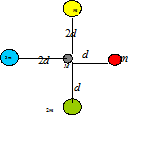
- ABlue and Gray
- BGray and Green
- CGray and Red
- DGray and Yellow
21A hypothetical solar system has planets evenly spaced in circular orbits from the sun in the following distances and with the following masses, that they are given in terms with the mass of Jupiter MJ. Which of the following planets exerts the larger gravitational force of the star.

- AA
- BB
- CC
- DD
22Given its orbital period of 76 years, what is the average distance of Comet Halley from the Sun?
- A18 AU
- B38 AU
- C54 AU
- D114 AU
23An object has been located orbiting the Sun at a distance of 65 AU. What is the approximate orbital period of this object?
- A8.1 years
- B65 years
- C524 years
- D4225 years
24On average, Saturn is 10 AU from the Sun. What is the approximate orbital period of Saturn?
- A10 years
- B32 years
- C1000 years
- D3200 years
25The orbit of the planet Jupiter is an ellipse with the Sun at one focus. What is located at the other focus?
- Athe Earth
- Bthe asteroid belt
- CSaturn
- Dnothing
26The orbit of the Moon is an ellipse with the Earth at one focus. What is located at the other focus?
- Anothing
- Bthe asteroid belt
- Ccomets
- Dthe Sun
27A comet is found in a highly elliptical orbit with a semi-major axis equal to one astronomical unit (AU). According to Kepler’s third law of planetary motion, what would the sidereal period of this comet be?
- AIt would be more than one year.
- BIt would be one year.
- CIt would be less than one year.
- DIt would be 76 years; the same for every comet.
28At perihelion the gravitational force of the sun exerted on the Earth is the following equation. What is the force exerted on the sun by the Earth?

- ALarger
- BThe same
- CSmaller
29At which position (A, B, C) is the gravitational force of the Earth on the spaceship (green capsule) going to the Moon is the greatest?
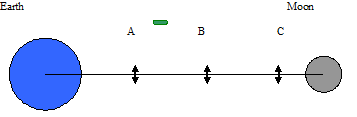
- AA
- BB
- CC
30An object moves in a straight line at a constant speed. Which number of forces could not act on the object?
- A0
- B1
- C2
- D3
- E4
31What does the orbital velocity of an object with respect to the distance does?
- AStays the same
- BDeceases
- CInceases
32Would your mass and weight change if you went to the Moon?
- AWeight would change but mass would not
- BMass would change but weight would not
- CBoth would change
- DNeither would change
33At which lunar phase(s) are tides at their lowest?
- Aboth new Moon and first quarter Moon
- Bboth first quarter Moon and third quarter Moon
- Cnew Moon
- Dfull Moon
34If Mars rises approximately the same time as a particular star. If Mars is in normal prograde motion at what time Mars will rise next night?
- ASame time as the star
- BEarlier than the star
- CLater than the star
35A planet orbits a planet in a circular orbit. How many forces are acting on the planet?
- A0
- B1
- C2
- D3
- E4
Informationen
- Beschreibung
- Astronomy
- Autor
- Ryan Tram
- Sprache
- English
- Aufrufe
- 847
- Schlagwörter
- Bewertung
- 5,0 von 5 · 3 Bewertungen Bewerte dieses Quiz