
Quiz
Chapter 9
Erstelle ein kostenloses Konto, um dieses Quiz zu beenden
Speichere deinen Fortschritt und sieh dir dein Endergebnis an.
oder mit deiner E-Mail registrieren
Schon ein Konto? Anmelden
Fragen in diesem Quiz (24)
1What is the term for a collection of 105 to 106 old stars in a region 30 to 100 light-years in diameter?
- AHerbig-Haro object
- Bglobular cluster
- Copen cluster
- Dgiant cluster
2What is the defining characteristic of stars within a cluster that are at the turnoff point?
- AThey are just leaving the main sequence
- BThey are just becoming white dwarfs
- CThey are just entering the main sequence
- DThey are about to explode in supernovae
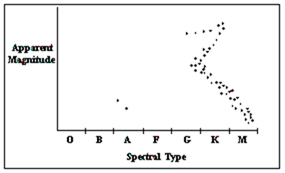
3What is the approximate age of the star cluster in the H-R diagram? (Hint: Main sequence stars of spectral types O and B have a core supply of hydrogen that is sufficient to last about 250 million years; types A and F, about 2 billion years; type G about 10 billion years; types K and M about 30 billion years. The apparent magnitude scale means that larger numbers are toward the bottom of the vertical axis.)
- A200 million years
- B2 billion years
- C10 billion years
- D30 billion years
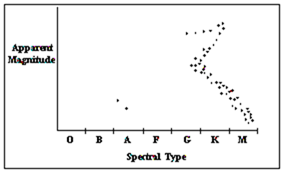
4Refer to the H-R diagram. How would the H-R diagram of a more distant star cluster look different?
- AThe points would shift down, because all of the stars would have larger apparent magnitudes
- BThe points would shift to the right, because all of the stars would appear to be cooler
- CThe points would shift up, because all of the stars would have smaller apparent magnitudes
- DThe points would shift to the left, because all of the stars would appear to be hotter
5Which nuclear fuels does a one solar mass star use over the course of its entire lifespan?
- Ahydrogen
- Bhydrogen and helium
- Chydrogen, helium, and carbon
- Dhydrogen, helium, carbon, and oxygen
6What is the ultimate fate of our Sun?
- AIt will become a neutron star
- BIt will explode in a supernova
- CIt will become a white dwarf
- DIt will explode in a nova
7Which of the following is the most important factor that determines a life cycle of a star (for example, why some stars have a short life span)?
- Amass
- Btemperature
- Cluminosity
- Dradius
8What principle explains why matter flowing from one star in a binary system to its companion forms an accretion disk?
- Aconservation of tidal forces
- Bconservation of temperature
- Cconservation of angular momentum
- Dconservation of energy
9Suppose you discover a binary star system with a 0.7 solar mass giant star and a 2 solar mass main sequence star. Why is this surprising?
- A0.7 solar mass stars are not expected to become giants
- BAll 2 solar mass stars should have left the main sequence
- CGiant stars are expected to destroy their companions, so the 2 solar mass star shouldn’t exist
- DThe 2 solar mass star should have become a giant before the 0.7 solar mass star
10When material expanding away from a star in a binary system reaches the edge of its Roche lobe, what happens?
- AThe material will start to fall back toward the star
- BAll of the material will accrete on to the companion
- CThe material will no longer be gravitationally bound to the star
- DThe material will increase in temperature and eventually undergo thermonuclear fusion
11When mass is transferred toward a white dwarf in a binary system, the material forms a rapidly growing whirlpool of material. What is that whirlpool called?
- Aan accretion disk
- Ban Algol paradox
- Ca planetary nebula
- Da supernova remnant
12Under what conditions are Type Ia supernovae believed to occur?
- Awhen the core of a massive star collapses
- Bwhen a white dwarf exceeds the Chandrasekhar-Landau limit
- Cwhen hydrogen detonation occurs
- Dwhen neutrinos in a massive star form a shock wave that explodes the star
13Which of the following is almost always associated with a nova?
- Aa very massive star
- Ba star undergoing helium burning
- Ca white dwarf in a close binary system
- Da solar-like star that has exhausted its hydrogen and helium
14Why can’t massive stars generate energy through iron fusion?
- Abecause iron fusion requires very high density
- Bbecause no star can get hot enough for iron fusion
- Cbecause both fusion and fission of iron nuclei absorb energy
- Dbecause massive stars go supernova before they create an iron core
15If the hypothesis that novae occur in close binary systems is correct, then which of the following should novae do?
- AThey should produce synchrotron radiation
- BThey should occur in regions of star formation
- CThey should all be visual binaries
- DThey should repeat after some interval
16Why is the material that accretes onto a neutron star or black hole expected to emit X-rays?
- AThe material contains magnetic fields that will produce synchrotron radiation
- BHydrogen nuclei begin to fuse and emit high energy photons
- CThe material will become hot enough that it will radiate most strongly at X-ray wavelengths
- DAs the material slows down it converts thermal energy to gravitational potential energy
17What is the term for the form of electromagnetic radiation produced by rapidly moving electrons spiralling through magnetic fields?
- ALagrangian radiation
- Bultraviolet radiation
- Csynchrotron radiation
- Dinfrared radiation
18What type of object is the Crab nebula?
- Aa planetary nebula
- Ban open cluster
- Can absorption nebula
- Da supernova remnant
19In the year 1054 CE, Chinese astronomers observed the appearance of a new star. What occupies that location now?
- Aa molecular cloud
- Ba planetary nebula with a white dwarf in the centre
- Ca supernova remnant with a pulsar in the centre
- Dnothing
20What produces synchrotron radiation?
- Aobjects with temperatures below 10,000 K
- Bhigh-velocity electrons moving through a magnetic field
- Ccold hydrogen atoms in space
- Dhelium burning in a massive star
21Where is synchrotron radiation produced?
- Ain planetary nebulae
- Bin the outer layers of red dwarfs
- Cin the collapsing iron cores of massive stars
- Din supernova remnants
22What does the explosion of a type II supernova typically leave behind?
- AIt leaves behind a planetary nebula
- BIt leaves behind a shell of hot, expanding gas with a white dwarf at the centre
- CIt leaves behind a shell of hot, expanding gas with a pulsar at the centre
- DNothing is ever left behind
23Which of the following offered support for the theory that the collapse of a massive star’s iron core produces neutrinos?
- Athe detection of neutrinos from the supernova of 1987
- Bthe brightening of supernovae a few days after they are first visible
- Cunderground counts of solar neutrinos
- Dlaboratory measurements of the mass of the neutrino
24If you were to land on a neutron star, how would your mass change compared to your mass on the Earth?
- AIt would increase a lot
- BIt would decrease a lot
- CIt would increase a little
- DIt would remain the same
Informationen
- Beschreibung
- Astronomy
- Autor
- Ryan Tram
- Sprache
- English
- Aufrufe
- 439
- Schlagwörter
- Bewertung
- 5,0 von 5 · 1 Bewertung Bewerte dieses Quiz