
Quiz
MODULE 2
Dieses Quiz enthält Fragetypen, die sich im gewohnten Player öffnen.
Fragen in diesem Quiz (62)
1What is the current model of an atom?
- AProtons and electrons found at the centre, neutrons orbit. The shells are the dense area, and the nucleus takes up most of the area.
- BProtons and neutrons found at the centre, electrons orbit. The nucleus is the dense area, and the shells take up most of the area.
- CProtons and neutrons found at the centre, electrons orbit. The shells are the dense area, and the nucleus takes up most of the area.
2Protons are [blank_start]positive[blank_end], electrons [blank_start]negative[blank_end] and a neutral atom has [blank_start]equal[blank_end] amounts. Proton and neutron weigh [blank_start]1[blank_end], and electron weighs [blank_start]1/2000[blank_end].
- Apositive
- Bnegative
- Cequal
- D1
- E1/2000
3Most elements are made up of a mixture of isotopes. These have:
- ADifferent masses.
- BDifferent numbers of protons.
- CDifferent numbers of neutrons.
- DSame number of protons and electrons.
- ESame masses.
4Different isotopes react the same way. True or False?
- ARichtig
- BFalsch
5Instead of finding the mass of atoms directly, we compare the masses of different atoms, using relative mass. Which isotope is the international standard for the measure of relative mass?
- ACarbon 13
- BNitrogen 14
- CCarbon 12
- DOxygen 8
6Most elements have a mix of isotopes with different masses and abundances, so we use the term weighted mean mass. These two factors are what decides the contribution made by each isotope to the relative mass. Which is the formula for the weight mass?
- AAdd the mass of each isotope, times by the abundances and divide by 100
- BAdd the abundances, add the isotopes, times together, and divide by 100.
- CTimes the mass of each isotope by the abundance, add together and divide by 100.
7A mass spectrometer is a piece of apparatus that can be used to find out about [blank_start]molecules[blank_end]. It can identify an unknown compound, the [blank_start]relative abundance[blank_end] of an element or determine structural information.
It determines the mass of a molecule by measuring the [blank_start]mass to charge[blank_end] ratio of ions. It does this by:
1) Causing substance to become [blank_start]positive[blank_end].
2) These positive ion are then passed through, separated according to mass and charge.
3) A computer analyses the data on the ions present and produces a [blank_start]mass spectrum[blank_end]. This is similar to a bar graph and shows abundance and ions present.
Its important use is to determine the [blank_start]isotopes[blank_end] present, and to do this you need to be able to analyze a mass spectrum to find the proportions of each isotope in the element.
A mass spectrum shows relative or percentage abundance on the [blank_start]y-axis[blank_end] and the mass to charge (m/z) on the [blank_start]x axis[blank_end].- Amolecules
- Brelative abundance
- Cmass to charge
- Dpositive
- Emass spectrum
- Fgraph spectrum
- Gisotopes
- Henergy shells
- Iy-axis
- Jx axis
8The graph shows there are three peaks in the spectrum, so there are three isotopes of magnesium, with masses 24,25,26. The heights give the relative abundances of the isotopes, therefore in this case 79%,10%,11% respectively. Usually, the mass spectrum will give values for the abundances, but if they aren't, how would you work them out?
- AAbundance = total heights of peaks/height of peak of one sample x 100
- BAbundance = height of peak of one sample/total heights of peaks x 100
9Elements in the same group, react in the similar ways. True or false?
- ARichtig
- BFalsch
10Atoms of metals in groups 1-3 will [blank_start]lose[blank_end] electrons to form positive ions. Atom of non metal in group 5-7 gain electrons, to form [blank_start]negative[blank_end] ions. Atoms of Be, B, C and Si [blank_start]do not[blank_end] normally form ions. They require [blank_start]too much[blank_end] energy to transfer the outer shell electrons to form ions. Some elements can form more than one ion, therefore the [blank_start]oxidation number[blank_end] is written in roman numerals to make it clear (Iron(II)). Groups of covalently bonded atoms can also lose or gain electrons to form ions called [blank_start]molecular ions[blank_end]. Ionic compounds always have a charge of [blank_start]0[blank_end].
- Alose
- Bgain
- Cnegative
- Dpositive
- Edo not
- Fdo
- Gtoo much
- Htoo little
- Ioxidation number
- Jatomic mass
- Kmolecular ions
- Latomic ions
- M0
- N1
11Amount of substance is measured in mole (m).
- ARichtig
- BFalsch
12Which one is true?
- Amoles = mass/mr
- Bmoles = mr/mass
- Cmoles = mass x mr
13Empirica formula is the simplest way of showing a chemical formula.
- ARichtig
- BFalsch
14To work out empirical formula, you:
1) Divide the amount of each element by its [blank_start]Mr[blank_end], to get [blank_start]moles[blank_end].
2) Divide the answer by the [blank_start]smallest[blank_end] number, making it 1:x.
3) If necessary, multiply the answer by a suitable value to make are it's a [blank_start]whole[blank_end] number ratio.- AMr
- Bmoles
- Csmallest
- Dwhole
15Molecular formulae are used for compounds that exist as simple molecules. A molecular formula tells you the number of each type of atom make up a molecule.
- ARichtig
- BFalsch
16At room temperature and pressure (RTP), one mole of gas molecules approx 24dm3mol-1. What is the formula for a gas?
- ANumber of Moles = volume/43
- BNumber of Moles = volume/24
- CNumber of Moles = volume/100
17Gases are assumed to behave in an ideal way.
- AThey are in continuous motion and don't experience any intermolecular forces.
- BThe exert pressure when they collide with walls, and collisions don't cause a lose of kinetic energy.
- CThe exert pressure when they collide with walls, and collisions causes a loss of kinetic energy.
- DDIfferent sizes in gas molecules are ignored.
- ETemperature doesn't effect the particles.
- FThe relationship is pV=nRT - pressure, volume = number of moles, gas constant (8.314Jmol-1k-1), and T= temperature
- GThe relationship is pR=nVT - pressure, gas constant (8.314Jmol-1k-1) = number of moles, volume, and T= temperature
18The concentration of a solution tells you how much solute is dissolved in given amount of solvent, measured in moldm-3. The equation is?
- An = c x v
- Bn = c/v
- Cn = v/c
19A standard solution has a known [blank_start]concentration[blank_end]. Standard solutions are important in certain types of investigation, for example a [blank_start]titration[blank_end] to find out the [blank_start]conc[blank_end] of another substance. To do this you will need too:
1) Known the concentration and [blank_start]volume[blank_end] of the solution you need to make.
2) Work out the amount, in mol, of substance needed, and convert this to [blank_start]mass[blank_end].
The mass concentration of a solute is the mass dissolved in 1dm3 of solution. If a solution contains 2.805g of KOH dissolved in 250cm3 of solution, there would be 11.220g in [blank_start]1000[blank_end]cm3. Therefore, there is a concentration of KOH is 11.220gdm-3.- Aconcentration
- Btitration
- Cconcentration
- Dvolume
- Emass
- F1000
20Which of the following statements are true?
- AIn a chemical reaction, the number and type of atom is conserved. A chemical reaction only rearranges the atoms into different combinations.
- BA type of particle that doesn't take part in reaction is called a species.
- CA type of particle that doesn't take part in a reaction is a spectator molecule.
- DThe molecules are shown by their molecular formula in the simplest whole number ratio.
- EState symbols are added to equations to provide more information about the species in reactions: (s) = solid, (l) = liquid, (aq) = aqueous, (q) = gaseous.
21When writing a fully balanced chemical equation, it is assumed that all of the [blank_start]reactants[blank_end] will be converted into products. IF this were the case, the yield will be [blank_start]100[blank_end]%.
However, practically, this doesn’t happen as:
- the reaction may be at [blank_start]equilibrium[blank_end] and may not go to completion
- [blank_start]side[blank_end] reactions may occur, leading to by-products.
- The reactants may no be [blank_start]pure[blank_end]
- the reactants or products may be left behind in the [blank_start]apparatus[blank_end].
- separation and [blank_start]purification[blank_end] may results in some loss of product.- Areactants
- B100
- Cequilibrium
- Dside
- Epure
- Fapparatus
- Gpurification
22The calculation for percentage yield is: [blank_start]actual/theoretical x100[blank_end]
- Aactual/theoretical x100
23Some reactions created by-products, which are often considered as waste and usually have to be disposed of. This is costly, and can be harmful to the environmental and wastes resources.
Reactions with high atom economies are processes that are more sustainable, as they reduce waste. Atom economy describes the efficiency of a reaction in terms of all the atoms involved. A reaction with a high atom economy uses atoms with minimal waste. What is the formula of atom economy?- ADesired/sum of all x 100
- BSum of all/desired x 100
- CSum of by product/desired x 100
- DSum of by product/sum of all x 100
24Addition reactions have an atom economy of 100%. Reactions in substitution or elimination also have an atom economy of 100%.
- ARichtig
- BFalsch
25The most common acids are Sulfuric Acids H2SO4, Hydrochloric Acid HCl and Nitric acid HNO3. Sulfuric acid is used in battery acid and hydrochloric is in your stomach.
A weak acid is ethanoic acid CH3COOH which is found in what? [blank_start]Vinegar[blank_end]!- AVinegar
26When acid is added to water, the acid released [blank_start]H+ ions (protons)[blank_end] into solution. This is why an acid is a [blank_start]proton[blank_end] donor.
Strong acids are good at giving up H+ ions, meaning they [blank_start]fully dissociate[blank_end]. However, weak acids release them, but quickly take them back. Weak acids are good at excepting H+ ions, meaning they [blank_start]partially dissociate[blank_end].
The most common bases are metal oxides and hydroxides like Mg(OH)2 which is [blank_start]Magnesium Hydroxide[blank_end] and Ca(OH)2 which is [blank_start]Calcium Hydroxide[blank_end]. Ammonia is also a base.
Mg(OH)2 is known as [blank_start]milk of magnesia[blank_end] which is used for treating [blank_start]acid indigestion[blank_end]. And Ca(OH)2 is known as [blank_start]lime[blank_end] and reduces the [blank_start]acidity of acid soils[blank_end].
Bases are the opposite of an acid, is a [blank_start]proton[blank_end] acceptor, and they [blank_start]neutralize[blank_end] acids.- AH+ ions (protons)
- BOH- ions
- Cproton
- Danion
- Efully dissociate
- Fattack well
- Gpartially dissociate
- Hattack badly
- IMagnesium Hydroxide
- JMagnesium oxide
- KCalcium Hydroxide
- LCalcium Oxide
- Mmilk of magnesia
- Nlime of magnesia
- Oacid indigestion
- Psoil
- Qlime
- Rpear
- Sacidity of acid soils
- Talkalinity of soils.
- Uproton
- Velectron
- Wneutralize
- Xacidify
27An Alkali is any substance that gives a solution with a pH greater than [blank_start]7.0[blank_end] when dissolved in water.
Common examples are sodium hydroxide ([blank_start]NaOH[blank_end]), potassium hydroxide ([blank_start]KOH[blank_end]) and [blank_start]ammonia[blank_end] (NH3).
Sodium hydroxide is used in over cleaners and [blank_start]paint strippers[blank_end]. This is as alkalis are very [blank_start]corrosive[blank_end], even more than acids. Sodium hydroxide (alkali) is corrosive even when as dilute as 0.5moldm-3, and hydrochloric has to be stronger than 6.5 to be.
An alkali is a special type of [blank_start]base[blank_end] that can dissolve in [blank_start]water[blank_end] to form [blank_start]aqueous hydroxide ions[blank_end] OH-. In solution, the hydroxide ions from alkalis [blank_start]neutralize[blank_end] the protons from acid, forming [blank_start]water[blank_end].
Ammonia is a gas that dissolves in water to form a weak alkaline solution. It is weak, because only a [blank_start]small[blank_end] proportion of the dissolved NH3 reacts with water, shown by the [blank_start]equilibrium[blank_end] sign.
Substances that have acids and bases are [blank_start]amphoteric[blank_end] substances, e.g. [blank_start]glycine[blank_end] (amino acid).- A7.0
- BNaOH
- CKOH
- Dammonia
- Epaint strippers
- Fcorrosive
- Gbase
- Hwater
- Iaqueous hydroxide ions
- Jneutralize
- Kwater
- Lsmall
- Mequilibrium
- Namphoteric
- Oglycine
28A salt is an ionic compound, which of the options bellow are a feature of them.
- AThe positive ion, cation, in a salt is a metal or ammonium ion.
- BThe positive ion, cation, in a salt is derived from an acid.
- CThe formula of a salt is the same as that of the parent acid, except that an H+ ion has been replaced by the positive ion.
29Sulfuric acid, [blank_start]H2SO4[blank_end] = Sulfate salts, like [blank_start]potassium[blank_end] sulfate (K2SO4)
Hydrochloric acid, HCl = Chloride salts, like sodium chloride ([blank_start]NaCl[blank_end])
Nitric acid, [blank_start]HNO3[blank_end] = Nitrate salts, for example calcium nitrate ([blank_start]Ca(NO3)2[blank_end])- AH2SO4
- BHSO2
- Cpotassium
- Dphosphorous
- ENaCl
- FSCl
- GHNO3
- HNSO4
- ICa(NO3)2
- JCaNO3
30Salts can be produced by neutralising acids with bases like carbonates, metal oxides and alkalis.
Acid + Carbonates --> Salt + [blank_start]Carbon Dioxide[blank_end] + [blank_start]Water[blank_end]
Acid + Metal Oxide --> Salt + [blank_start]Water[blank_end]
Acid + Alkali --> Salt + [blank_start]Water[blank_end]
Acid + Metal --> Salt + [blank_start]Hydrogen[blank_end]- ACarbon Dioxide
- BWater
- CWater
- DWater
- EHydrogen
31Some compounds contain water within their structures ([blank_start]hydrated[blank_end] - the crystalline form containing water) and some don’t ([blank_start]anhydrous[blank_end] – the form containing no water). If a compound crystallizes within water, the water can become part of the resulting crystalline structure. Water that becomes involved in this way is [blank_start]water of crystallization[blank_end]. The amount of water contained is shown by a [blank_start]dot[blank_end] formula. This gives the ratio between the number of compound molecules and the number of water molecules within the structure, e.g. cobalt chloride hexahydrate CoCl2. 6H2O
You can work the dot formula of hydrated salts by using the [blank_start]empirical[blank_end] formula, gained from percentage or mass compositions or experimental results.- Ahydrated
- Bdehydrated
- Canhydrous
- Dhydrated
- Ewater of crystallization
- Fa hydration reaction
- Gdot
- Hdash
- Iempirical
- Jmolecular
32In acid-base titrations, you measure the volume of on solution that reacts with a measured volume of solution that you must know the conc of. What is a solution called if you know the concentration of?
- AStandard Solution
- BAcid
- CBase
33Oxidation numbers cannot be measured directly by experiment. They are used to keep track of how electrons are used in polar charges.
- ARichtig
- BFalsch
34The overal charge of a molecular must equal the oxidation number.
- ARichtig
- BFalsch
35Oxyanions are [blank_start]negative[blank_end] ions that contain an element along with [blank_start]oxygen[blank_end] like SO4 2-, or NO3-. They usually end in ate. As with transition element ions, an element may form oxyanions in which the element has [blank_start]different[blank_end] oxidation numbers.
- Anegative
- Bpositive
- Cneutral
- Doxygen
- Enitrogen
- Fcarbon
- Gdifferent
- Hthe same
36Uncombined element oxidation number?
- A1
- B0
- C2
37Oxidation number of combined oxygen?
- A-1
- B-2
- C-3
38Oxidation of oxygen in peroxides?
- A-1
- B-2
- C-3
39Combined hydrogen's oxidation number?
- A1
- B3
- C0
40Combined hydrogen in metal hydrides oxidation number?
- A1
- B0
- C-1
41Combined fluorine oxidation number?
- A-1
- B0
- C-2
42Oxidation is the [blank_start]gain[blank_end] of oxygen, and reduction is the [blank_start]loss[blank_end] of oxygen. Oxidation is also the [blank_start]loss[blank_end] of electrons, and reduction is the [blank_start]gain[blank_end] of electrons. The substance that is reduced [blank_start]takes[blank_end] electrons from the substance that is oxidized.
Reduction must always be accompanied by oxidation. A reaction in which both reduction and oxidation take place is a [blank_start]redox[blank_end] reaction.
Magnesium reacts with chlorine to form magnesium chloride. Electrons have been transferred from the magnesium to the chlorine. Metals tend to be [blank_start]oxidized[blank_end] and non metals [blank_start]reduced[blank_end].
Reduction is a [blank_start]decrease[blank_end] in oxidation number and oxidation is an [blank_start]increase[blank_end] in oxidation number. You can identify the oxidation and reduction processes using oxidation numbers. Assign an oxidation number to each atom in a redox reaction. Then follow any changes to these oxidation numbers.
Reactive metals undergo redox reactions with acids:
- The metal is [blank_start]oxidized[blank_end], forming [blank_start]positive[blank_end] metal ions.
- The hydrogen in the acid is [blank_start]reduced[blank_end], forming the element hydrogen as a [blank_start]gas[blank_end].- Again
- Bloss
- Closs
- Dgain
- Etakes
- Fredox
- Goxidized
- Hreduced
- Idecrease
- Jincrease
- Koxidized
- Lpositive
- Mreduced
- Ngas
43There are rules governing where electrons are allow to be within each shells. It was once thought that electrons orbit the nucleus in a path. Its found that each atomic orbital can hold a maximum of two electrons with opposite spins. An orbital is a region of space where electrons may be found. Which is correct?
- AP orbitals are a spherical shape, and from n = 1, each shell contains one s orbital.
D orbitals are three dimensional dumb-bell shapes. There are 3, so they can hold 6 electrons. 3 x 2 = 6.
S and F orbitals are more complex. There are 5 d orbitals, 5 x 2 = 10 electrons, and there are 7 f orbitals, 7 x 2 = 14 electrons. - BD orbitals are a spherical shape, and from n = 1, each shell contains one s orbital.
P orbitals are three dimensional dumb-bell shapes. There are 3, so they can hold 6 electrons. 3 x 2 = 6.
S and F orbitals are more complex. There are 5 d orbitals, 5 x 2 = 10 electrons, and there are 7 f orbitals, 7 x 2 = 14 electrons. - CS orbitals are a spherical shape, and from n = 1, each shell contains one s orbital.
P orbitals are three dimensional dumb-bell shapes. There are 3, so they can hold 6 electrons. 3 x 2 = 6.
D and F orbitals are more complex. There are 5 d orbitals, 5 x 2 = 10 electrons, and there are 7 f orbitals, 7 x 2 = 14 electrons.
- AP orbitals are a spherical shape, and from n = 1, each shell contains one s orbital.
44Chemical reactions are usually accompanied by [blank_start]electron[blank_end] transfers, making atoms more [blank_start]stable[blank_end].
The most stable and unreactive elements are the [blank_start]noble[blank_end] gases (furthest group on the right), which have a [blank_start]full[blank_end] outer shell.
Chemical bonds are classified into: ionic, covalent and [blank_start]metallic[blank_end].
Ionic bonding: Ionic bonding occurs in compounds consisting of a [blank_start]metal[blank_end] and non metal. Electrons are transferred to form oppositely charged ions, that are held together by [blank_start]electrostatic[blank_end] forces. E.g. MgO. When this occurs, the elements involved usually get a [blank_start]full[blank_end] outer shell and usually match the noble gas configurations.
Covalent bonding: Covalent bonding occurs in compounds consisting of two [blank_start]non metals[blank_end]. Electrons are [blank_start]shared[blank_end] and are attracted to both of the nuclei. E.g. H2O. It also usually leads to the atoms getting a [blank_start]full[blank_end] outer shell and matching the noble gas configurations.
Metallic bonding: Metallic bonding occurs in metals and electrons are [blank_start]shared[blank_end] between all atoms. E.g. iron or their alloys such as brass.- Aelectron
- Bstable
- Cnoble
- Dfull
- Emetallic
- Fmetal
- Gelectrostatic
- Hfull
- Inon metals
- Jshared
- Kfull
- Lshared
45In ionic bonding, the non metal is usually negative, and the metal is usually positive.
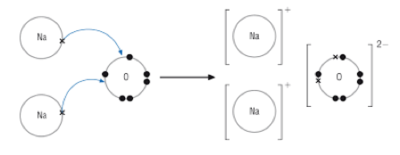
- ARichtig
- BFalsch
46Ionic compounds can form giant lattices with each ion surrounded by oppositely charged ions, forming a three dimensional giant ionic lattice, shown above. All ionic compounds exist as giant ionic lattices in the solid state, but in liquid state can move around (e.g. sodium chloride). Can they conduct electricity?
- AYes.
- BAs a solid, but not a liquid.
- CAs a liquid, but not a solid.
- DNo.
47Ionic compounds are [blank_start]solids[blank_end] at room temp, as a [blank_start]large[blank_end] amount of energy is needed to break the [blank_start]strong[blank_end] electrostatic bonds, making them have [blank_start]high[blank_end] melting and boiling points. The higher the charge on the ions, the [blank_start]stronger[blank_end] the forces. E.g. The melting point of Mg2+ and O2- is [blank_start]higher[blank_end] than Na+ and Cl-.
An ionic lattice dissolves in [blank_start]polar[blank_end] solvents like water and they contain substances with polar bonds. Polar water molecules break down an ionic lattice by surrounding each ion to form a [blank_start]solution[blank_end], and the slight charges attract the charged ions, [blank_start]disrupting[blank_end] the lattice.- Asolids
- Bliquids
- Clarge
- Dsmall
- Estrong
- Fweak
- Ghigh
- Hlow
- Istronger
- Jweaker
- Khigher
- Llower
- Mpolar
- Nnon polar
- Osolution
- Ppowder
- Qdisrupting
- Rbuilding up
48Covalent bonding occurs in compounds consisting of [blank_start]non metals[blank_end] and involves sharing [blank_start]pairs[blank_end] of electrons, which are attracted to [blank_start]both nuclei's[blank_end]. The attraction overcomes the [blank_start]repulsion[blank_end] between the two positively charged nuclei, resulting in a [blank_start]covalent bond[blank_end].
If atoms are bonded by one shared pair of electrons, it is a [blank_start]single bond[blank_end].
Sharing two pairs of electrons forms a [blank_start]double bond[blank_end] O2), and sharing three pairs of electrons forms a [blank_start]triple bond[blank_end] (N2).
Some times there is a lone pair in an atom after it has bonded with other elements, like in Ammonia, NH3. This gives a [blank_start]concentration[blank_end] of negative charged around an atom and influences the chemistry of a molecule.
Some covalent bonds are stronger than others, and a measure of this is called the [blank_start]average bond enthalpy.[blank_end]
Bond breaking is an [blank_start]endothermic[blank_end] change, one that [blank_start]requires[blank_end] energy, so they are shown with a [blank_start]+[blank_end] sign. (e.g. +413)- Anon metals
- Bpairs
- Cboth nuclei's
- Drepulsion
- Ecovalent bond
- Fsingle bond
- Gdouble bond
- Htriple bond
- Iconcentration
- Javerage bond enthalpy.
- Kendothermic
- Lrequires
- M+
49Dative covalent bonding is where each of the atoms supplies one electron to the covalent bond.
- ARichtig
- BFalsch
50When an acid is added to water, water molecules form what ions? (H3O+), which are responisble for reactions of acids. In this ion, one of the lone pairs in a water molecule provides the electrons for a dative covalent bond.
- AHydroxide
- BProton
- COxonium
51The octet rule (full outer shell) doesn't always work as there may not be enough electrons or more than four electrons may pair up in bonding which is an expansion of the octet. Within period 2, beryllium, which 2 elements form compounds with covalent bonds. Neither of them have enough unpaired electrons to reach a noble gas configurations. However, they can pair up any unpaired electrons.
- ABoron
- BBeryllium
- CCarbon
- DNitrogen
52For elements at groups 5-7, something happens from period 3. As you move down, more outer shell electrons are able to take part in bonding. What is this?
- AExpansion of the Octet.
- BMetallic Bonding.
- CGiant Structures.
53Atoms of non metals in group15 can form [blank_start]three[blank_end] to [blank_start]five[blank_end] covalent bonds, atoms of non metals in group 16 can form [blank_start]two[blank_end], [blank_start]four[blank_end] or [blank_start]six[blank_end] covalent bonds and atoms of non metals in group 17 can form one, [blank_start]three[blank_end], [blank_start]five[blank_end] or [blank_start]seven[blank_end] covalent bonds.
E.g. sulfur has 6 electrons in its outer shell therefore six covalent bonds can be formed. Each of sulfurs six electrons is [blank_start]paired[blank_end], so sulfur now has 12 outer electrons, expanding the [blank_start]octet[blank_end]. This can make sulfur hexafluroide.- Athree
- Bfive
- Ctwo
- Dfour
- Esix
- Fthree
- Gfive
- Hseven
- Ipaired
- Joctet
54Elements and compounds with covalent bonds can have either a [blank_start]simple[blank_end] molecular lattice or a [blank_start]giant[blank_end] covalent structure.
Simple Molecular Structures: Made up from small, simple molecules in a solid simple molecular lattice. The atoms are held together by strong [blank_start]covalent[blank_end] bonds and the molecules are held by weak [blank_start]intermolecular forces[blank_end].
PROPERTIES: They have [blank_start]low[blank_end] melting/boiling points because the intermolecular forces are so [blank_start]weak[blank_end], and they don’t conduct electricity as there are no [blank_start]charged[blank_end] particles free to move. They are soluble in [blank_start]non-polar[blank_end] solvents like hexane as weak forced can form between covalent molecules and solvents, [blank_start]breaking[blank_end] the lattice shape.
Giant Covalent Structures: [blank_start]Diamond[blank_end] and graphite are examples of giant covalent lattices.
PROPERTIES: They have [blank_start]high[blank_end] melting/boiling points as there are strong covalent bonds. They [blank_start]aren't[blank_end] conductors of electricity as there are no free charged particles, except for [blank_start]graphite[blank_end]. They are [blank_start]insoluble[blank_end] as the covalent bonds are too strong to be broken.- Asimple
- Blarge
- Cgiant
- Dsmall
- Ecovalent
- Fionic
- Gintermolecular forces
- Helectronegative forces
- Ilow
- Jhigh
- Kweak
- Lstrong
- Mcharged
- Nneutral
- Onon-polar
- Ppolar
- Qbreaking
- Rstrenghtening
- SDiamond
- Tgraphene
- Uhigher
- Vlower
- Waren't
- Xare
- Ygraphite
- Zdiamond
- AAinsoluble
- ABsoluble
55The shape of a molecule or ion is determined by the number of electron pairs in the outer shell surrounding the central atom, due to the electrons repelling other electron pairs, making them far apart as possible.
If the central atom is surrounded by bonded pairs, they will repel equally. In shapes, a double or triple bond is thought as a bonding region, and the other electrons repel it equally, and the bonding region is fixed in place.
A lone pair of electrons is slightly more electron-dense than a bonded pair, therefore it repels more. By how many degrees does this happen?- A2
- B3
- C2.5
56LINEAR
- [blank_start]2[blank_end] bonding pairs around a central atom
- The two pairs are at [blank_start]180[blank_end] degrees.
- E.g. CO2
TRIGONAL PLANAR
- 3 bonding pairs around a central atom
- All three of the bonds are on the [blank_start]same[blank_end] planes (2D)
- Bond angle = [blank_start]120[blank_end] degrees.
- E.g. [blank_start]Boron trichloride[blank_end] (BCl3)
TETRAHEDRAL (three dimensional)
- [blank_start]Four[blank_end] bonds around a central atom.
- Angle between electrons is [blank_start]109.5[blank_end] degrees.
- E.g. [blank_start]Methane[blank_end] (CH4)
[blank_start]TRIGONAL BIPYRAMIND[blank_end]
- Five bonding pairs around a central atom
- Three pairs in one plane have an angle of 120, and the other two pairs are [blank_start]90[blank_end].
- E.g. Phosphrous pentafluroide ([blank_start]PF5[blank_end])
OCTAHEDRAL
- [blank_start]6[blank_end] bonding pairs aorund a central atom.
- This results in a bond angle of [blank_start]90[blank_end] degrees between all the bonds.
- E.g. Sulfur hexafluroide.- A2
- B180
- Csame
- D120
- EBoron trichloride
- FFour
- G109.5
- HMethane
- ITRIGONAL BIPYRAMIND
- J90
- KPF5
- L6
- M90
57Electronegativity measures the attraction of a bonded atom for the pair of electrons in a covalent bond.
- ARichtig
- BFalsch
58What effect does atomic radius have on electronegativity?
- AThe larger it is, the more electronegative it is.
- BThe smaller it is, the more electronegative it is.
59What effect does the number of unshielded protons have on electronegativity?
- AThe more unshielded protons, means higher electronegativity.
- BThe more unshielded protons, means lower electronegativity.
60Electronegativity [blank_start]increases[blank_end] across a period as the atomic radius decreases:
- As you go across the group, the number of electrons are increasing, [blank_start]protons[blank_end] go up too. As there are no more [blank_start]shells[blank_end], it pull the electrons closer, decreasing atomic radius.
The charge on the nucleus increases without significant shielding. New electrons don’t contribute to shielding as they are added to the same [blank_start]energy level[blank_end].
It decreases down a [blank_start]period[blank_end] as the atomic radius increases. Although the charge on the nucleus increases, [blank_start]shielding[blank_end] also increases a lot as the electrons are added to knew principle [blank_start]energy levels[blank_end].- Aincreases
- Bprotons
- Cshells
- Denergy level
- Eperiod
- Fshielding
- Genergy levels
61Which of these are intermolecular forces?
- APermanent dipole induced dipole interaction
- BPermanent dipole dipole interaction
- CCovalent
- DHydrogen bonding
- EInduced dipole Induced dipole (London Forces)
- FIonic
62Oxygen, nitrogen and fluorine are all highly electromagnetic elements. Molecules containing [blank_start]N[blank_end] – H, [blank_start]F[blank_end] – H, or O – H have strong intermolecular forces called hydrogen bonds.
In a hydrogen bond, the [blank_start]positive[blank_end] hydrogen ion attracts a lone pair of electrons bonded within a different molecule, creating the bond.
A hydrogen bond in water has only 5 per cent of the strength of the O-H covalent bonds. However, it still has big effects of the properties of water.
ICE IS LESS DENSE THAN WATER: When ice forms, water molecules arrange themselves in a pattern and hydrogen bonds form. Ice has an [blank_start]open lattice[blank_end] structure with hydrogen bonds holding them apart slightly. This collapses as ice melts.
WATER HAS HIGHER THAN EXPECTED MELTING/BOILING POINTS: The hydrogen bonds are much [blank_start]stronger[blank_end] than other intermolecular forces and energy is needed to overcome these.
OTHER PROPERTIES OF WATER: The extra intermolecular bonding also explains why it has [blank_start]high[blank_end] surface tension so small insects can walk on water.- AF
- BCl
- CBr
- DN
- EO
- FC
- Gpositive
- Hnegative
- Iopen lattice
- Jclosed lattice
- Kstronger
- Lweaker
- Mhigh
- Nlow
Informationen
- Beschreibung
- A level Chemistry Quiz am MODULE 2, erstellt von Molly Butcher am 08/04/2017.
- Autor
- Molly Butcher
- Sprache
- English
- Aufrufe
- 2
- Schlagwörter
- Bewertung
- Noch keine Bewertungen Bewerte dieses Quiz