
Quiz
AQA AS Biology 7401- 3.4- Topic 8 DNA, Gene and Protein Synthesis
Dieses Quiz hat ein Zeitlimit und öffnet sich deshalb im gewohnten Player.
Fragen in diesem Quiz (24)
1what is a gene
- Aa gene is a section of DNA that contains the coded information for making polypeptides and functional RNA.
- Ba gene is a long chain of DNA
- Ca gene is a part of chromosome
- Da gene is a link in DNA
2what is a locus
- Aa section of DNA located at a particular position
- Ban allele
- Cthe environmental factors that determine the nature and development of all organisms
3what does the DNA base sequence code for
- Athe amino acid sequence of a polypeptide
- Ba functional RNA
- Cmutations
- DDNA codes for mRNA and tRNA
4in trying to discover how DNA bases coded for amino acids, scientists suggested that there must be a minimum of three bases that coded for each amino acid. their reasoning was as follows:
Only [blank_start]20[blank_end] different amino acids regularly occur in proteins
Each amino acid must have its own code of bases on the DNA
Only [blank_start]four[blank_end] different bases are present in DNA
If each base coded for a different amino acid, only four different amino acids could be coded for
Using a pair of bases [blank_start]16 (4^2) different codes[blank_end] are possible, which is [blank_start]still inadequate[blank_end]
Three bases produce [blank_start]64 (4^3) different codes[blank_end], [blank_start]more than[blank_end] enough to satisfy the requirement of [blank_start]20 amino acids[blank_end]- A20
- Bfour
- C16 (4^2) different codes
- Dstill inadequate
- Esatisfactory to the requirement
- F64 (4^3) different codes
- Gmore than
- Hthis is not
- I20 amino acids
- Jfour different amino acids
5what is a triplet
- Aa set of three bases that codes for an amino acid
- Bthree daughter cells produced by meiosis
- Cthree portions of DNA
6further experiments have revealed the following features of the gentic code:
- Aa few amino acids are coded for by only a single triplet
the remaining amino acids are coded for by between two and six triplets each - Ba triplet is read various directions along the dna strand
- Cthe code is known as degenerate code because most amino acids are coded for by more than one triplet
- Da triplet is always read in one particular direction along the dna strand
- Ethe start of a dna sequence that codes for a polypeptide is always the same triplet. this codes for the amino acid methionine, if this methionine molecule does not form part of the final polypeptide, it is later removed
- Fthree triplets do not code for any amino acid. these are called stop codons and mark the end of a polypeptide chain. they act in much the same way as a full stop at the end of a sentence
- Gthe code is non-overlapping, in other words each base in the sequence is read only once. thus six bases numbered 123456 are read as triplets 123 456, rather than triplets 123 234 345 456
- Hthe code is universal, with a few minor exceptions each triplet codes for the same amino acid in all organisms. this is indirect evidence for evolution
- Ione amino acid codes for only a single triplet
- Jthe code is known as non-degenerate code because most amino acids are coded for only one triplet
- Aa few amino acids are coded for by only a single triplet
7even within genes, only certain sequences code for amino acids. these coding sequences are called [blank_start]exons[blank_end]. within the gene these [blank_start]exons[blank_end] are seperated by further non-coding sequences called [blank_start]introns[blank_end].
- Aexons
- Bexons
- Cintrons
8in [blank_start]prokaryotic[blank_end] cells, such as bacteria, the dna molecules are [blank_start]shorter[blank_end], form a [blank_start]circle[blank_end] and are [blank_start]not associated[blank_end] with protein molecules. [blank_start]Prokaryotic[blank_end] cells therefore [blank_start]do not[blank_end] have chromosomes.
- Aprokaryotic
- Beukaryotic
- Cshorter
- Dlonger
- Ecircle
- Fsquare
- Gline
- Hnot associated
- Iassociated
- JProkaryotic
- KEukaryotic
- Ldo not
- Mdo
9in [blank_start]Eukaryotic[blank_end] cells, the DNA molecules are [blank_start]longer[blank_end], form a [blank_start]line rather than a circle[blank_end] and occur [blank_start]in association[blank_end] with proteins called [blank_start]histones[blank_end] to form structures called [blank_start]chromosomes[blank_end]. the mitochondria and chloroplasts of [blank_start]Eukaryotic[blank_end] cells also contain DNA which, like the DNA of [blank_start]Prokaryotic[blank_end] cells, is [blank_start]short, circular[blank_end] and no associated with proteins.
- AEukaryotic
- BProkaryotic
- Clonger
- Dshorter
- Eline rather than a circle
- Fcircle rather than a line
- Gin association
- Hnot in association
- Ihistones
- Jcentromere
- Kchromosomes
- Lchromatids
- MEukaryotic
- NProkaryotic
- OProkaryotic
- PEukaryotic
- Qshort, circular
- Rlong, square
10chromosomes are visible during the whole cell cycle
- ARichtig
- BFalsch
11each thread on a chromosome is called a [blank_start]chromatid[blank_end]
- Achromatid
12the DNA in chromosomes is held together by [blank_start]histones[blank_end]
- Ahistones
13How is DNA packed into chromosomes
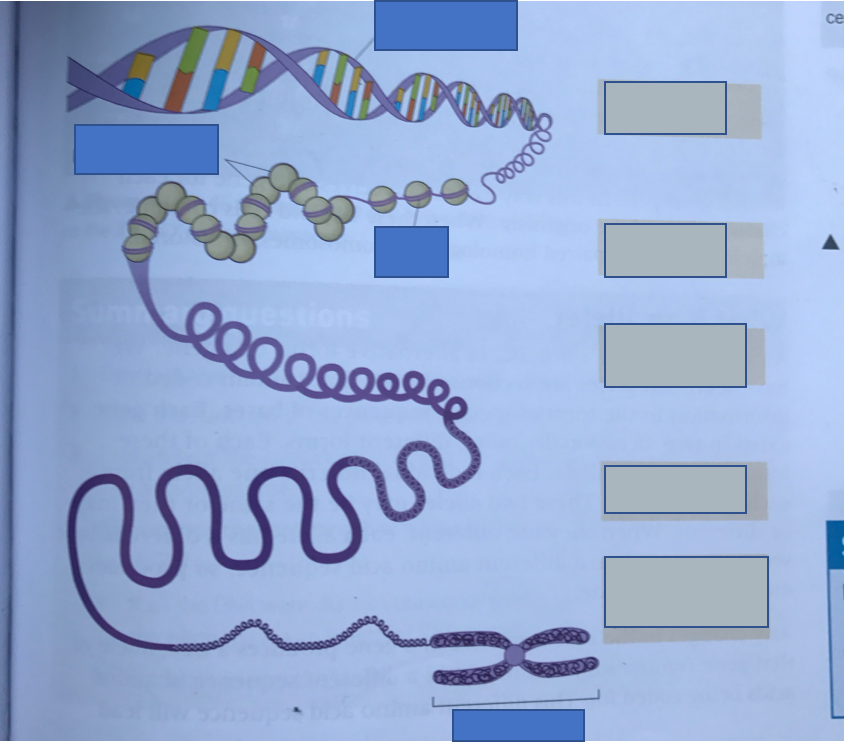
- ADNA double helix
- BDNA molecule
- CDNA combined with histones
- DDNA-histone complex is coiled
- ECoils fold to form loops
- Floops coil and pack together
- Gchromosome
- HDNA
- IHistone molecules
14[blank_start]sexually[blank_end] produced [blank_start]organisms[blank_end], such as [blank_start]humans[blank_end], are the result of the [blank_start]fusion[blank_end] of a [blank_start]sperm[blank_end] and an egg, each of which contributes [blank_start]one[blank_end] complete [blank_start]set[blank_end] of chromosomes to the offspring.
- Asexually
- Basexually
- Corganisms
- Dbacteria
- Ehumans
- Fmule
- Gfusion
- Hdivison
- Isperm
- Jegg
- Kone
- Ltwo
- Mthree
- Nfour
- Ofive
- Psix
- Qten
- Ra hundred and twenty
- Sa hundred
- Tset
- Usets
15a homologous pair is always two chromosomes that carry the same genes but not necessarily the same alleles of the genes
- ARichtig
- BFalsch
16what is an allele
- Aan allele is one of a number of alternative forms of a gene
- Ban allele is a section of DNA that contains the coded information for making polypeptides and functional RNA
17if an allele is different, why is this?
- Aeach allele has a different base sequence, therefore a different amino acid sequence, so produces a different polypeptide
- Beach allele started off as one polypeptide chain but due to mutations, the alleles have changed and matured into a different allele
18where is eukarytoic DNA stored
- Anucleus
- Bfloating in cytoplasm
19the synthesis of proteins takes place in cytoplasm. how is it possible for the DNA to be transferred so it can be translated?
- Asections of DNA are transcribed onto a single stranded molecule called ribonucleic acid
- Bsections of DNA are transcribed onto a single stranded molecule called rebonucleic acid
- Csections of DNA are transcribed onto a single stranded molecule called transfer ribonucleic acid
20what are the two types of RNA?
[blank_start]messenger[blank_end] RNA ([blank_start]m[blank_end]RNA)
[blank_start]transfer[blank_end] RNA ([blank_start]t[blank_end]RNA)- Amessenger
- Bm
- Ctransfer
- Dt
21the term [blank_start]codon[blank_end] refers to the [blank_start]sequence[blank_end] of [blank_start]three[blank_end] bases on [blank_start]mRNA[blank_end] that codes for a single amino acid
- Acodon
- Bgenome
- Cproteome
- Dsequence
- Edirection
- Fthree
- Gtwo
- Htree
- ImRNA
- JtRNA
22[blank_start]genome[blank_end]- the [blank_start]complete[blank_end] set of [blank_start]genes[blank_end] in a cell, including those in mitochondria and/or chloroplasts
- Agenome
- Bcodon
- Cproteome
- Dcomplete
- Eincomplete
- Fgenes
- Galleles
23[blank_start]proteome[blank_end]- the [blank_start]full[blank_end] range of proteins produced by the genome. this is sometimes called the complete proteome, in which case the term proteome refers to the [blank_start]proteins[blank_end] produced by a given type of cell under a certain set of conditions
- Aproteome
- Bcodon
- Cgenome
- Dfull
- Eincomplete
- Fproteins
- Genzymes
24RNA is made up of repeating mono nucleotide sub-units. it forms a single strand in which each nucleotide is made up of:
- Apentose sugar: ribose
- Borganic bases: adenine, guanine, cytosine, uracil
- Ca phosphate group
- Dpentose sugar: deoxyribose
- Eorganic bases: thymine, adenine, guanine, cytosine
- Fa glycerol group
Informationen
- Beschreibung
- AQA AS Biology 7401- 3.4- Topic 8 DNA, Gene and Protein Synthesis
- Autor
- Luke Shaw
- Sprache
- English
- Aufrufe
- 46
- Schlagwörter
- Bewertung
- 1,0 von 5 · 1 Bewertung Bewerte dieses Quiz