
Quiz
Gross Motor Development
Dieses Quiz enthält Fragetypen, die sich im gewohnten Player öffnen.
Fragen in diesem Quiz (55)
1Which of the following are correct rules-of-thumb regarding gross motor development?
- AOccurs in a cephalocaudal direction
- BOccurs in a proximal to distal direction
- CProgresses from gross movement to fine movement
- DOccurs in a Caudal -> Cephalic direction
- EOccurs in a distal to proximal direction
- FProgresses from fine movement to gross movement
2Put the Four Stages of Control in proper order:
1.) [blank_start]Mobility[blank_end]
2.) [blank_start]Stability[blank_end]
3.) [blank_start]Controlled Mobility[blank_end]
4.) [blank_start]Skill[blank_end]- AMobility
- BStability
- CControlled Mobility
- DSkill
- ERigidity
- FFluidity
- GSemi-Controlled Mobility
3[blank_start]Structural[blank_end] Stability allows us to stay in a position due to muscle tissue tightness.
[blank_start]Positional[blank_end] Stability occurs when we use parts of our body to create a large base of support (BOS).
[blank_start]Internal[blank_end] Stability utilizes righting reactions, equilibrium reactions, and protective extension reactions to maintain position.- AStructural
- BPositional
- CInternal
- DExternal
- EMuscular
- FQuadruped
- GRelative
- HCircumstantial
4Once we have gained internal stability in a position, we can always choose to go back to using positional stability in that position.
- ARichtig
- BFalsch
5The ability to weight shift within a posture while still maintaining the overall posture is called ____________.
- AControlled Mobility
- BControlled Stability
- CStability
- DMobility
- ESkill
- FSkilled Mobility
6From the quadruped position, if you shift your weight posteriorly, just behind your knees, what happens to the point of stability (POS)?
- APOS shifts to your knees
- BPOS shifts to your hands
- CPOS is unaffected
- DPOS is evenly distributed across hands and knees
- EPOS disappears
7From the quadruped position, if you shift your weight posteriorly, just behind your knees, what happens to the Base of support (BOS)?
- ABOS is unaffected
- BBOS shifts posteriorly
- CBOS shifts anteriorly
- DBOS disappears
8Of the following reaction types, which develop first?
- ARighting Reactions
- BEquilibrium Reactions
9Development of postural control in the three planes of space.
This development occurs sequentially first in the [blank_start]sagittal[blank_end] plane, followed by the [blank_start]frontal[blank_end] plane, and then in the [blank_start]transverse[blank_end] plane.- Asagittal
- Bfrontal
- Ctransverse
- Dfrontal
- Esagittal
- Ftransverse
- Gtransverse
- Hsagittal
- Ifrontal
10The most significant developmental postures (in order of development) are:
[blank_start]Prone[blank_end]
[blank_start]Supine[blank_end]
[blank_start]Sidelying[blank_end]
[blank_start]Sitting[blank_end]
[blank_start]Quadruped[blank_end]
[blank_start]Kneeling[blank_end]
[blank_start]Standing[blank_end]- AProne
- BSupine
- CSidelying
- DSitting
- EQuadruped
- FKneeling
- GStanding
11The ATNR position typically first appears around _____.
- A1 month
- B2 months
- C3 months
- D4 months
12During Pull-to-Sit, a 1-month old has greater head lag than a neonate.
- ARichtig
- BFalsch
13When does the cervical lordosis begin to appear?
- A1-month
- B2-months
- C3-months
- D4-months
14The infant’s primary movement at [blank_start]2[blank_end]-months of age is to lift the head off the support surface and rotate it slightly while in extension. This allows the infant to begin to visually explore its environment.
- A2
- B3
- C4
- D5
15From supine, lateral vision becomes dominant and results in lots of uncontrolled swiping at toys along the babies side at which age?
- A2-months
- B3-months
- C4-months
- D5-months
16The combination of scapular adduction and shoulder abduction and external rotation will increase extension in the thoracic region. This position, which begins at 2-months of age, is called _______.
- AHigh Guard
- BProtective Extension Reaction
- CATNR
17The Prone on Elbows (POE) position begins around age ______.
- A3 months
- B2 months
- C4 months
- D5 months
18At 3-months of age, accidental side-lying may result from weak shoulder stability and/or the PTNR.
- ARichtig
- BFalsch
19Symmetrical Frog-Leg position begins in which month?
- A3
- B2
- C4
- D5
20This baby is demonstrating which position?
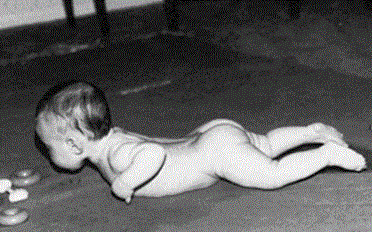
- APivot Prone Position
- BPOE
- CATNR
- DPTNR
21The Prone-on-Hands (POH) position develops at what month?
- A5
- B3
- C4
- D6
22Children begin sucking on their toes at what age?
- A5-months old
- B4-months old
- C3-months old
- D2-months old
23Children who do not suck on their toes are likely to develop tactile sensitivity issues with their feet, which can impede the development of a proper gait pattern.
- ARichtig
- BFalsch
24Volitional rolling from supine into side lying begins at what age?
- A5-months of age
- B6-months of age
- C4-months of age
- D7-months of age
25Head Lag during Pull-to-Sit disappears at which age?
- A5-months of age
- B4-months of age
- C6-months of age
- D7-months of age
26Prop-Sitting is common at which age?
- A5-months of age
- B4-months of age
- C3-months of age
- D6-months of age
27The Full-Pivot-Prone position demonstrated in this image is developed at which age?
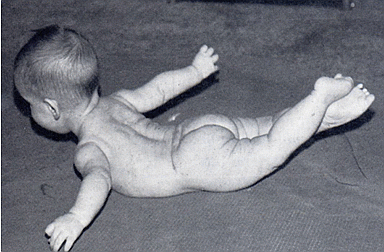
- A5-months old
- B6-months old
- C7-months old
- D8-months old
28The ability to independently lift the head off the supporting surface from the supine position occurs at which age?
- A6-months old
- B5-months old
- C4-months old
- D3-months old
29Volitional rolling from supine to prone occurs at which age?
- A6-months old
- B5-months old
- C7-months old
- D8-months old
30Pivot in Prone begins at which age?
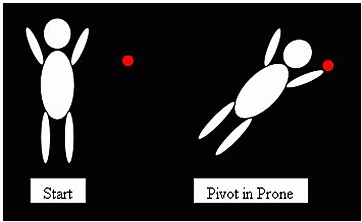
- A7-months old
- B8-months old
- C4-months old
- D5-months old
31Crawling begins at which age?
- A7-months of age
- B8-months of age
- C6-months of age
- D5-months of age
32Supine equilibrium reactions are possible at what age?
- A7-months of age
- B6-months of age
- C5-months of age
- D4-months of age
33Independent Pull-to-Sit is possible beginning at what age?
- A7-months old
- B6-months old
- C8-months old
- D9-months old
34Rocking in Quadruped helps the baby develop which of the following?
- AControl of COG in this position
- BArches of the hand
- CNeck extension strength
- DElongation of Hamstrings
35Bear-Stance begins in which month?
- A5
- B6
- C7
- D8
36Starting in the 8th-month, the baby will spend less time in supine, prone, and side-lying.
- ARichtig
- BFalsch
37If you observe a baby sitting with one leg in long-sitting and the other in ring-sitting, you can be relatively certain they are at least what age?
- A8-months old
- B7-months old
- C6-months old
- D9-months old
38By 7 months of age the infant will have equilibrium reactions in sitting and good lateral protective extension reactions so that if a weight shift is too great and the infant starts to fall toward the side, it will be able to bring the arm out on that side to stop the fall.
- ARichtig
- BFalsch
39The [blank_start]8[blank_end] month old will be able to creep in quadruped and this becomes the infant’s main form of mobility. The infant will begin creeping using lateral trunk flexion which results in a homolateral pattern moving the arm and leg forward on one side of the body. This will progress to reciprocal creeping where one arm and the opposite leg are moved forward, by the [blank_start]8th[blank_end] month.
- A8
- B9
- C10
- D7
- E6
- F8th
- G9th
- H10th
- I11th
- J7th
40Generally, babies learn to move into Bear-Stance and to Bear-Walk in the 7th month.
- ARichtig
- BFalsch
41Which sitting postures are developed in the 9th month?
- ASide-Sitting
- BW-Sitting
- CLong-Sitting
- DRing-Sitting
- EBear-Sitting
42As you sit in your chairs adjust your posture so that you are sitting up tall with your weight equally distributed on your ischial tuberosities. Now, shift your weight to your right so that more weight is on your right ischial tuberosity. With this weight shift you should note that the right side of your trunk is elongated and the left side is shortened.
What sort of weight-shift is this?- AMature Weight-Shift
- BImmature Weight-Shift
43As you are sitting in your chair with your trunk upright and your weight equally distributed between your two ischial tuberosities, you realize that you have dropped something on the floor just to the right of your right foot. As you reach down with your right hand to pick up this item you will be shifting your weight to your right but the right side of your trunk will be shortening instead of elongating.
Which sort of weight-shift is this?- AImmature Weight Shift
- BMature Weight Shift
44W-Sitting is bad for proper development of the lower extremities and we should immediately correct this behavior.
- ARichtig
- BFalsch
45Tailor-sitting begins in which month?
- AMonth 10
- BMonth 9
- CMonth 8
- DMonth 7
46The 10 month old will use [blank_start]creeping[blank_end] as its primary form of mobility.
- Acreeping
- Bwalking
- Ccruising
- Dcrawling
- Eswimming
47The [blank_start]2[blank_end] month old will be characterized by astasia-abasia. The infant will have less control than before and the primary standing and automatic walking disappear. The lack of [blank_start]supporting part of the body weight[blank_end] in standing is called astasia and the lack of [blank_start]automatic walking[blank_end] is called abasia. This is thought to be due to a period of rapid growth and re-organization which the infant is undergoing.
- A2
- B3
- C1
- D4
- Esupporting part of the body weight
- Fautomatic walking
- Gautomatic walking
- Hsupporting part of the body weight
48For how many months does astasia-abasia typically last?
- A1
- B2
- C3
- D4
49The only difference between walking and running is speed.
- ARichtig
- BFalsch
50A full-term newborn's hips are:
- Aflexed
- Bab-ducted
- Cextended
- Dad-ducted
- Einternally rotated
- Fexternally rotated
51During the first 3-4 months the newborn's hips start to AD-Duct, but they are still Flexed.
- ARichtig
- BFalsch
52***Motor development in Prone: Which list of milestones correctly represents the age and the order the milestone is typically achieved?***
- ALift head to 45 degrees at 2 months;
lift head up to 90 degrees by 4 months;
demonstrate a pivot prone position by 6 months;
reach for a toy by 7 months - BCapital extension used to turn head 0-2 months;
Prone on elbows 3 months;
prone on hands by 6 month;
commando crawling by 7 months;
Creeping by 9 months;
bear walk by 10 months - CProne on elbows 0-2 months;
Capital extension used to turn head 3 months;
prone on elbows by 6 month;
commando crawling by 7 months;
bear walk by 9 months;
Creeping by 10 months
- ALift head to 45 degrees at 2 months;
53Put these into the Proper Order for the Development of Postural Control in Sitting
[blank_start]Head sags, back rounded[blank_end]
[blank_start]Rounded spine, neck extension[blank_end]
[blank_start]Propped-Sitting[blank_end]
[blank_start]Sitting w/ erect spine[blank_end]
[blank_start]Ring-Sitting[blank_end]
[blank_start]Half-Ring-Sitting[blank_end]
[blank_start]W-Sitting[blank_end]
[blank_start]Side-Sitting[blank_end]
[blank_start]Long-Sitting[blank_end]- AHead sags, back rounded
- BRounded spine, neck extension
- CPropped-Sitting
- DSitting w/ erect spine
- ERing-Sitting
- FHalf-Ring-Sitting
- GW-Sitting
- HSide-Sitting
- ILong-Sitting
54Put these into the Proper Order for the Locomotor Skill Progression
[blank_start]Rocks in creeping position[blank_end]
[blank_start]Pulls-to-Stand with symmetrical LE ext.[blank_end]
[blank_start]Bounces in stand[blank_end]
[blank_start]Pulls to stand through ½ kneel[blank_end]
[blank_start]Cruise/walking with 2 hands held[blank_end]
[blank_start]Cruising semi-turned along furniture[blank_end]
[blank_start]Lowers self from supported stand[blank_end]
[blank_start]Walks with 2 hands held[blank_end]
[blank_start]Stands alone for short periods of time[blank_end]
[blank_start]Stands alone[blank_end]
[blank_start]Walks w/ one hand held[blank_end]
[blank_start]Walks alone[blank_end]- ARocks in creeping position
- BPulls-to-Stand with symmetrical LE ext.
- CBounces in stand
- DPulls to stand through ½ kneel
- ECruise/walking with 2 hands held
- FCruising semi-turned along furniture
- GLowers self from supported stand
- HWalks with 2 hands held
- IStands alone for short periods of time
- JStands alone
- KWalks w/ one hand held
- LWalks alone
55***Think about the development of postural control from sit to cruising. Of the following milestones, which set best describes a typical sequence?***
- AProp sitting,
Pulling to stand using 1/2 kneel,
Ring sit w/o support,
Bear walking,
Cruising using 1 hand - BRing sit w/o support,
Prop sitting,
Pulling to stand using 1/2 kneel,
Bear walking,
Cruising using 2 hands - CProp sitting,
Ring sit w/o support,
Pulling to stand using symmetrical LE extension,
Bear walking,
Cruising forward,
Reaching for furniture out of reach. - DPull to stand w/ symmetrical LE,
Bear walk,
Ring sit,
Cruise reaching for furniture.
- AProp sitting,
Informationen
- Beschreibung
- USA - Child Development (Exam 1) Quiz am Gross Motor Development, erstellt von Ben Williams am 24/05/2017.
- Autor
- Ben Williams
- Sprache
- English
- Aufrufe
- 327
- Schlagwörter
- Bewertung
- Noch keine Bewertungen Bewerte dieses Quiz